


![System.Func`2[BlackCircles.Interfaces.IECommerceModuleData,System.String]](https://images.blackcircles.com/search/feature-ev.svg)
Michelin Primacy 5
The Michelin Primacy 5 tyre has been designed with safety and longevity in mind. So you can drive with confidence every day.
Price from
Find your size97.99to333.04
...searching


If you're driving in Europe and want one honest recommendation - for most UK drivers taking the car abroad, a premium all-season tyre with the 3PMSF (snowflake) marking is the best all-round choice.
It's road-legal in the mountain zones that require winter equipment, it copes with both a summer heatwave and a cold snap. And it saves you swapping tyres for a two-week trip.
That said, the best tyre depends on when and where you're will be driving:
Below I've split this piece into Summer, All Season and Winter. Covering the winter-tyre laws (because the rules catch a lot of British drivers out), and added what I learned this summer when I was driving through the Netherlands, Belgium and France on a set of Michelin CrossClimate 3.
Two things change the moment you roll off the ferry or out of the tunnel.
The first is variety. A single European trip can take you from a 35°C motorway in central France to an alpine pass with snow on the verges. Sometimes even on the same day.
When buying tyres in the UK we only have to deal with a fairly narrow temperature range. European driving doesn't always give you that luxury.
The second is the law. Several countries have winter specific rules around the tyres fitted to vehicles. That also applies to you as a visitor, not just to locals. Fines are often handed out on the spot.
Getting this wrong isn't just a safety risk. Depending on where you are, it can mean a €135 penalty and being turned back at a mountain pass.
The rubber compound in summer tyres is optimised for grip and low rolling resistance in warmer conditions, and they're quietest and most efficient above roughly 7°C.
They lose grip as temperatures drop and they're not built for snow.
These use a compound and tread pattern designed to work across a wider temperature range in all season tyres.
Many carry the 3PMSF marking (the three-peak-mountain-with-snowflake symbol), which means they've passed a standardised snow-traction test and count as winter-legal in most European countries. Always check for this though. As not all qualify.
Purpose-built for cold, snow and ice - with a soft compound and heavy siping
Winter tyres are a strong choice in genuine winter conditions. However, you will find that they wear faster and do not react as well when in warm weather.
The 3PMSF symbol is an official regulatory certification, which indicates that a tyre has passed rigorous and standardised testing for severe snow performance.
Whereas the M+S is a manufacturer self-declared, classification. As such, M+S ("Mud & Snow") classification on a tyre is not enough for a tyre to be considered winter-legal in several countries.
Only the 3PMSF snowflake reliably counts - and is recognised as the legal standard.
Europe has some of the safest roads in the world, but the scale is still sobering.
According to the European Commission, 19,940 people died in road crashes across the EU in 2024 - about 45 deaths per million people.
On unfamiliar roads, driving on the other side, after a long ferry or a full day behind the wheel, your margin for error is smaller than it is at home.
You can see the full figures in the European Commission's 2024 road safety statistics.
Your tyres are the only thing connecting the car to the road. So choosing the right tyre for the conditions, with enough tread and the correct pressures is very important.
If your takes place during the summer, a premium summer tyre is a strong choice.
On hot tarmac it gives you:
It's the natural pick for touring cars covering big distances on European motorways during the hotter months.
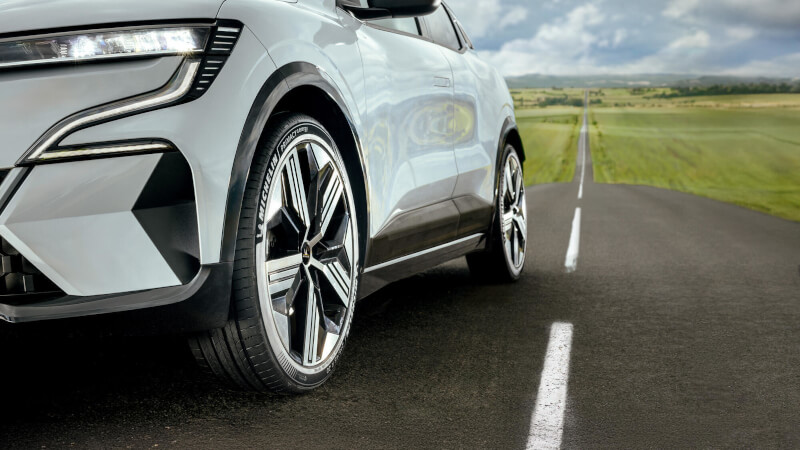
A premium touring tyre built for exactly the kind of long motorway driving. It's been designed for a quiet, comfortable ride over big distances - and low rolling resistance for better fuel economy.
Michelin markets the Primacy 5 it on longer tread life than the previous generation, the metric that matters most when you're covering a lot of miles
There's also a Primacy 5 Energy variant - aimed specifically at electric cars. It has consistently scored well in independent European tyre tests.
Buy Michelin Primacy 5 tyres

The choice for more powerful or sportier cars where grip and steering precision matter.
It delivers an ultra-high-performance for dry and wet grip, while still being engineered for reasonable longevity.
It's a regular test-winner in the UHP summer category.
If your European driving means fast, engaging roads rather than pure motorway cruising, the Pilot Sport 5 is one to seriously consider.
Buy Michelin Pilot Sport 5 tyres


A strong all-round premium touring tyre with a good balance of wet grip, comfort and efficiency. The PremiumContact 7 provides outstanding performance and responsive braking.
Buy Continental PremiumContact 7 tyres


Leans towards fuel efficiency and low rolling resistance, so it's worth a look if economy tops your list for long European runs. The EfficientGrip Performance 2 has been developed for increased braking in wet weather.
Buy Goodyear EfficientGrip Performance 2 tyres


A tyre developed for both comfort and wet-performance. Bridgestone has constructed the Turanza 6 to deliver a premium touring option - one that nicely rounds out the summer shortlist.
Buy Bridgestone Turanza 6 tyresAll-season tyres are a great option for driving in Europe. Especially if the trip spans several countries and different weather conditions.
A quality 3PMSF-marked all season tyre keeps you legal in the countries where winter tyre laws are in place - and handles the conditions of a hot motorway.
They are the most flexible choice for drivers doing a bit of everything.



![System.Func`2[BlackCircles.Interfaces.IECommerceModuleData,System.String]](https://images.blackcircles.com/search/feature-all-season.svg)
The current-generation CrossClimate, launched in July 2025, and the tyre I'd point most European road-trippers towards first. I have them on my own MG.
They are 3PMSF-certified – meaning they cover you for the winter-equipment rules in France's mountain zones, Germany and Austria - while still performing well in hot conditions.
Michelin has focused the CrossClimate 3 on two things that matter for most cars when travelling long distances - longer tread life, and lower cabin noise.
It's also built to keep its grip as the tread wears down rather than only when new, and it's engineered to suit electric cars, where extra weight and instant torque are hard on tyres.
This is the tyre I ran across the Netherlands, Belgium and France this summer.
Buy Michelin CrossClimate 3 tyres

The higher-performance version of the CrossClimate 3. Aimed at more powerful cars and drivers who want sportier handling.
The CrossClimate 3 Sport carries the top wet-grip rating across its sizes and keeps the 3PMSF winter certification.
A good fit for a capable car doing long, varied European miles.
Buy Michelin CrossClimate 3 Sport tyres
The previous generation of the CrossClimate range is still widely available - and still a very capable 3PMSF all-season tyre.
The Michelin CrossClimate 2 is worth including where the CrossClimate 3 isn't yet made in your size. As the CC3 range is still rolling out across all fitments.
Buy Michelin CrossClimate 2 tyres

A consistently strong all-season tyre with balanced wet and cold-weather performance. The AllSeasonContact 2 is one of Continental's leading all season options on the market.
Buy Continental AllSeasonContact 2 tyresA well-regarded 3PMSF all-season option that performs solidly across the seasons. Goodyear have developed the Vector 4Seasons Gen-3 to deliver a solid year-round performance.
Buy Goodyear Vector 4Seasons Gen-3 tyres

Another credible premium all-season pick to complete the shortlist. Bridgestone's Turanza All Season 6 is a popular tyre for many.
Buy Bridgestone Turanza All Season 6 tyresIf you're specifically heading somewhere cold and snowy. For example a ski trip, or an Alpine/Scandinavian route in the deepest winters, then a dedicated winter tyre could be an option to consider.
Below about 7°C, a fully fledged winter tyre out-grips even a good all-season one.
It's the right call when winter conditions in Europe's mountain regions are the point of the trip.
Michelin's Alpin 7 is their latest generation winter tyre for cars. It has been developed to deliver high levels of grip and control in cold, wet, snowy and icy conditions.
The compound and heavy siping are built to bite into snow while staying composed on cold, wet motorways.
The two things a UK driver heading to the somewhere like the Alps actually needs.
Buy Michelin Alpin 7 tyresConsidered by many to be the performance winter option. The tyre has been aimed at more powerful saloons and sports cars.
The Michelin Pilot Alpin 5 keeps winter grip while preserving more of the handling precision a capable car's owner will expect.
Buy Michelin Pilot Alpin 5 tyresA strong, widely trusted premium winter range. The WinterContact is a very solid option for those looking for a winter specific tyre.
Buy Continental WinterContact tyresAn established premium winter option with a solid all-round reputation in snow and cold. Goodyear's UltraGrip Peformance+ is a winter tyre, developed for high performance cars.
Buy Goodyear UltraGrip tyresA long-standing name in winter and ice performance, rounding out the winter shortlist. The Blizzak LM005 delivers a good performance on snow and ice.
Buy Bridgestone Blizzak tyresRemember: fit winter tyres in sets of four, mind the minimum tread requirements (e.g. Austria's 4 mm), and take them off in spring.
Winter tyres wear quickly and feel soft once it warms up – due to their compound composition.
| Tyre | Type | 3PMSF? | Notable |
|---|---|---|---|
| Michelin Primacy 5 | Summer | No | Premium touring tyre that also has a seperate energy variant for EVs looking to enhance range |
| Michelin Pilot Sport 5 | Summer (UHP) | No | High-performance grip and excellent option for high performance vehicles. |
| Michelin CrossClimate 3 | All-season | Yes | Year-round high performance with focus on grip, longevity & noise levels. |
| Michelin CrossClimate 3 Sport | All-season (UHP) | Yes | A sporty all-season tyre that is developed for high-performance vehicles |
| Michelin CrossClimate 2 | All-season | Yes | Previous generation but still a very good tyre |
| Michelin Alpin 7 | Winter | Yes | Winter & snow specialist performance |
| Continental AllSeasonContact 2 | All-season | Yes | Good year round performance |
| Goodyear Vector 4Seasons Gen-3 | All-season | Yes | Another all season option that will see you through the year |
| Bridgestone Turanza 6 | Summer | No | A strong summer tyre with good touring performance |
Rules change by country and often by region. Visitors to a country with specific laws and regulations around the fitment of winter tyres (or 3PMSF tyres) should make sure to follow all relevant rules.
Here's the state of play for the 2026 winter season (at the time of writing).
Always double-check before you travel, as regions can update the detail each year.
| Country | Winter tyres required? | When / where | Notes for UK drivers |
|---|---|---|---|
| France | Regional | 1 Nov–31 Mar, in designated mountain communes across 34 departments (Alps, Pyrenees, Massif Central, Jura, Vosges, Corsica) | The "Loi Montagne". You need 3PMSF winter/all-season tyres in Zones as signposted. Fine ~€135, now actively enforced. M+S-only tyres no longer accepted in many areas. |
| Germany | Situational (nationwide) | Whenever conditions are wintry (snow, ice, slush, black ice) - no fixed dates | Must be 3PMSF. M+S tyres made before 2018 no longer count. Fines from €60, more if you obstruct traffic, and possible insurance issues after an accident. |
| Netherlands | No | — | Not mandatory. |
| Belgium | No | — | Not mandatory but recommended below 7°C. |
| Luxembourg | Yes, in winter conditions | When roads are wintry | Winter or all-season tyres required (3PMSF). |
| Austria | Yes, in winter conditions | 1 Nov–15 Apr when wintry | 3PMSF required, min 4 mm tread. Strict enforcement, with the potential for heavy fines. |
| Italy | Region-specific | Varies; e.g. Aosta Valley & A22 Brenner 15 Oct–15 Apr; elsewhere by signage | Winter tyres (or 3PMSF) where signed. |
| Spain | Regional / signage only | Mountain areas when signed | Follow local road sign guidance. |
Here you can find a comprehensive breakdown of winter tyre specific laws in Europe.
A good 3PMSF all-season set keeps you legal across almost all of the above without a tyre change.
When travelling this summer with my family, we were not near any of the French mountain regions, so the laws didn't affect us. However, I still I checked to make sure before we left on our holiday. Always check.
Although it may vary depending on the country the following are good items to have in the car when driving through mainland Europe:

This summer I put a proper shift on Michelin CrossClimate 3 - a two-week camping trip that took the car from Scotland, across the Netherlands, through Belgium and down into northern France.
All in, it worked out at roughly 1,000 miles (about 1,600 km) of driving on one set of all-season tyres.
Which is exactly the kind of long, mixed European run this guide is about.
The route, for context:
So, the trip covered the lot, UK motorways, Dutch roads, a Belgian transit leg and finally French autoroutes. With close to a fortnight of stop-start local driving in between.
I should also mention, for those interested, all of this was in a MG HS Trophy with a tyre size 235/50 R18.
The two big motorway legs were the 459-mile Dover to Edinburgh run and the 268 km trip down to St Omer.
Throughout these drives, the CC3s felt great. They delivered little noise compared with the budget tyres that came on the car when I bought the car.
With noticeable stability at high (legal) speeds, I found them to be a very durable tyre for long distance driving. With no worries on stopping distances. Even with a (very) full car and roof box.
Even though we were there during the summer, mainland Europe did at times make us feel like we were at home with some rain showers.
I was very confident with the braking and cornering in the wet. Although there was not enough to test standing water on the motorways, the CC3s always left me in no doubt that the car would stop in time.
Like England, we were there during a heatwave. All season tyres are sometimes criticised for a dip in performance when driving in hot conditions – when compared to a summer tyre.
However, again, I can honestly say that the CrossClimate 3s did not disappoint. At no point during the 35 degree heat did I ever feel that they were lacking in responsiveness or gripping ability.

For European trips specifically, a few things that make Michelin a common pick:
Not everywhere. Some countries (like the Netherlands and Belgium) never require them. Others (Germany, Austria) require winter-capable tyres whenever conditions are wintry. France requires winter tyres or chains in designated mountain zones from 1 November to 31 March.
A 3PMSF-marked all-season tyre keeps you legal across almost all of these without a tyre change.
Yes, provided they carry the 3PMSF (snowflake) marking.
That symbol means the tyre has passed a snow-traction test and is treated as winter-legal in most European countries.
Tyres marked only "M+S" are no longer accepted in most countries.
Outside the designated mountain zones, yes. Inside a signposted Loi Montagne zone between 1 November and 31 March, you must have either 3PMSF tyres or carry snow chains/socks. Fines are around €135 and enforced.
No. It stopped being a legal requirement in 2020.
It's still sensible to carry one because the French drink-drive limit is low. But you won't be fined for not having one.
A UK identifier (sticker or plate), warning triangle, a hi-vis vest for each occupant kept inside the cabin, headlamp beam deflectors, and a Crit'Air sticker for low-emission city zones. Carry your licence, passport, V5C and insurance certificate. Add snow chains if entering a winter mountain zone.
Look for premium tyres that hold grip as they wear and with strong mileage.
Michelin’s latest CrossClimate and Primacy generations have been developed with this longer tyre life at their core. Other premium brands (such as Continental, Goodyear, Bridgestone) also offer high-mileage touring options too.
For long trips, it can be useful to consider the overall cost-per-mile of that tyre. Not just the upfront costs.
They wear faster and feel less responsive in warm weather. You also have to store them and swap out for a second set.
That's why all-season tyres are popular with drivers who don't face regular deep-winter conditions.
Only in mountain areas where signs require them.
Elsewhere they're not mandatory.

We love to hear from our customers. Connect with us today and let’s start a conversation.
