I’d hazard a guess that many of us would rate ourselves as careful drivers. We are careful to watch the road, react quickly and trust ourselves to stop in time.
Now, although your reactions decide when braking starts - how quickly the car actually stops is down to the four small patches of rubber where the tyres meet the road. No bigger than a hand in many cases.
On a wet October morning, the gap between how much control we think we have and how much we really have gets a lot wider.
October is
Tyre Safety Month, the annual campaign run by road safety charity
TyreSafe. To mark it, we're looking at what really decides how far you travel before you stop in the wet, and at the simple ACT check that puts some of that control back in your hands.
How does it take to brake in the wet?
In the wet, you need at least twice the distance to stop that you would on a dry road.
In a
survey of 2,000 UK drivers for road safety charity Brake, more than two-thirds underestimated stopping distances in the wet.
Only around ¼ of respondents knew the correct figure. And four in ten thought they were about 50% longer, and one in ten thought there was no difference at all.
The Highway Code has a section that covers this – stating that
in wet weather, stopping distances will be at least double those on a dry road.
Here's what that looks like using the Highway Code's
typical stopping distances (rule 126):
| Speed
| Dry road
| Wet road (at least)
|
|---|
| 30mph
| 23m
| 46m
|
| 50mph
| 53m
| 106m
|
| 70mph
| 96m
| 192m
|
At 70mph in the rain, that's nearly the length of two football pitches before you come to a stop. And those figures assume a car with tyres in good condition.
Where long does the driver's control end?
The part of each tyre touching the road at any moment is called the contact patch. On a typical car it's roughly the size of the palm of your hand. Four of those palm-sized patches are all that connect a car weighing well over a tonne to the road.
When you press the brake pedal, the pads clamp the discs and slow the wheels. Whether that slows the car depends entirely on grip.
Lots of grip, and the car stops in a short distance. Too little, and the wheels slow while the car keeps sliding forward.
On a car with ABS, the system will step in to stop the wheels locking, but it can only work with the grip the tyres give it.
That grip comes from three things you can check yourself: the depth of the tread, the air pressure in the tyre, and the condition of the rubber.
How does worn tread affect braking on wet roads?
Worn tread hits hardest in exactly the conditions where stopping distances have already doubled.
TyreSafe's research found that a worn tyre can add around 27 metres to the Highway Code stopping distance at motorway speeds, taking it from 96 metres to 123 metres. That's an extra 28%, or roughly six car lengths.
The grooves in your tyre are there to clear water from the contact patch. As tread wears down, the grooves hold less water, so more of it stays trapped between rubber and road. That's what causes aquaplaning, when the tyre rides on a film of water instead of the tarmac.
The law on tread depth: the
legal minimum for cars in the UK is 1.6mm, across the central three-quarters of the tread and around the whole circumference. Driving on an illegal tyre can mean a fine of up to £2,500 and three penalty points, per tyre.
How does tyre pressure and condition affect braking?
A tyre with plenty of tread can still be dangerous if it has poor air pressure, or is damaged.
This is because an underinflated tyre flexes more, and heats up quicker – due to the fact that more of the tyre is in contact with the road. This too changes the shape of the contact patch. So grip is less even and the tyre will respond slowly when you brake or steer.
On a wet road, a soft tyre is also less able to clear water from under the tread. Fewer than half of UK drivers check their pressures monthly, according to TyreSafe - even though it takes a few minutes at a petrol station.
You'll find the correct pressures in your handbook, inside the fuel filler flap or on the driver's door frame.
Similarly, the condition of the tyre plays a very important role. To make sure your tyres are safe you should regularly inspect them for any signs of damage.
This entails visually inspecting the tyres, looking for cuts, cracks, bulges or anything stuck in the tread.
A bulge in the sidewall usually means internal damage. If this is the case, then the tyre needs replacing straight away.
Fine cracking in the rubber can be a sign of age, so it's worth asking a fitter to take a look if your tyres have been on the car for several years.
Three stopping distance myths
Myth: "ABS stops the car faster."
ABS stops the wheels locking so you can keep steering while you brake hard. It doesn't create grip, and on loose or wet surfaces your stopping distance can still be long.
Myth: "If it's legal, it's fine."
1.6mm is the minimum the law allows, not a measure of how well a tyre will perform. Grip in the wet drops as tread wears, so keep a closer eye on your tyres as they approach the limit, especially going into autumn and winter.
Myth: "My car has electronic aids, so tyres matter less."
Traction control, stability control and automatic emergency braking all rely on the tyres to do what the computer asks.
The more your car does for you, the more it depends on the four tyres that are fitted.
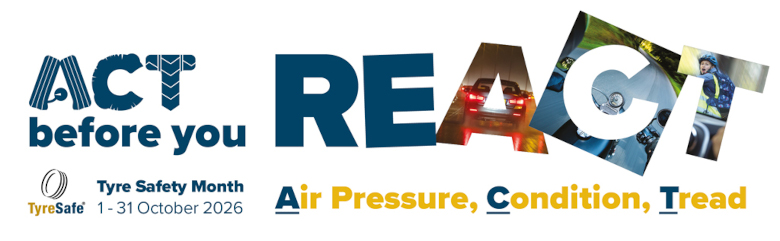
Tyre Safety Month checklist, ACT
TyreSafe sums up the checks every driver should do at least once a month. And before any long journey. These are:
- A for Air pressure. Check all four tyres, and the spare if you have one, against your car's recommended pressures.
- C for Condition. Look over the tread and sidewalls for cuts, cracks, bulges and embedded objects.
- T for Tread. Use a tread depth gauge, or try the 20p test. This entails putting a 20p coin into the central grooves. If you can see the outer band of the coin, have your tyres checked by a professional.
If any of your tyres fail the checks, you can find the right replacements for your car on Blackcircles by entering your registration.
Frequently Asked Questions
When is Tyre Safety Month?
Tyre Safety Month runs every October. It's organised by TyreSafe, the UK charity dedicated to tyre safety, and has been held annually since 2010.
How much longer does it take to stop in the wet?
The Highway Code says stopping distances will be at least double those on a dry road. At 70mph, that means at least 192 metres instead of 96 metres, assuming your tyres are in good condition.
How much longer does it take to stop on worn tyres?
TyreSafe found a worn tyre can add around 27 metres to the Highway Code stopping distance at 70mph, taking it from 96 metres to 123 metres. The difference grows in the wet.
What is the legal minimum tread depth in the UK?
1.6mm across the central three-quarters of the tread, around the whole circumference. The penalty is up to £2,500 and three points for each illegal tyre.
How often should I check my tyres?
At least once a month and before long journeys, using the ACT checks: Air pressure, Condition and Tread.