Parking is one of the most important practical driving skills, yet can also be a challenge for some drivers.
Whether you are learning to drive at the moment, or you are looking to improve your accuracy, knowing the correct techniques can help to make a big difference.
This guide covers parallel parking, forward bay parking, and reverse bay parking.
Along with some safety rules, common mistakes, and easy steps to help you park with confidence.
Types Of Car Parking
Most driving situations involve three main parking methods:
- Parallel parking (often done at the side of the road)
- Forward bay parking (when you drive into a space)
- Reverse bay parking (when you reverse into a space)
Crucually, each of these methods requires different understanding of your vehicle’s positioning and the required steering techniques.
One thing they all have in common though is the need for good observations, a slow approach and accurate judgement.
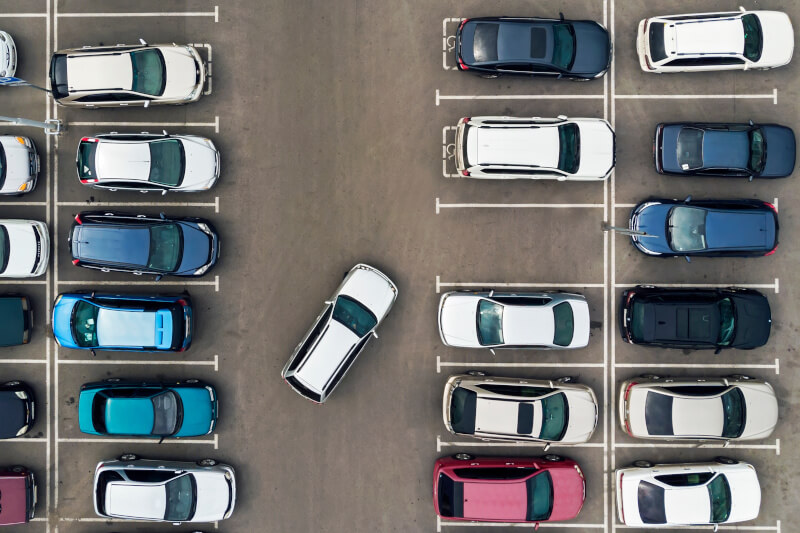
What To Do Before Parking?
Before you begin the parking manoeuvre, it is important that you do the following:
- Check rear-view and both side mirrors
- Look over your shoulders at the ‘blind spots’
- Watch for pedestrians, cyclists, and other moving vehicles
- Ensure your car will fit comfortably into your planned space
It is important that when parking you move slowly at all times. In a controlled manner. Low speed gives you more time to react and correct any potential mistakes.
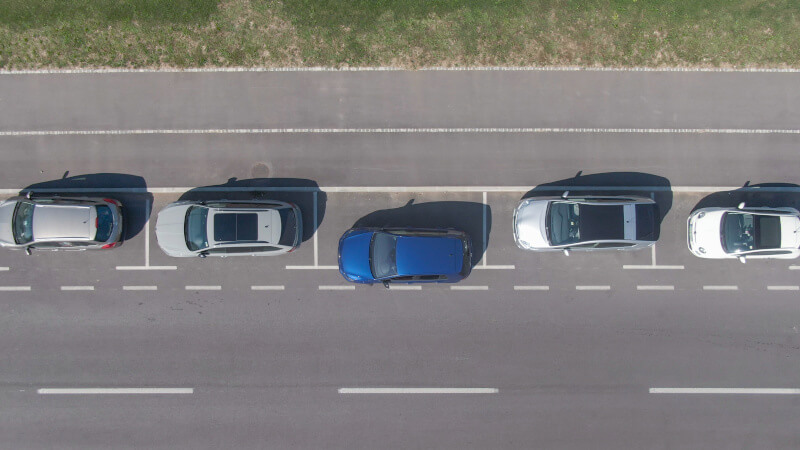
How To Parallel Park Step By Step
Parallel parking is commonly used on residential streets. It is a key driving test manoeuvre.
- Choose a suitable space
The space should be at least one and a half times the length of your car.
- Signal and position
Indicate and pull up alongside the car in front of the space, leaving a small gap (around 0.5 to 1 metre).
- Align your vehicle
Position your car so the middle of your passenger window lines up with the front of the parked car.
- Check all around
Look in mirrors and blind spots for traffic, cyclists, and pedestrians.
- Begin reversing slowly
Steer one full turn towards the kerb while reversing.
- Watch your angle
As the rear of your car moves into the space, check your left mirror for the pavement kerb and your surroundings behind.
- Counter-steer
When your car is at roughly a 45-degree angle, turn the wheel in the opposite direction to bring the front in.
- Straighten the car
Adjust your steering to align parallel with the kerb.
- Final position
Stop close to the kerb without touching it, leaving space in front and behind.
Why this works
The initial turn brings the rear into the space, while the counter-steer aligns the front. Controlling the timing of these turns is key to accuracy.
How To Forward Bay Park Step By Step
Forward bay parking is most common in supermarket and shop car parks.
- Select a suitable parking space
- Position your car
Stay wide of the bay to create a larger turning angle.
- Check surroundings
Look for pedestrians and moving vehicles.
- Move forward slowly
Align your wing mirror with the space's line as a reference point.
- Turn the wheel fully
Steer into the bay in one smooth movement.
- Straighten up
Adjust the wheel to centre your car between the lines.
- Stop within the parking space
Ensure the car is fully inside the markings.
Important consideration: you will need to reverse out when leaving, which can be more difficult in busy areas.
How To Reverse Bay Park Step By Step
Reverse bay parking is often easier for exiting and provides better visibility when leaving. This is my personal favourite way to park – as I don’t like to reverse out of spaces.
- Identify your space
Indicate early to show your intention.
- Position your car
Drive slightly past the bay, about one to two car lengths ahead, and keep around one metre distance from the bays.
- Select reverse gear
Check all mirrors and blind spots.
- Begin reversing
Turn the wheel fully towards the bay.
- Use your mirrors
Watch both bay lines in your side mirrors as you move back.
- Straighten the wheel
Once the car is mostly inside the bay, straighten the steering.
- Adjust your position
Ensure you are centred between the lines.
Why this is often easier
Reversing into the space gives better control and makes exiting safer, as you can drive forward with a clear view.
Common Parking Mistakes And How To Fix Them
Parking errors are usually caused by rushing or poor positioning.
Common issues include:
- Turning too early or too late
- Being too close or too far from the kerb
- Ending up at an angle in a bay
- Not checking surroundings properly
How to correct them:
- Stop the car and reassess. Don’t rush.
- Move forward slightly to reset your angle
- Reverse again slowly with adjusted steering
- Take your time rather than forcing the manoeuvre
Repositioning is normal and does not indicate poor driving.
Parking On Hills: What Should You Do?
When parking on a slope or a steep hill, wheel direction is important:
- Facing uphill: turn wheels away from the kerb
- Facing downhill: turn wheels towards the kerb
This prevents the car from rolling into traffic if the brakes fail.
Always apply the handbrake and leave the car in gear (manual) or in park (automatic).
Where Can And Can’t You Park In The UK?
You can typically park:
- On the side of the road without restrictions
- On single yellow lines during permitted times
- In marked parking bays
- Away from junctions (at least 10 metres)
You must not park:
- On double yellow lines
- On zigzag lines near crossings
- In bus stops or taxi ranks
- On clearways or red routes
- Blocking driveways or pavements (unless permitted)
Always check local signage before leaving your vehicle.
Tips To Improve Parking Confidence
- Move slowly and stay in control
- Practise in quiet car parks
- Use reference points (mirrors and markings)
- Ignore pressure from other drivers
- Use parking sensors and cameras if available
- Get out and check your position if unsure
Confidence improves with repetition and familiarity.
Parking A Vehicle
Learning how to park a car effectively comes down to 3 main things. Observation, positioning, and control.
Each manoeuvre follows a logical sequence. With practice, these steps become second nature.
Taking your time, understanding why each movement matters. If you need to correct any mistakes calmly. This will help you develop consistent and safe parking skills in any situation.
Frequently Asked Questions
Is it better to reverse or drive into a parking space?
This can often come down to personal preference. Personally I like reversing into a space is because you can exit forwards with better visibility.
Should you always use the handbrake when parking?
Yes. The handbrake secures the vehicle and prevents rolling.
Can you fail your driving test for poor parking?
You may fail if the manoeuvre shows poor control, observation, or safety. Minor adjustments are usually acceptable.
How close should you be to the kerb when parallel parking?
Aim to be reasonably close without touching the kerb, typically within 15–30 cm.
Is it illegal to park facing oncoming traffic?
At night, you must park in the direction of traffic unless in a marked bay.