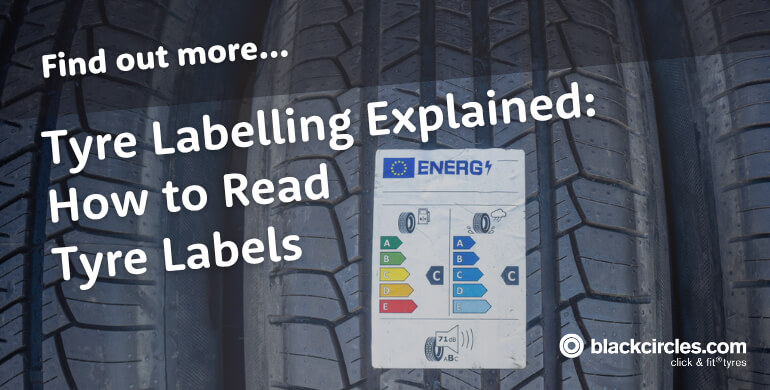
You might think that choosing the right tyre doesn’t go beyond making sure it’s the right size for your vehicle. Surely that information-stuffed sticker is just for show?
No. In fact, it’s every bit as important in the decision-making process as picking the correct fit.
Every new tyre sold in the UK carries a label that rates it on three things: how much fuel it uses, how well it grips in the wet and how much noise it makes. It looks simple enough – a strip of letters, a decibel figure and a couple of small icons. But it’s easy to skim past without really knowing what any of it means or which parts matter for the way you drive.
Don’t fret, though, as we’ve got you covered with this very guide. We’ll steer you right, breaking down what each rating means and how to bear them in mind when looking for the right tyres for your car.
What Is a Tyre Label?
Contrary to what you might think, the tyre label is not a manufacturer’s marketing sticker: it is a legal requirement.
Every new tyre sold for cars, vans and buses or lorries must display one at the point of sale. That can be in a shop, printed on a delivery note or shown online next to the product listing.
It exists so you can compare tyres on a like-for-like basis before you buy, just as an energy label helps you compare fridges or washing machines. Underneath the letters and numbers, the label reports the results of standardised tests that every tyre must pass before it can legally be sold. It’s not a brand’s own claims about its product.
The label covers three headline ratings:
- Fuel efficiency (also called rolling resistance) – graded A to G
- Wet grip – graded A to G
- External noise – shown in decibels, plus a 1-to-3 sound wave symbol
Two further icons can appear alongside these: a snowflake symbol for tyres rated for severe snow conditions and an ice grip symbol for tyres tested specifically for icy roads (mainly relevant to Nordic and studded winter tyres and rarely seen on standard UK tyres).
Is the UK Tyre Label Different Post-Brexit?
Legally, yes – but what you’ll actually see on the shelf or online is a different story.
When the EU introduced a newer, stricter tyre label in May 2021, Great Britain (GB) didn’t adopt it into domestic law. Retained UK legislation still technically points to the older scheme: a wider A to G scale for fuel efficiency and wet grip, with noise shown as a decibel figure alongside the 1-to-3 sound wave symbol rather than a letter grade.
In practice, though, the UK tyre industry – Blackcircles included – moved across to the newer label format UK-wide from 2021, so customers see the same, more informative label regardless of where they’re buying. That’s the tighter A to E label shown throughout this guide, complete with its QR code.
Northern Ireland’s position is more clear-cut: it stayed legally aligned with the EU’s newer rules under the Windsor Framework, so the A to E label – plus its extra required details, including the supplier’s name, model name, size, tyre class and snow/ice suitability – is a legal requirement there, not just an industry convention.
So, the ratings themselves haven’t changed dramatically since Brexit – a tyre rated highly for wet grip is still highly rated. But which label format is a legal requirement, versus an industry-wide choice, still depends on whether you’re buying in Great Britain or Northern Ireland. The Driver and Vehicle Standards Agency (DVSA) enforces the rules on both sides and handles reports of non-compliant sellers.
Why You Might Still Occasionally See an Older Label
Because GB law never formally caught up, you may still occasionally come across an older-style label with the wider A to G scale and the sound wave noise symbol, rather than a letter, for noise. This is usually down to tyres manufactured and put into stock before the industry-wide switch, or an older listing that hasn’t been refreshed. It doesn’t mean anything’s wrong with the tyre – it’s simply a legacy label that predates the voluntary move to the newer format.
How to Read a Tyre Label: The Three Core Ratings
| Label area
| What it measures
| Best rating (A) means
| Worst rating (G) means
| Premium example
|
|---|
| Fuel efficiency | Rolling resistance – energy the tyre loses as it turns, which feeds into fuel use
| Lowest rolling resistance; most fuel-efficient
| Highest rolling resistance; least efficient (largely phased out under tightening standards)
| Continental EcoContact 6 – built around low rolling resistance, consistently rated A
|
| Wet grip | Braking distance on a wet road, tested against a reference tyre
| Shortest wet braking distance; safest in the wet
| Longest wet braking distance (also phased out)
| Michelin Primacy 4 – most commonly rated A for wet grip across its size range
|
| Noise | External rolling noise – an exact dB figure plus a 1–3 sound-wave symbol, not a letter grade
| 1 wave: at least 3dB below the current legal limit (quietest)
| 3 waves: within the older, more lenient limit still being phased out (loudest)
| Goodyear EfficientGrip Performance 2– as low as 67dB in some sizes, among the quieter options in its class
|
Fuel Efficiency (Rolling Resistance)
This rating measures how much resistance a tyre creates as it rolls, which directly affects how hard your engine has to work – and therefore how much fuel you use. It’s graded from A (most efficient) down through the alphabet, with the poorest-performing grades now phased out of sale entirely as minimum standards have tightened.
A lower-resistance tyre won’t transform your fuel bill on its own, but over the life of a set of tyres, the difference between a top-rated and a mid-rated tyre can add up, particularly on higher-mileage cars.
If fuel efficiency is your main concern, it’s worth weighing the label rating alongside your typical mileage and driving style rather than treating the letter grade as the whole story.
Wet Grip
Wet grip measures how effectively a tyre can brake on a wet road, specifically, how short (or long) the stopping distance is compared with a reference tyre. It’s the rating most directly tied to safety. In a country where wet roads are the rule rather than the exception, such as the home nations, it’s usually the one worth paying closest attention to.
An A-rated tyre will generally stop noticeably shorter in the wet than a tyre rated D or E. That gap can matter in exactly the situations where it counts most – an emergency stop on a motorway in heavy rain, for example.
Noise Rating
The noise rating shows two things: an exact figure in decibels (dB) and a symbol of one, two or three sound waves showing how that figure compares with EU noise limits.
- One wave – the tyre is at least 3dB below the current limit (quietest)
- Two waves – the tyre meets the current limit
- Three waves – the tyre is louder than the current limit but still within the older, more lenient limit that’s being phased out
As a rough guide, anything in the high 60s dB or below is generally considered quiet for a car tyre. Once you’re into the 70s, road noise becomes more noticeable inside the cabin, especially at motorway speeds.
In everyday driving, the difference between a one-wave and a three-wave tyre is usually more noticeable on long motorway runs than around town, where engine and traffic noise tend to dominate anyway.
Winter and Snow/Ice Symbols
Not every tyre carries these, and that’s normal. They’re only relevant if you’re choosing a winter or all-season tyre.
- 3PMSF (Three-Peak Mountain Snowflake): This mountain-and-snowflake icon shows a tyre has passed a specific severe-snow performance test. It appears on genuine winter and many all-season tyres, but not on standard summer tyres, and it does appear on the UK label in exactly the same form as the EU one.
- Ice grip symbol: This one is far less common on tyres sold in the UK. It’s mainly used on tyres designed for genuinely icy conditions, including studded tyres common in Scandinavia – not something most UK drivers need to look for.
If you’re comparing winter or all-season tyres, the 3PMSF symbol is a more useful signal of snow performance than the general tyre label ratings alone. That’s because it’s a dedicated test rather than a byproduct of the fuel efficiency or wet grip scores.
The QR Code and EPREL Database
The newer-style label also carries a QR code, usually tucked in a corner. Scanning it takes you straight to the tyre’s entry on EPREL – the European Product Registry for Energy Labelling – a free, publicly searchable database of tyre products and their label data.
On EPREL, you’ll typically find the full label as shown at the point of sale, plus a Product Information Sheet with extra details the printed label doesn’t have room for – things like the tyre’s exact size, load and speed rating, and its supplier and model identifier.
It’s a handy way to double-check a rating you’re relying on, especially if a listing looks like it might be out of date, or if you simply want the complete technical picture beyond the headline letters.
Which Rating Matters Most for UK Driving?
There’s no single ‘correct’ answer, but for most UK drivers, wet grip is the rating worth prioritising. The UK’s climate means wet-road driving is a regular fact of life rather than an occasional scenario, and it’s the rating most closely tied to stopping distance and safety.
That doesn’t make fuel efficiency and noise irrelevant. If you do a lot of miles, fuel efficiency has a genuine ongoing cost impact, and if you spend a lot of time on the motorway, noise affects comfort on every single journey.
A reasonable approach: don’t compromise heavily on wet grip, then use fuel efficiency and noise to choose between tyres that are otherwise closely matched.
Are A-Rated Tyres Worth the Extra Cost?
Usually, but not automatically. A-rated tyres tend to sit at the premium end of a manufacturer’s range, particularly for wet grip. That premium is often justified by genuinely shorter stopping distances and lower long-term running costs.
Whether it’s ‘worth it’ for you depends on:
- How you drive – high motorway mileage makes fuel efficiency gains add up faster
- What you’re comparing against – the practical difference between an A and a B is usually smaller than between an A and a D or E
- Your budget ceiling – a well-reviewed B-rated tyre from a reputable brand may be a better real-world choice than stretching for an A-rated tyre from a brand with weaker overall reviews
The label is a useful filter, not the only factor. It’s worth reading alongside independent tyre tests and reviews rather than in isolation.
Are Tyre Label Ratings Independently Tested?
Yes. Tyre labels aren’t a manufacturer’s own marketing claim – they’re based on standardised tests carried out under EU-wide testing protocols. Manufacturers are legally required to hold evidence supporting the rating they display. Market surveillance authorities carry out spot checks and can penalise tyres that don’t perform as labelled.
That said, mismatches can occasionally happen. This is usually down to batch variation, a supplier updating a rating after retesting or a retailer’s listing lagging behind the latest label update, rather than the rating being invented.
If a tyre you’ve received doesn’t match what was advertised, it’s worth raising it with the retailer directly rather than assuming the whole labelling system is unreliable.
Comparing Ratings Across Brands
| Brand
| Fuel Efficiency
| Wet Grip
| Noise
| Notes
|
|---|
| Michelin | A (e.Primacy) / C (Primacy 4)
| A (Primacy 4)
| 69dB (Primacy 4)
| Ratings vary by model – link to existing Michelin comparison articles
|
| Goodyear | A (EfficientGrip Performance 2)
| A (EfficientGrip Performance 2)
| 67–71dB (EfficientGrip Performance 2)
| Rare case of A/A across both core ratings, and quietest of the group
|
| Bridgestone | B (Turanza 6)
| A (Turanza 6)
| 70dB (Turanza 6)
| Best-in-class wet grip across the Turanza 6 line-up
|
| Continental | A (EcoContact 6)
| B (EcoContact 6)
| 72dB (EcoContact 6)
| Efficiency-focused; PremiumContact range trades some efficiency for grip
|
Continental’s EcoContact 6 is a strong all-rounder within an efficiency-focused range – A for fuel efficiency, B for wet grip and 72dB for noise. The PremiumContact range, by contrast, trades some of that efficiency for stronger wet-weather grip.
Michelin’s range works similarly: the e.Primacy leads on fuel efficiency, while the Primacy 4 leads on wet grip. It’s worth choosing based on which rating matters most to you rather than assuming one tyre does everything.
Premium brands do tend to cluster toward the better end of the label, but it’s not a hard rule. Some budget and mid-tier tyres now match or beat older premium models on specific ratings.
Because every tyre is tested to the same standardised protocol regardless of brand, the label can be trusted for like-for-like comparison. It’s worth checking model-by-model rather than assuming a brand name alone guarantees the rating.
Do Tyre Labels Apply to EV Tyres?
Yes: EV-specific tyres carry the same label format as any other car tyre.
Because EVs are heavier and torque delivery is different from a combustion engine, EV-specific tyres are often engineered for lower rolling resistance to help offset that extra weight’s effect on range. That makes it common (though not guaranteed) to see strong fuel-efficiency-equivalent ratings on tyres designed specifically for EVs.
Where to Compare Tyre Labels Before You Buy
The easiest way to compare tyre labels side by side is through the Blackcircles tyre search – ratings are listed alongside price and fitting availability, so there’s no need to look up each tyre’s label separately.
Simply enter your registration or tyre size, filter by the rating that matters most to you and book a fitting at a garage near you in the same visit.
Need new car tyres?
Enter your registration and postcode and we’ll show you the best tyres for your car
Frequently Asked Questions
What do the letters on an EU tyre label mean?
The letters (A to G) show how a tyre performs on two of the three main ratings: fuel efficiency and wet grip. A represents the best performance, and lower letters represent weaker performance. Noise is shown in decibels rather than a letter.
Are tyre labelling ratings different in the UK post-Brexit?
Not in the label you’ll actually see, though the legal picture is more nuanced. Northern Ireland is legally required to use the newer EU-style label. Great Britain’s law technically still points to the older A to G scheme, but the tyre industry – including Blackcircles – has used the newer label UK-wide since 2021, so what you’ll see day to day is consistent across the UK. An A rating means the same thing wherever you buy.
What does the QR code on a tyre label link to?
Scanning it takes you to the tyre’s entry on EPREL, the EU’s public tyre product database, where you can view the full label plus extra details such as the exact size, load and speed rating, and the supplier and model identifier.
What is considered a good wet grip rating?
A or B ratings represent the strongest wet-weather braking performance. Given how much UK driving happens on wet roads, this is generally the rating worth prioritising over fuel efficiency or noise if you have to choose.
How much fuel can an A-rated efficiency tyre actually save?
It varies by vehicle, driving style and mileage, so it’s best not to rely on a single blanket figure. By and large, lower rolling resistance does translate into a genuine (if modest) reduction in fuel use over the life of a tyre, with the effect most noticeable on higher-mileage driving.
Is a 68dB noise rating considered quiet for a car tyre?
Generally, yes. A figure in the high 60s dB sits toward the quieter end for a car tyre. Once ratings move into the low-to-mid 70s dB, road noise becomes more noticeable, particularly at motorway speeds.
Does the 3 Peak Mountain Snowflake symbol appear on UK tyre labels?
Yes. It appears on UK tyre labels in the same form as on EU labels, shown on winter and qualifying all-season tyres that have passed the dedicated severe-snow performance test.
Are A-rated tyres worth the extra cost over C-rated tyres?
Often, especially for wet grip, where the safety benefit of a shorter stopping distance can be significant. Whether it’s worth it for you depends on your mileage, budget and how the specific tyres compare beyond the label alone.
Are tyre label ratings independently tested, or set by manufacturers?
They’re based on standardised, EU-wide testing protocols, with manufacturers required to hold evidence for the ratings they publish and market surveillance bodies carrying out spot checks. It isn’t simply a manufacturer’s own claim.
Do tyre label ratings apply to winter and all-season tyres?
Yes, all tyre types carry the same three core ratings. Winter and qualifying all-season tyres may additionally carry the 3PMSF snowflake symbol, which standard summer tyres don’t.
Why might my tyres have a different rating than the one advertised online?
This is usually down to a batch update, a retest, or a listing that hasn’t been refreshed to match the latest label revision – not the rating being unreliable. It’s worth flagging the discrepancy with the retailer if you spot one.