Different vehicle types fall under different
MOT classes – with each class outlining the requirements, procedures, and regulations that apply to that category.
Read on to find what class your
vehicle is, what it means for testing, and why it matters.
What is an MOT?
The MOT (Ministry of Transport) test is an annual roadworthiness check for most vehicles older than three years in the UK (older than four years in Northern Ireland).
It ensures a vehicle meets minimum safety and environmental standards – checking things like brakes, lights, tyres, structure, emissions, and more.
Vehicles that are exempt, such as
historic vehicles (over 40 years), certain agricultural vehicles, or those adapted off-road, might not always need an MOT.
The test is carried out by authorised testers at DVSA-approved test centres.
Using the correct MOT class ensures your vehicle undergoes the right type of inspection under the law.

All MOT Classes
Here are the main vehicle classes under current MOT regulations in Great Britain, plus the special cases (Classes 4a, 5a) relating to seatbelt checks:
MOT Class 1
Class 1 covers small motorcycles and motorbikes up to 200cc, and electrically powered solo motorcycles with a power output up to 4 kW and a design speed of up to 45 km/h (28 mph).
These are relatively light, simple machines, so the MOT for Class 1 focuses on basic safety features: lights, brakes, tyres, steering, frame integrity, etc.
First MOT is required three years after first registration.
MOT Class 2
Class 2 includes all other motorcycles (or motorcycle combinations) not covered by Class 1 – typically those over 200cc, or more powerful machines.
As with Class 1, many of the inspections are similar (lights,
tyres, brakes, etc.), but there may be more rigorous standards due to increased complexity or power.
First MOT is usually required after three years from registration.

MOT Class 3
Class 3 is for three-wheeled vehicles whose unladen weight does not exceed 450 kg.
If a three-wheeler weighs more than 450 kg unladen, it falls into Class 4 instead.
The first MOT for Class 3 is due three years after registration.
The test will examine similar roadworthiness checks: tyres, lights, suspension, brakes, and structure.
MOT Class 4 & 4a
Class 4 is the most common. It applies to cars, small vans (goods vehicles) up to 3,000 kg design gross weight, motor caravans, taxis, ambulances, dual-purpose vehicles, motor tricycles, quadricycles (within specified weights/power), etc.
If a vehicle is older than three years it needs an annual MOT under this class.
Class 4a is a variation of Class 4: it applies to vehicles with 9-12 passenger seats that have more seat belts than the minimum required and where there hasn’t already been a type-approved seat belt installation when built – or where there’s no proof of having passed a previous test covering the extra belts.
Class 4a adds a seat belt-installation check on top of the standard Class 4 test.

MOT Class 5 & 5a
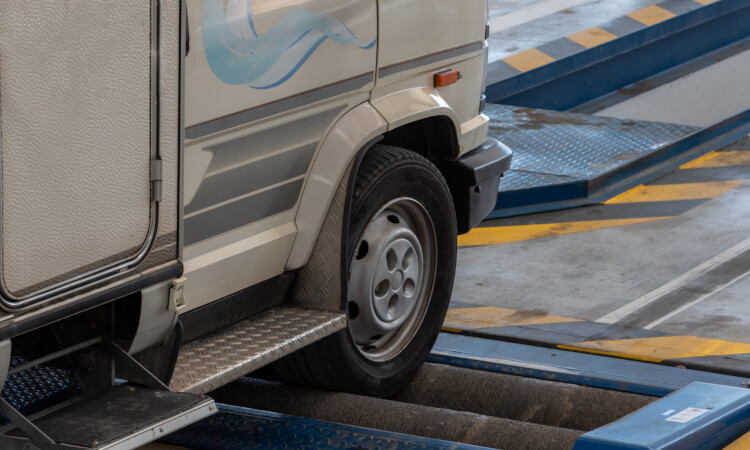
Class 5 covers larger passenger-carrying vehicles: private passenger vehicles, ambulances, or motor caravans with 13 or more seats.
These require more detailed checks relevant to accommodating many passengers.
As with Class 4/4a, Class 5a is where there is an added seat belt installation check, where extra belts are fitted beyond the minimum requirement.
First test for these typically comes one year after first registration.
MOT Class 7
Class 7 is for goods vehicles with a design gross weight (DGW) over 3,000 kg up to 3,500 kg.
These heavier vans or small trucks undergo more rigorous testing for components like braking system, suspension, lights, emissions, and structural condition – because their greater weight means higher stresses on safety-critical parts.
The first MOT for Class 7 is generally required three years after registration.
Why Do Vehicles Have Different MOT Classes?
Having different MOT classes ensures that each vehicle is tested against appropriate safety, environmental, and structural standards.
A motorcycle has very different risks to a large van; seat-belt requirements change with passenger numbers; heavier vehicles place more stress on road surfaces and safety components.
The correct class affects what gets checked, how often, and where the test can be performed.
Book Your MOT Test Through Blackcircles.com
If your MOT is due,
you can book quickly and easily through Blackcircles.com.
With access to a wide network of trusted
garages across the UK, you’ll be able to find the right MOT class for your vehicle and secure a convenient appointment at a competitive price.
FAQs:
What happens if my vehicle is tested under the wrong MOT class?
If a vehicle is tested under an incorrect MOT class, the test may not cover all the checks required by law, which could mean the certificate is invalid. It is the responsibility of the garage to ensure the correct class is applied, but it is worth confirming with the test centre beforehand if you are unsure which class applies to your vehicle — particularly for less common vehicle types such as motorhomes, quadricycles, or ambulances.
Can I take my vehicle to any garage for its MOT regardless of class?
Not all garages are authorised to test every MOT class. While Class 4 tests are widely available at most approved test stations, higher classes such as Class 5 and Class 7 require specialist equipment and authorisation that not all garages hold. If your vehicle falls outside of Class 4, it is worth checking that your chosen test centre is approved for the relevant class before booking.
Do electric vehicles follow the same MOT class structure?
Yes. Electric vehicles are classified using the same MOT class system as petrol and diesel vehicles, based on their vehicle type and weight rather than their powertrain. A standard electric car falls under Class 4, for example. The test itself does differ slightly for EVs — there is no exhaust emissions check — but the class structure and the core safety checks remain the same.
Does the MOT class affect how much the test costs?
Yes, to some extent. The DVSA sets maximum fees that garages can charge per class, and these vary. Class 4 cars and vans have a different maximum fee to Class 7 goods vehicles or Class 1 and 2 motorcycles. Garages are free to charge less than the maximum, so it is worth shopping around — particularly for higher class vehicles where the statutory maximum is greater.