At the end of June 2026 there were
2,017,000 licensed zero emission cars in the UK. A third more than a year earlier. The Department for Transport counted another 147,000 registered in that quarter alone.
Plenty of those drivers are now coming up to their first tyre change and finding a wall of jargon:
- EV-specific compounds
- Acoustic foam
- Kilograms per tonne
- Etc
Then there's the technology and terms that manufacturers have developed to meet the needs of EVs. Michelin has more of that vocabulary than most - because it got into it early.
But before we get into the terminology, one thing to look at in terms of EV tyres.
Michelin's position, in its own words (
electric car tyre guide), is that 'while all MICHELIN tyres are suitable for EV, some respond to specific driving demands'.
So, there is no EV certification for tyres and No EV class on the label. What we do have on the market today is a set of engineering developments and technologies that have been brought together to suit a heavy, quiet, car with instant torque.
EV Tyre Demands
An electric car will ask a lot from the tyres. And it will require different needs than many petrol cars.
Weight is the obvious one. the average battery in an electric sports car is around 400kg, and that mass sits low in the car.
Torque is perhaps a less obvious issue. An electric motor delivers instant pull from a standstill. And so the tread take their hardest shove at the same time that they have the least help from any momentum.
Then there is the sound angle. When you take an ICE engine out of a car, the noise that remains is mostly coming from the tyres.
The EU requires electric vehicles to generate a
minimum of 56 decibels at low speeds so pedestrians can hear them coming. That is against roughly 65 decibels for a petrol car. Above about 30mph, though, what you hear inside an EV is rubber on tarmac.
And finally there is efficiency. Which in an electric car is measured in miles (or range) rather than miles per gallon.
Rolling resistance in EVs
Rolling resistance is the energy a tyre loses as it moves. It is measured as a coefficient in newtons per kilonewton. Which is numerically the same as kilograms per tonne. It is what the left-hand letter on the tyre label is grading.
Those letters are defined in law - where the
Retained Regulation (EU) 2020/740, Annex I sets the bands for C1 car tyres:
| Fuel efficiency class
| Rolling resistance (kg/t)
|
|---|
| A
| 6.5 or lower
|
| B
| 6.6 to 7.7
|
| C
| 7.8 to 9.0
|
| D
| 9.1 to 10.5
|
| E
| 10.6 or higher
|
Michelin EV Tyre Technology
Energy Passive Compound. On the e.Primacy, is focused on rolling resistance. The compound is formulated to give back more of the energy it absorbs as the tread deforms. Rather than losing it as heat. The Primacy 5 energy carries a second-generation version of it.
ElectricGrip Compound. On the Pilot Sport EV, works the other end of the problem. Michelin describes a high-stiffness centre profile for efficient torque transmission, which is a technical way of saying the middle of the tread is built to cope with an electric motor's shove.
Slim Belt. This is a thinner belt package under the tread. Less mass to flex means less energy lost. Michelin links it directly to battery range. It appears across the efficiency-focused range.
MaxTouch. Part of Michelin's aim to spread braking, accelerating and cornering forces evenly across the tyre. Which it associates with longer tread life.
MICHELIN Acoustic technology. A ring of polyurethane foam bonded to the inside of the casing. This help to dampen the air resonating in the cavity.
Michelin claims it reduces perceived noise inside the cabin by up to 20%. This was tested by Michelin on size, 245/45 R19, on a Kia Cadenza, in the 170 to 230Hz band. Michelin's own footnote says results vary by vehicle, size, speed and road surface.
Piano Acoustic Tuning. A different approach to noise that has been introduced on the newer Primacy 5 energy, Pilot Sport 5 energy and CrossClimate 3. The tread blocks are spaced in a varied sequence so the noise spreads across frequencies instead of concentrating into a hum.
EVs and tyre labels
Every tyre sold in Great Britain carries three ratings:
- fuel efficiency
- wet grip
- external noise.
There is no EV rating or suitability marking. The
DVSA's guidance does not mention electric vehicles at all.
The noise figure is the one most often misread. DVSA states plainly that the decibel number is the tyre's external noise level, 'not any tyre noise heard inside the vehicle'.
So a tyre can carry an excellent label and still potentially create a drone. An Acoustic version with foam inside it will show the same external number as the one without.
The label is essentially measuring what your neighbours or pedestrians will hear.
Michelin's EV range
Five Michelin tyres do most of the work for electric cars in the UK.
Michelin e.Primacy
EV approved tyres: electric vehicle (EV) tyres are a category of car tyre that has been developed by several manufacturers to meet the specific requirements of an electric vehicle.
Michelin e.PrimacyGet more mileage out of your car with the Michelin e.Primacy. This summer road tyre is a popular choice of OEMs for electric, hybrid, and low fuel consumption vehicles. Say goodbye to energy waste and hello to efficiency.
Find your sizeThe efficiency specialist. Michelin's figures, tested by Applus Idiada in 2020 on a 205/55 R16, are 5.58kg/t new and 5.13kg/t worn, which Michelin converts to up to 7% more range for a VW e-Golf.
Michelin also describes its longevity as excellent, but the DEKRA test in its own footnote scores it at 100% against 102.1% for the Primacy 4. So we should not present mileage as a measured advantage here.
e.Primacy Customer Reviews
customers have reviewed the e.Primacy as follows:
Michelin e.Primacy 2
EV approved tyres: electric vehicle (EV) tyres are a category of car tyre that has been developed by several manufacturers to meet the specific requirements of an electric vehicle. The newer version, co-designed with Renault and Mercedes-Benz, rated B for wet grip across all dimensions. Michelin has not published rolling resistance, range or longevity figures for it yet.
e.Primacy 2 Customer Reviews
customers have reviewed the e.Primacy 2 as follows:
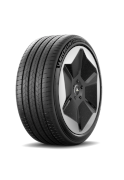
Michelin Pilot Sport EV Acoustic
EV approved tyres: electric vehicle (EV) tyres are a category of car tyre that has been developed by several manufacturers to meet the specific requirements of an electric vehicle. Sold mostly in 20 to 22-inch fitments. Michelin's headline is up to 60km of extra range, and the comparison behind it is with Michelin's own Pilot Sport 4 SUV on a hypothetical 2,151kg car with 540km of range, in
255/45 R19.
The same study is where the 15% increase in cornering stiffness comes from. It is a summer tyre and it is not 3PMSF marked.
Owners rate it
4.8 out of 5 from 133 ratings through our sister company DriverReviews, mostly on Model Ys, iXs, Ioniq 5s and EV6s, and the comments come back to quietness more than anything else.
Pilot Sport EV Acoustic Customer Reviews
customers have reviewed the Pilot Sport EV Acoustic as follows:
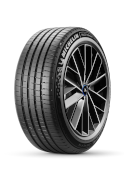
Michelin Primacy 5 energy
Latest Model
EV approved tyres: electric vehicle (EV) tyres are a category of car tyre that has been developed by several manufacturers to meet the specific requirements of an electric vehicle. Launched in March 2026 and sold for petrol, hybrid and electric cars alike. It carries an A rating on all three label criteria. Which means the sub-6.5kg/t rolling resistance in the table above, and Michelin quotes up to 10% more range on an EV.
Its longevity claim of up to 40% comes from a DEKRA test on a VW ID.3 in which Michelin indexed at 100% and the lowest-scoring competitor at 60%. So it describes the widest gap in that test rather than a typical one. There is an Acoustic version with the foam ring inside it.
Primacy 5 energy Customer Reviews
customers have reviewed the Primacy 5 energy as follows:
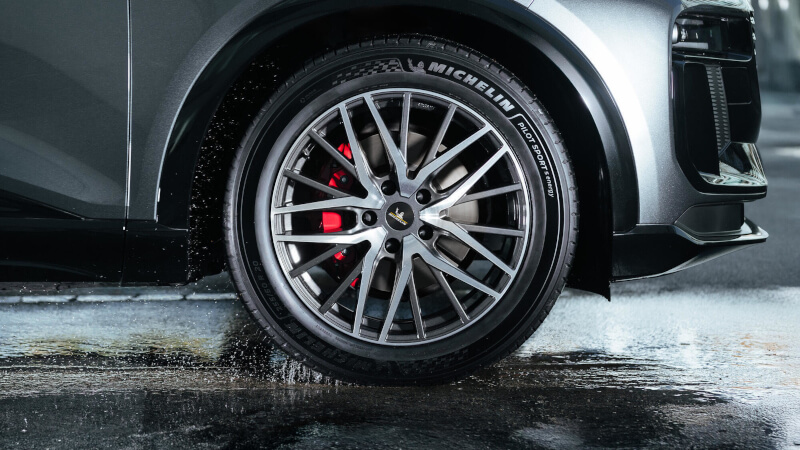
Michelin Pilot Sport 5 energy
Latest Model
EV approved tyres: electric vehicle (EV) tyres are a category of car tyre that has been developed by several manufacturers to meet the specific requirements of an electric vehicle. The sports version of the same thinking, launched the same day in 19 to 21-inch fitments. Michelin rates it A for wet grip and A for rolling resistance on the sizes it lists.
Pilot Sport 5 energy Customer Reviews
customers have reviewed the Pilot Sport 5 energy as follows:
Michelin CrossClimate 3 and the rest of the range
All season tyres: designed to cope with various weather conditions and deliver a reliable performance throughout the different seasons.
EV approved tyres: electric vehicle (EV) tyres are a category of car tyre that has been developed by several manufacturers to meet the specific requirements of an electric vehicle. The CrossClimate 3, Primacy 5 and the rest are sold as suitable for electric cars without carrying EV-specific technology.
For a lot of EV drivers, particularly those doing short, cold, damp British journeys, an
all-season tyre is a useful choice.
CrossClimate 3 Customer Reviews
customers have reviewed the CrossClimate 3 as follows:

Looking for tyres for an electric car?
You can check what fits yours on Blackcircles by
entering your registration, then book fitting at a local garage or with a mobile fitter. If your car came on HL tyres, the size finder will show HL options for it.
Frequently Asked Questions
Do electric cars need special tyres?
Not specifically. Any tyre in the correct size, load index and speed rating is legal on an electric car. Michelin's position is that all of its tyres are suitable for EVs. Tyres designed around EV demands tend to add low rolling resistance and extra load capacity.
What does HL mean on a tyre?
High Load Capacity. It is an ETRTO standard for a tyre carrying more weight than an XL tyre of the same size at the same pressure. Created for heavier electric and hybrid cars. If your car was supplied with HL tyres, replace them with HL tyres.
Which Michelin tyre gives an electric car the most range?
On Michelin's own published figures the Primacy 5 energy is the strongest. With an A rating for rolling resistance and a quoted gain of up to 10%. The e.Primacy is the long-standing efficiency option, and the Pilot Sport EV is the performance one. All of those gains are quoted against a stated comparison tyre, not against every tyre on the market.
Does the tyre label tell me how quiet a tyre is inside the car?
No. The decibel figure on the label is external noise, measured outside the vehicle. Cabin noise is a different measurement and is not on the label. Which is why foam-lined Acoustic versions often carry the same external rating as the standard version.
Can I fit summer EV tyres all year round in the UK?
You can, but the Pilot Sport EV and e.Primacy are summer tyres without the 3PMSF snowflake marking, and Michelin recommends switching to winter or all-season tyres below 7°C. An all-season tyre such as the CrossClimate 3 avoids the swap.
Do heavier electric cars wear tyres out faster?
It is widely assumed, and the evidence is thinner than you would expect. DEFRA's
review of responses on tyre and brake wear found that data on EV tyre wear was lacking, and that while many respondents expected more wear from the extra weight, none submitted data to support it. Driving style and regular pressure checks make a measurable difference either way.