

![System.Func`2[BlackCircles.Interfaces.IECommerceModuleData,System.String]](https://images.blackcircles.com/search/feature-ev.svg)
Michelin Pilot Sport 5
Giving you sports performance designed to last, the Michelin Pilot Sport 5 allows you to enjoy each moment.
Price from
Find your size119.99to341.99
...searching


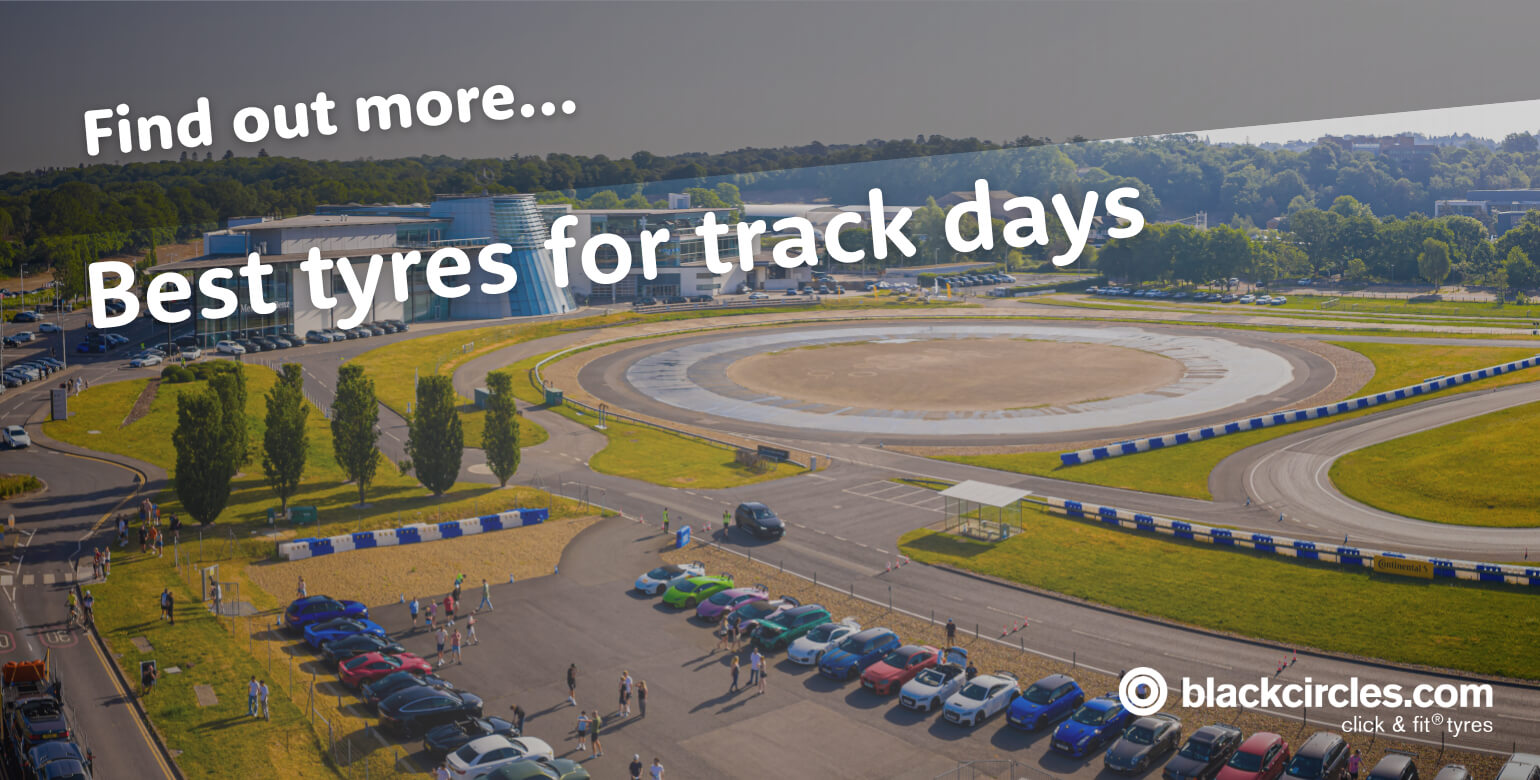
There are a lot of article covering the topic of track day tyres, where they assume you are buying a second set. However, for those who are looking to drive on the circuit with the same tyres they commute on - there is not as much coverage.
What if you need a tyre that can do three or four twenty-minute sessions and then driving home again - often in the rain?
That question deserves a proper answer. Especially for those who like to take part in 'bring your own car' track days.
The gap between a good fast road tyre and a dedicated track tyre is real. However, it is narrower than the price difference, the faff and the compromise might suggest.
On a cold, damp British circuit – which, let's be honest, is most of them - the road tyre is not always compromise at all.
The difference is closer than you may think. What's handy, is that there has been some recent clean piece of evidence for it.
In March 2026, Tyre Reviews ran eight ultra-high-performance tyres in 235/35 R19 on a VW Golf 8 GTI Clubsport.
Seven of these were road tyres. One was the Michelin Pilot Sport Cup 2 - a tyre that Michelin itself describes as 80% track and 20% road.
Over a 76.5-second lap, the Cup 2 was 0.32 seconds off the fastest road tyre in the test.
For a tyre with barely any tread, that you would likely think twice about driving home in the rain on, and that costs considerably more – that's not really a massive difference.
Michelin published information on which four road tyres from its range are suitable for track use. That gives you some serious options. Below we have covered each one so you can work out which tyre matches your needs.
In a recent sport tyre test by AutoView, published on 31 August 2026, they ran seven summer tyres in 225/45 R18 on a BMW 120 MSP.
The Pilot Sport 5 finished second overall, and it did it on the back of the single most useful result in the test for a British driver - the shortest wet braking distance of all seven tyres.
It was second in dry braking too and, third on dry cornering speed at 72.28 km/h.
| Test | Michelin Pilot Sport 5 | Best in test |
|---|---|---|
| Wet braking, 80–0 km/h | 25.45m — 1st | (Michelin) |
| Dry braking, 100–0 km/h | 35.13m — 2nd | Continental MaxContact MC7, 34.38m |
| Dry cornering speed | 72.28 km/h — 3rd | Continental MaxContact MC7, 73.07 km/h |
| Subjective dry handling | 7.20 — 3rd | Continental MaxContact MC7, 7.50 |
Michelin has built the Pilot Sport 5 around their MaxTouch Technology. Which works to evenly distributes forces of acceleration, braking and cornering, offering a longer tread life.
This matters more than usual if you are going to spend a few days a year on the track.

In AutoView's 2025 sports tyre test, they put five ultra-high-performance tyres on a BMW M3 xDrive in 275/35 R19.
The Pilot Sport 4 S won on 97.5 points, and it with the fastest lap of the test at 1:25.95. It also had the best subjective ride comfort score. Along with joint-best subjective dry handling.
The Continental SportContact 7 was next on 93.3, the Kumho Ecsta Sport S third on 92.1, the Hankook Ventus Evo fourth on 88.9 and the Pirelli P Zero PZ4 last on 79.8.
Michelin's own description of it is “engineered to provide performance and driver feedback both on road and during occasional track use”.
The Pilot Sport 4 S is built with Michelin's Bi-Compound Technology. This makes sure that the tyre is optimised on-track performance. It is also an original equipment fitment option on cars from Mercedes-AMG, Ferrari and Porsche.
It's worth noting in that same test the Pilot Sport 4 S was fourth of five in wet braking. However, in AutoView's own explanation they said that BMW's original-equipment Michelins deliberately trade some wet performance for the dry balance BMW asks for.
Could that be seen as a good trade on a dry circuit and a worse one on a wet motorway? That's a question that only you can answer when it comes down to what you want from a tyre.

This is the newest tyre on the list. Michelin describes the Pilot Sport S 5 as a “high performance tyre designed for use on road and track”. The tyre uses Michelin's Dynamic Response Technology and a Dual Sport Tread Design with Bi-Compound Technology.
We should be straight about the evidence, though. It launched original-equipment-first in January 2026. There is no published independent magazine test data for it yet.
Everything above is Michelin's claim rather than an independent finding. It is available, it is the newest thing Michelin makes in this space, and it will be tested in due course.

This is the 80/20 tyre, and in Tyre Reviews' March 2026 test against seven road tyres it did what you would expect:
| Test | Michelin Pilot Sport Cup 2 | Best in test |
|---|---|---|
| Dry handling, lap time | 76.80s — 2nd | Pirelli P Zero R, 76.48s |
| Dry braking | 32.97m — 2nd | Pirelli P Zero R, 31.70m |
| Subjective dry handling | 8.75 — joint 1st | (joint with Pirelli P Zero R) |
| External noise | 71.30 dB — 1st | (Michelin) |
| Wet braking | 28.04m — 7th of 8 | Continental SportContact 7, 24.54m |
| Wet handling | 107.09s — 6th of 8 | Pirelli P Zero R, 99.38s |
Second-fastest of eight, second-shortest dry stop, tied for the best steering feel, and - perhaps surprisingly - the quietest tyre in the test. Michelin cites its fourth place overall in that test on its own website.
But look at the bottom two rows. Seventh of eight in wet braking, sixth in wet handling. Michelin grades it D for wet grip on the EU label. This is not a tyre to drive home on in November, and Michelin does not pretend otherwise.
Track days can be exceptionally hard on tyres. The levels of heat generated, alongside the load and sustained cornering that takes place is likely to wear the tread down at a faster pace than the daily commute.
However, there are a couple of things to consider in regards to this (legitimate) concern.
First, the tyre you choose matters more than the track day does. Germany's ADAC has built the largest independent tyre wear dataset in existence. 160 tyre models measured on public roads since 2023, on the same car. With rubber loss weighed and normalised per tonne.
Across the twelve manufacturers with at least five models in the programme, Michelin says its tyres are designed to “wear out 27% slower than our competitors”.
Michelin sources that figure as: “Based on ADAC survey 2023-2025 analyzing the average tyre wear by tyre manufacturer: a total of 160 models have been tested and at least 5 models of 12 main tyre manufacturers.” Two caveats worth knowing: the 27% is measured across all twelve brands in the survey, including mid-range ones, not against premium rivals alone. And ADAC is explicit that wear rate is not the same thing as tread life — how deep the tread starts and whether it wears evenly matter too.
Second, most of the damage is avoidable, and it is about pressures. A tyre run at road pressures on a hot circuit will over-inflate as the air inside expands, shrink its contact patch, overheat through the centre of the tread and grease off.
Michelin publishes a track day pressure protocol that costs nothing to follow and works whichever brand you are on:
Do that and a set of good road tyres will take several track days in its stride. Ignore it and no tyre on this page will make you happy.
Check what your car came on. If the manufacturer developed a specific version of a tyre for your car — Porsche's N-codes, BMW's star, Mercedes' MO — that marking is not badge engineering. It means the compound and construction were tuned for your car's weight, aerodynamics and electronics. In Auto Bild's 2026 track tyre test the winning tyre won largely because it had been developed for the exact car it was tested on, while a rival developed for a heavier car understeered on the same circuit. Fitment beats badge more often than people expect.
Ask how a tyre behaves on lap eight, not lap two. Independent testing repeatedly finds that the tyre with the best single lap is not the tyre with the best session. Tire Rack's 2026 test ran each set twice, once on a cool morning track and once in afternoon heat: one tyre went from second quickest to slowest of three as the heat built. Most track days are twenty-minute sessions, not qualifying laps.
Your tread limit is 1.6mm, across the central three-quarters of the tread, all the way round — Regulation 27 of the Road Vehicles (Construction and Use) Regulations 1986, restated in Annex 6 of the Highway Code. Below it, that is a £2,500 fine and three penalty points — per tyre. Worth checking after a track day, not before the next MOT.
And if you ever do go shopping for a dedicated track tyre, check the sidewall before you plan to drive home on it. The DVSA's MOT inspection manual permits a tyre carrying “NHS, Not for Highway Use or similar markings” only where the sidewall also shows “an 'E' marking and a number contained within a circle” plus a six digit number. No E-mark, no road use — and a tread depth failure is classed as a Dangerous defect.
For completeness, here is what the track day specific tyres looks like. The dedicated road-legal track tyres, or semi-slicks.
They have shallow tread and soft compound, and they are quicker in the dry. They are also markedly worse everywhere else, and three facts should decide it for you.
They need heat. Michelin's recommended minimum ambient temperature for its Pilot Sport Cup 2 R is 20°C. A great many British track days don't reach that often throughout the year. Or are only capable of it during the height of summer. Below the working window, a semi-slick is slower and less safe than the road tyre it replaced.
They are also typically much worse in the wet. In Auto Bild's 2026 test on a BMW M2, the road-biased Michelin Pilot Sport Cup 2 stopped from 100km/h in 47.00 metres on a wet surface.
The dedicated Pilot Sport Cup 2 R, on the same car on the same day, needed 55.50 metres. That is eight and a half metres.
They are a second set, with everything that implies another set of wheels, storage, and swapping them over twice per track day.
If you trailer the car, run six or more days a year and can pick your weather, tier two is for you. If you drive to the circuit, it almost certainly is not.
The road tyre is the overlooked answer, and for most people it is the right one.
A tyre Michelin calls 80% track was only three tenths quicker than a road tyre over a 76-second lap. That is the size of the prize, and it is smaller than the cost, the storage and the wet-weather penalty of buying a second set.
Within the road tyres, Michelin currently has the strongest independent record in the category. The Pilot Sport 5 took second overall and the shortest wet braking distance of seven tyres in AutoView's test published in August 2026. The Pilot Sport 4 S won AutoView's 2025 test outright with the fastest lap in it, though it gives up wet braking to do so.
The Pilot Sport S 5 is the newest and is built explicitly for road and track, but has no independent test data yet. And the Pilot Sport Cup 2 will get you to within three tenths of a semi-slick while still being road legal. As long as you have a plan for the rain.
Get your pressures right, check what your car was developed for, and buy for lap eight rather than lap two.

We love to hear from our customers. Connect with us today and let’s start a conversation.
