Blackcircles.com supports
TyreSafe’s Young Driver Campaign, helping new motorists understand why checking their tyres could protect more than just their safety.
For many new drivers, passing their driving test means freedom, independence and, in some cases, the ability to get to work or education.
But something as preventable as driving on illegal tyres could put that freedom at risk.
Launching on September 1st, which warns young and newly qualified motorists about their responsibility for tyre safety — and the potentially serious consequences of getting it wrong.
The message at the heart of this year’s campaign is simple:
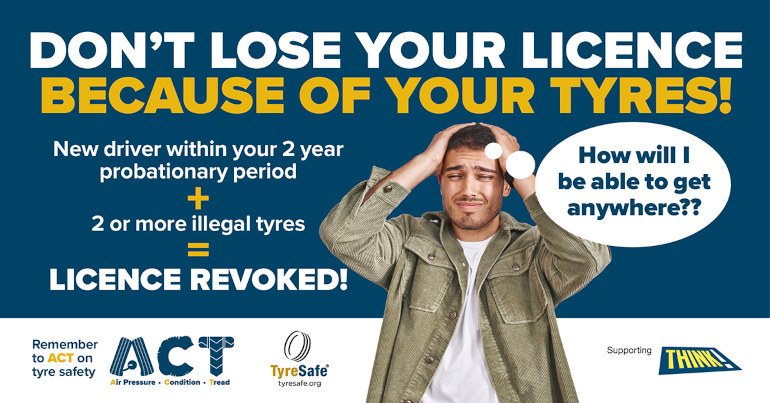
For a new driver, just two illegal tyres could be enough to have their driving licence revoked.
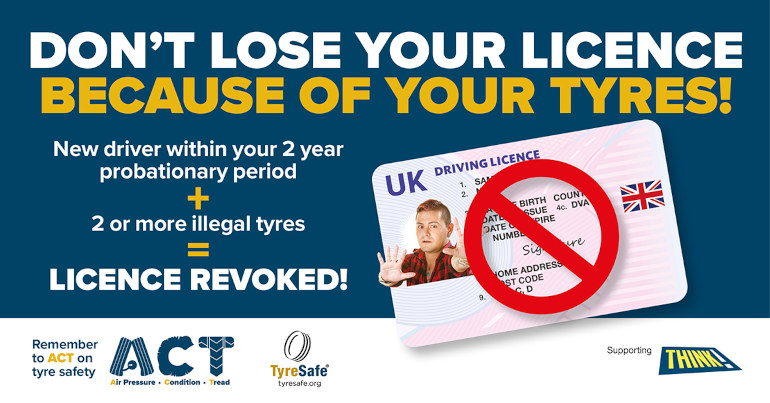
Why two illegal tyres can mean losing your licence
Drivers can receive three penalty points and a fine of up to £2,500 for each illegal tyre.
For most motorists, six penalty points are already a serious matter. But the consequences can be particularly significant for somebody who has only recently passed their test.
New drivers have a two-year probationary period after passing their driving test. Accumulating six or more penalty points during this period can result in their licence being revoked.
That means two illegal tyres carrying three points each could be enough to take a new driver back off the road.
It could mean losing the independence they have only just gained, affecting their ability to commute to work or college, and having to go through the process of qualifying to drive again.
More than half of young drivers don't know they're responsible for checking their tyres
One of the key reasons behind the campaign is a significant gap in young drivers' understanding of tyre responsibility.
TyreSafe research found that 52% of UK drivers aged 17–24 do not realise they are legally responsible for the tyres on any vehicle they drive — even when the vehicle doesn't belong to them.
And the knowledge gap isn't limited to younger motorists. The same research found only half of UK drivers are aware that fines and penalty points can apply for each individual illegal tyre.
That's an important distinction for young drivers in particular.
You might regularly drive a parent's car, share a vehicle with somebody else or borrow a car. Regardless of who owns it, as the driver you need to make sure the vehicle including its tyres are roadworthy.
Stuart Lovatt: young drivers have a responsibility to check their tyres
Stuart Lovatt,
Chair of TyreSafe, says the combination of inexperience and stricter licence rules makes tyre awareness particularly important for newly qualified motorists.
“Young and new drivers remain one of the highest-risk groups on UK roads, not only due to inexperience, but also because of the tighter restrictions placed on their licence.
“With the Government now setting out more ambitious targets to reduce killed and seriously injured casualties, particularly among young people, there is an even greater responsibility on all road safety partners to focus on educating young road users to be compliant and make them aware of the serious consequences if they aren’t.
“Tyres are one of the most critical safety factors on any vehicle, and young and new drivers have the responsibility to ensure that they are driving on safe,
legal and compliant tyres. The repercussions, if they don’t, can be extremely punitive when it comes to penalty points, financial penalties and operating costs.”
Remember to ACT on tyre safety
The good news is that checking your tyres doesn't need to be complicated.
TyreSafe encourages drivers to remember ACT:
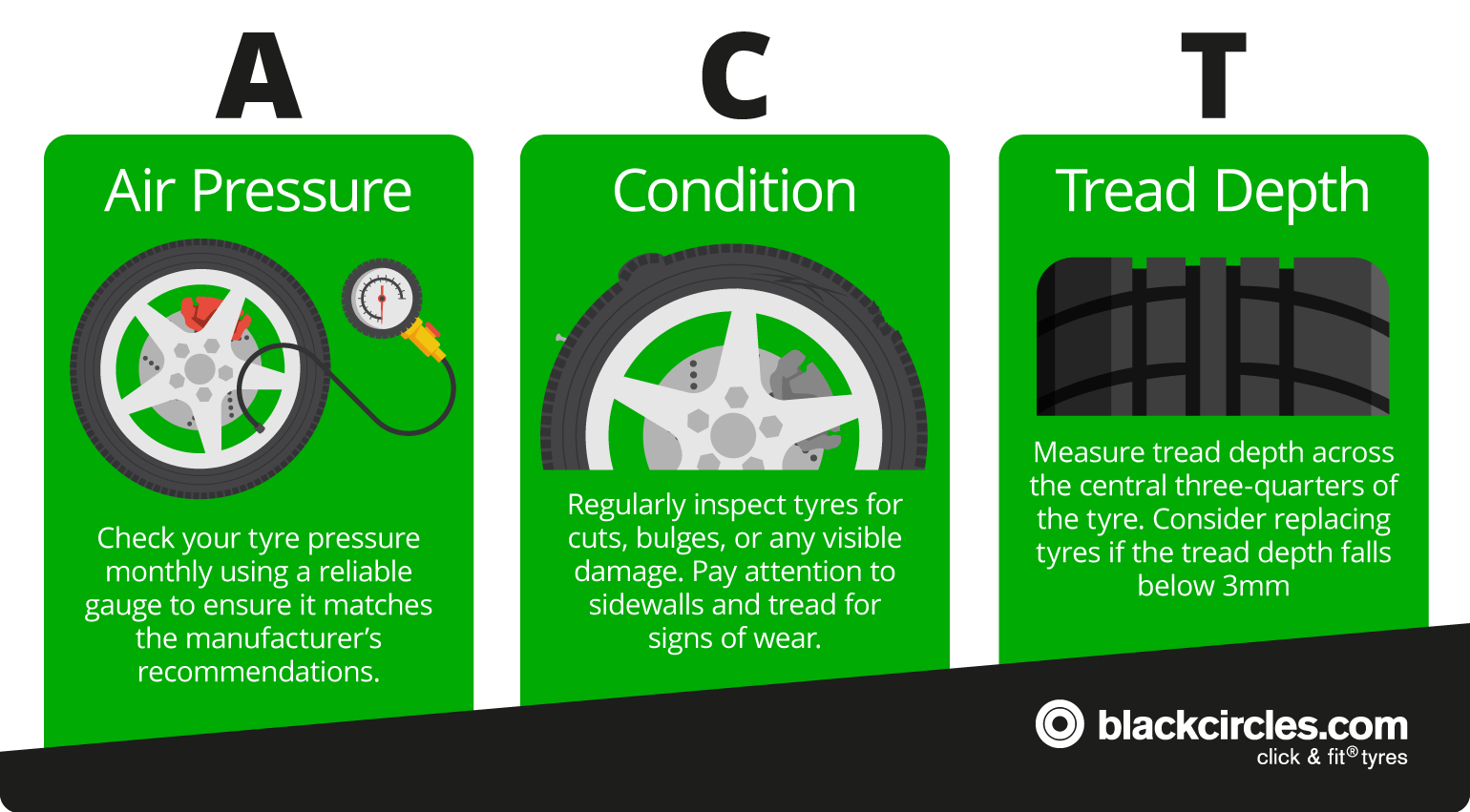
A – Air pressure: Check your tyre pressures regularly and make sure they're set to the vehicle manufacturer's recommended levels.
C – Condition: Look carefully for cuts, cracks, bulges or other visible damage that could make a tyre unsafe.
T – Tread: Check that your tyres have sufficient tread across the tyre. The UK legal minimum is 1.6mm, although tyre condition should never be judged on tread depth alone.
Understanding tread is about more than staying on the right side of the law. TyreSafe's research found that 25% of drivers don't understand how wet conditions and low tread depth affect stopping distances, with some even believing that traction improves.
TyreSafe recommends carrying out tyre checks at least once a month and before a long journey.
The campaign also encourages drivers not to ignore something they discover during a check. Its practical guidance includes looking for damage such as bulges and cracks and using the simple 20p test to help check tread depth.
Don't lose your licence because of your tyres!
If you've recently passed your test, make tyre checks part of your normal driving routine from day one.
Check your air pressure. Check your tyre condition. Check your tread.
For new drivers choosing their first set of tyres, knowing what to look for can make the decision much easier. Read our
guide to the best tyres for new drivers for our recommendations and advice on choosing the right tyres for your car.
Experienced driver? Pass your knowledge on
If you’ve been driving for years, looking after your tyres may feel like second nature. For someone who has only recently passed their test, however, knowing what to check and what to do when something goes wrong can take a little guidance.
That practical knowledge isn't something every driver has been given. One in five drivers has never been shown how to change a tyre, while 45% say they wouldn't feel confident doing it themselves.
If you have a new driver in your family, workplace or circle of friends, share this article with them. Better still, take a few minutes to pass on some of your own experience.
Show them how to find the correct tyre pressures for their car, how to check their tread and how to spot signs of damage such as cuts, cracks or bulges. You could also talk them through what to do if they discover a problem and how you deal with a tyre issue safely.
Driving experience is valuable, so pass it on. A quick conversation or a few minutes spent checking a car together could give a new driver knowledge and confidence they'll use for years to come.
Know a new driver? Share this article with them and help make tyre safety part of their driving routine from day one.
Frequently Asked Questions
How do I find the correct tyre pressure for my car?
The correct tyre pressure varies between vehicles, so don't rely on a pressure used for another car. Check the vehicle manufacturer's guidance for the recommended pressures.
The DVSA advises drivers to use a reliable pressure gauge and check and adjust pressures when the tyres are cold. If your car has a spare tyre, remember to check that too.
Depending on your vehicle, the recommended pressures may also be displayed inside the fuel filler cap or on the driver's door sill.
DVSA guidance on checking tyre pressures
How do I do the 20p tyre tread test?
The 20p test is a quick way to identify whether your tyre tread may be approaching or below the legal minimum.
Insert a 20p coin into the main tread grooves of the tyre. If the outer band of the coin is hidden, the tread is above the legal limit at that point. If you can see the outer band, your tyre may be illegal or unsafe and should be checked immediately by a qualified tyre professional.
TyreSafe recommends repeating the test at several points on each tyre rather than checking in just one place.
TyreSafe's 20p tyre test guide
What tyre damage should I look out for?
Take a good look around each tyre for cuts, cracks, bulges, lumps, tears or other visible damage. You should also look for objects that may have become embedded in the tread.
The Highway Code states that tyres must be correctly inflated and should be free from certain cuts and other defects. TyreSafe advises that cuts, cracks and bulges can indicate that a tyre is no longer safe, so suspected damage should be inspected by a tyre professional.
If you're unsure about something you've spotted, don't simply wait until your next MOT. GOV.UK makes clear that a vehicle can be unsafe to drive even if it has a current MOT certificate.
GOV.UK: check your vehicle is safe to drive
What should I check before driving someone else's car?
If you're borrowing a parent's, friend's or partner's car, don't assume that somebody else has already checked it.
Before driving, take a few moments to look at the tyres. Check that they appear properly inflated, have sufficient tread and don't show obvious cuts, bulges or other defects. The vehicle handbook can tell you how often different vehicle checks should be carried out and provide information specific to the car.
This is an especially useful habit for new drivers who regularly share or borrow a vehicle.
What should I do if I get a puncture and don't know how to change a tyre?
First, prioritise your safety. Don't attempt to change a wheel somewhere that puts you or other road users at risk.
Not every modern car has a conventional spare wheel. Your vehicle may have a space saver wheel or a temporary puncture repair kit instead, so it's worth checking what equipment your car has before you ever need it. You should also read the vehicle handbook so you know how that equipment is intended to be used.
If you're on a motorway or dual carriageway, TyreSafe advises that it is unsafe to change a tyre on the hard shoulder. Get yourself to a safe place and contact your breakdown recovery service.
Does tyre tread really make a difference when driving in the rain?
Yes. Your tyres have less grip on a wet road, which affects how quickly you can stop. The Highway Code states that stopping distances in wet weather will be at least double those required on dry roads because tyres have less grip.
Tread is designed to help tyres maintain grip in wet conditions, and its effectiveness reduces as the tyre wears. This is why checking tread shouldn't be viewed simply as a way of staying within the law. It's an important part of keeping the car safe to drive.
Should I learn how to check my tyres before taking my driving test?
Yes. Basic vehicle safety knowledge is already part of learning to drive.
During the practical driving test, you'll be asked two vehicle safety questions, commonly known as the "show me, tell me" questions. The official DVSA question bank includes questions about finding the correct tyre pressures and checking tyres for sufficient tread depth and general condition.
Even after you've passed, these are useful skills to keep practising. Knowing how to drive the car is only part of being a responsible driver. Knowing how to recognise when the car may not be safe to drive matters too.
DVSA official question bank: car show me, tell me vehicle safety questions
How can parents and experienced drivers help a new driver with tyre care?
Don't just tell a new driver to "check their tyres". Show them how.
Spend a few minutes together finding the recommended tyre pressures, using a pressure gauge, doing the 20p tread test and looking around each tyre for signs of damage.
This complements TyreSafe's campaign guidance, which identifies parents as an important secondary audience alongside driving instructors, schools and colleges. TyreSafe also actively encourages people to educate family members and loved ones about regular tyre checks.
It can be particularly useful to do this with the actual car the new driver will be using, so they know where to find the information and equipment they'll need.
TyreSafe campaign guidance for new and young drivers