Experience counts for a lot on the road. The more miles you drive, the better you get at reading junctions, spotting hazards early and knowing which roundabouts need extra care.
It's natural to trust that experience when something unexpected happens. What experience can't do, though, is change the physics of stopping your vehicle.
It helps you get your foot on the brake sooner. From that point on, where the car stops depends on your speed, the road surface and how much grip your tyres have.
That's the focus of this year's
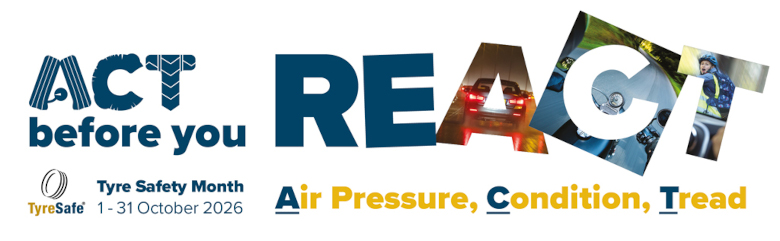
Tyre Safety Month, which runs throughout October under the theme "Act Before You REact". Research from road safety charity
TyreSafe suggests how prepared we feel and how prepared our cars are can be two different things.
What TyreSafe's research found
TyreSafe's research found that 83% of drivers believe they are in full control of how far their car takes to stop.
Yet when drivers were asked how much further they would need to stop on a wet road at motorway speeds, only 6% gave the correct answer.
Overall, 94% underestimated how much stopping distances grow in the wet, some by a wide margin.
The two numbers come from different questions, so they don't describe the same group of drivers.
Most of us underestimate wet-weather stopping distances, however confident we feel behind the wheel.
Which is understandable. Few of us ever have to brake hard enough in the wet to find out. And long may that continue.
That sense of distance still shapes the space we leave in the rain, the speed we choose on a wet motorway and when we start braking for a queue. So it's worth knowing the real figures.
Thinking distance vs braking distance
The Highway Code splits every stop into two parts.
Thinking distance is how far you cover between seeing a hazard and getting your foot on the brake pedal.
Experience helps with this bit. You spot trouble earlier, you're already covering the brake, and you react faster.
Braking distance is how far the car goes once the brakes are on. This is the part that's mostly down to the car and tyres, and grip sets the limit.
The Highway Code's
typical stopping distances show how fast braking distance grows compared with thinking distance:
| Speed
| Thinking distance
| Braking distance
| Total
|
|---|
| 20mph
| 6m
| 6m
| 12m
|
| 30mph
| 9m
| 14m
| 23m
|
| 40mph
| 12m
| 24m
| 36m
|
| 50mph
| 15m
| 38m
| 53m
|
| 60mph
| 18m
| 55m
| 73m
|
| 70mph
| 21m
| 75m
| 96m
|
At 20mph the two are about equal. By 70mph, braking makes up more than three-quarters of the total, so the car and its tyres are doing most of the work. And these are dry-road figures.
The physics: speed, grip and wet roads
Stopping a car means getting rid of its energy. A moving car's energy rises with the square of its speed, so double your speed and there's four times as much to lose. You can see it in the Highway Code figures: braking distance at 60mph is around four times what it is at 30mph.
The only thing turning that energy into a stop is friction between your tyres and the road.
Each tyre touches the tarmac through a patch roughly the size of your palm. And those four patches have to do all the work.
Add water and that friction drops. The Highway Code says
stopping distances will be at least double in wet weather, because tyres have less grip. At 70mph, that's at least 192 metres instead of 96.
How much grip you actually get on a wet road depends heavily on the tyre. The tread's job is to push water out of the way so the rubber can stay in contact with the tarmac.
As it wears, it shifts less water, and at speed the tyre can end up riding on a film of it. This is called aquaplaning, and it's why the steering suddenly goes light. The
legal minimum for cars is 1.6mm across the central three-quarters of the tread and around the whole circumference.
The air pressure within your tyres also plays its part. A soft tyre flexes more. Its contact patch changes shape, and it clears water less well.
The government's own MOT figures show how common tyre issues are. From 2025 to 2026, about one in 16 MOT tests (6.2%) had at least one tyre defect. Six in ten tyre defects were classed as dangerous. Which can be found in the
DVSA's MOT testing data. An MOT is only a snapshot, too. A tyre that passes in March can be worn or damaged by October.
After a near miss
TyreSafe's research also found that 38% of drivers had a near miss in the past 12 months. Only 11% checked their tyres afterwards.
When you stop just in time, it's natural to put it down to quick reactions, and often that's exactly what it was. A near miss is also a good prompt to check your car had everything it needed to stop.
Nobody can control when another car pulls out in front of your, or when traffic stops suddenly around a bend. However, want you can control is the condition of your tyres – and therefore whether or not they are in the best condition to deal with an emergency situation. This is a key factor in the TyreSafe message in this year's campaign theme.
Act Before You REact: the ACT checks
TyreSafe recommends checking your tyres at least once a month and before long journeys. It takes about five minutes on a petrol station forecourt:
- A for Air pressure. Check all four tyres when they're cold, against the pressures in your handbook, inside the fuel filler flap or on the driver's door frame. Use the higher figures if you're fully loaded.
- C for Condition. Look over the tread and sidewalls for cuts, cracks, bulges and anything stuck in the rubber. A bulge means the tyre needs replacing.
- T for Tread. Use a tread depth gauge or the 20p test. Put a 20p coin into the main grooves; if you can see the outer band of the coin, have your tyres checked by a professional.
Should you find that your tyres do not pass these checks, it is time to consider a new set of tyres. Use the tyre search tool at Blackcircles, by entering your registration, to find the right replacement set of tyres for you. You can then book the tyre fitting at a local garage or with a mobile fitter.
Frequently Asked Questions
Can an experienced driver stop in a shorter distance?
Experience can shorten your thinking distance by helping you spot hazards and react sooner. However, it won’t shorten the braking distance overall. This is dependant on how much grip your tyres have.
What did TyreSafe's 2026 research find?
83% of drivers believe they're in full control of their stopping distance, but only 6% correctly identified how much further it takes to stop on a wet road at motorway speeds. 94% underestimated the increase.
How much longer does it take to stop in the wet?
The Highway Code says stopping distances will be at least double those on a dry road. At 70mph, that's at least 192 metres.
Why does speed make such a difference to braking distance?
A car's energy rises with the square of its speed. Double your speed and your braking distance roughly quadruples.
What is Act Before You REact?
It's TyreSafe's theme for Tyre Safety Month 2026. It asks drivers to carry out the ACT checks (Air pressure, Condition and Tread) at least monthly, so their tyres are ready before an emergency.