Stopping distance. It isn’t just how far you travel after hitting the brakes.
It begins much earlier than the actual physical reaction. True stopping distance is from the moment you decide to stop until the car is stationary.
What Is Stopping Distance?
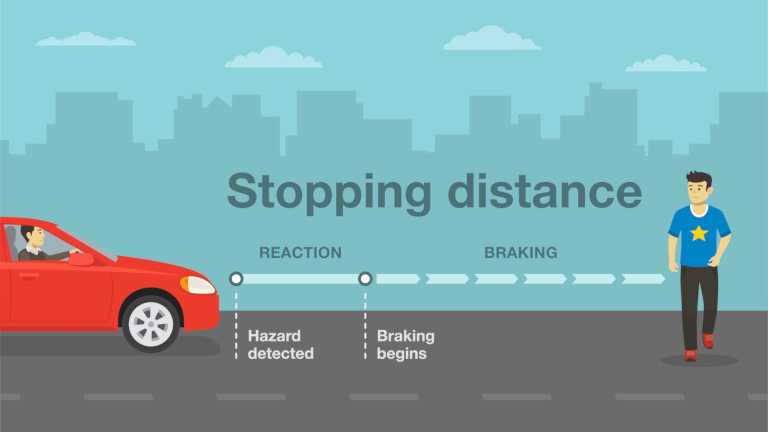
Think of it in the following way - stopping distance = ‘thinking distance’ + ‘braking distance’.
In that formula the 2 variables can be broken down as such:
- Thinking distance: how far you travel while your brain reacts and your foot moves.
- Braking distance: how far the car travels once the brakes are applied.
In terms of the mechanical, tyres dominate the braking distance of a car.
This is because they’re the only part of your vehicle that is in contact with the road.
So, factors that affect tyres can change the speed at which you stop.
Stopping Distances of Cars
When travelling on a dry, well-maintained road with good tyres, the Highway Code gives us these average stopping distances as a baseline:
| Speed
| Thinking distance
| Braking distance
| Total stopping distance
|
|---|
| Stopping distance 20 mph (32 km/h)
| 6 m
| 6 m
| 12 m
|
| Stopping distance 30 mph (48 km/h)
| 9 m
| 14 m
| 23 m
|
| Stopping distance 40 mph (64 km/h)
| 12 m
| 24 m
| 36 m
|
| Stopping distance 50 mph (80 km/h)
| 15 m
| 38 m
| 53 m
|
| Stopping distance 60 mph (96 km/h)
| 18 m
| 55 m
| 73 m
|
| Stopping distance 70 mph (112 km/h)
| 21 m
| 75 m
| 96 m
|
However, in wet conditions the braking distances can double. It gets even worst on ice. These conditions are capable of increasing the stopping disctance of a car by up to 10x the baseline.
This is all before you consider factors that affect the condition of the tyres. Such as the level of wear or the pressure they are running them at.
What Will Affect Your Vehicle's Stopping Distance
Tread depth (and water clearance)
One of the functions of a tyre’s tread pattern is to evacuate water. This is so the rubber can remain in contact with the road and reduce the risk of aquaplaning.
As the tyre’s tread wears down over time, water clearance falls and the tyre is at a higher risk of aquaplaning - when the tyre rides on a thin film of water.
This is a scary experience for any driver and lengthens the braking distance.
What changes with tyre wear?
For most tyres, the level of tread that a tyre has can affect the effectiveness of its performance. Below is a breakdown of how tread depth can affect braking.
| Tread depth (mm)
| Aquaplaning resistance
| Typical wet braking vs new
|
|---|
| 8 mm (new)
| Best
| Baseline (shortest)
|
| 4–5 mm
| Reduced water clearance
| +10–15% distance
|
| 3 mm
| Noticeably lower grip in heavy rain
| +20–30% distance
|
| 1.6 mm (legal min)
| High aquaplaning risk
| +35–50% distance (car and tyre dependent)
|
Quick checks
- Use a tread gauge (accurate) or the 20p test (the coin’s outer band should be obscured).
- Check all four tyres and multiple points across each tyre; inner shoulders often wear first if alignment is out.
Tyre pressure (contact patch shape)
The grip required when braking comes from the size and shape of the tyre’s contact patch (the area touching the road). A big factor in this is how evenly the load is shared across the tyre. The air pressure within a tyre changes the performance and effectiveness of the tyre in the following ways:
- Under-inflation: results in a bigger but distorted patch. Heat builds quicker, and stopping distances increase. Look out for increased edge wear.
- Over-inflation: results in a smaller patch, with the centre doing most of the work. This leads to reduced grip and longer stops. Expect wear in the centre of the tread.
| Condition
| What happens at the tyre
| Braking effect
| What to do
|
|---|
| -15% cold pressure
| Tread deforms, longer carcass flex
| Longer distance, vague feel
| Inflate to placard value
|
| Correct (placard)
| Even load across tread
| Shortest, most consistent
| Check monthly and before trips
|
| +15% cold pressure
| Smaller patch, less compliance
| Longer distance, harsher ride
| Bleed to placard value
|
When checking the air pressure of a tyre, measure when the tyre is cold.
Tyre age and heat cycles
Rubber hardens with time and heat. Even if tread remains, a 7–8-year-old tyre with good tread can still have reduced wet grip. To find out the age of your tyres, check the DOT date code (week/year). Many manufacturers advise replacement at 6–10 years regardless of tread if cracks or hardening are present.
Road, load and vehicle factors
- Surface: polished or oily tarmac lengthens braking. Gravel and standing water are worst case.
- Temperature: cold rubber can mean less grip, unless the tyre is designed for it – such as a winter tyre.
- Load: passengers/boot weight stretches stopping distance. Increase pressure if the handbook specifies a loaded/laden setting.
- Brakes & suspension: worn shocks let tyres “skip” under heavy braking; new pads/discs can’t overcome a poor contact patch.
Practical ways to shorten your stopping distance
Weekly to monthly (5–10 minutes)
- Pressures: set to the placard (front/rear, loaded/unloaded). Re-check after big temperature swings.
- Tread: inspect with a gauge to ensure the tread depth is appropriate and/or legal.
- Wear pattern: fix alignment if you see inner/outer edge wear or steering pull.
- Clean grooves: remove stones; clear sipes so they can cut through water.
- TPMS: treat a warning as urgent; confirm with a manual gauge.
Before heavy rain or winter
- Once a tyre hits the 3 mm tread depth – it is time to start planning your next set. The tyres will still be ok, but it gives you time to begin researching which set you want to buy next.
- For those in harsher climates, it’s a good idea to consider all-season or winter tyres. Especially if you regularly drive in sub-7°C conditions.
- Slow earlier and leave more space – even perfect tyres can’t beat physics on a greasy road.
How much difference can tyres make?
A simple example at 50 mph on wet asphalt:
- Car A on quality tyres at correct pressure, ~6–8 mm tread: stops in ~53 m (baseline wet factor).
- Car B on worn tyres at legal minimum (1.6 mm), slightly under-inflated: may need ~65–75 m or more.
That extra 12–22 metres is three to five car lengths – enough to turn a near miss into an impact.