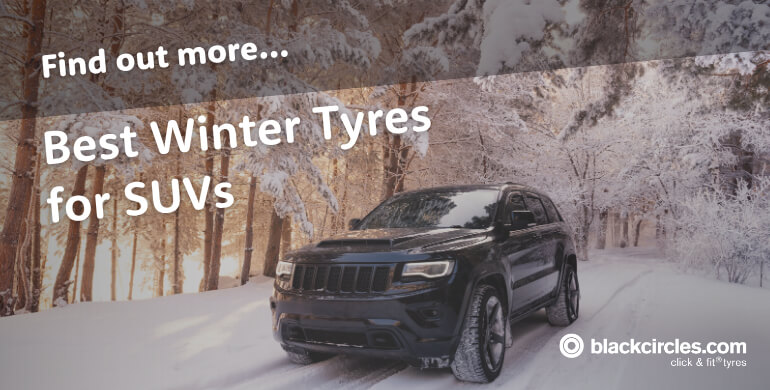
You may think that the stockier build, extra weight and higher centre of gravity that an SUV possesses would make winter weather easier to handle. You would be wrong.
Sure, all-wheel drive gets you moving from a slushy standstill, but that's no help when it comes to braking and cornering on icier, more unpredictable terrain with hardened rubber underneath you. Take into account the need for more grip, not less, when handling a heavier vehicle, and that assumption becomes all the slipperier.
No need to fret, though, as fitting the right tyre is more than enough to level the playing field – specifically, a dedicated winter tyre that doesn't freeze in the cold and can bite into the slush and snow with denser siping. That helps an SUV not only on wet and icy tarmac, but also on slush and snow, and the reinforced casing helps handle the extra weight without ballooning under the increased load.
That begs the question: what are the best winter tyres for your SUV? Our comprehensive guide covers the five best winter tyres for SUVs, the most common sizes from compact crossover to full-size 4x4, whether 4WD still needs winter rubber and how winter tyres compare to all-season for UK driving.
A-rated wet grip with noise-cancelling foam for a quieter cabin
C
A
71 dB
Note: EU tyre label ratings can vary depending on the exact tyre size and specification.
Common Winter SUV Tyre Sizes
Before choosing new tyres, confirm the correct size fitted to your vehicle. SUV fitments span a wider range than a typical family car, running from compact crossovers on 16-inch wheels through to full-size 4x4s on 20-inch alloys and beyond.
The most frequently used winter SUV tyre sizes include:
Compact and mid-size crossovers –
Qashqai,
Tiguan,
Sportage-sized SUVs – typically run 17- to 18-inch fitments. Larger 4x4s and premium SUVs move up to 19- or 20-inch wheels, where XL (Extra Load) construction becomes the norm rather than the exception.
Check your vehicle handbook, the sticker in the driver's door aperture or the tyre sidewall to confirm both the correct size and the minimum load index for your SUV before purchasing. A set specified below your vehicle's requirements will not carry its weight safely in winter conditions.
Do You Actually Need Winter Tyres If Your SUV Has 4WD?
Simply put: yes. All-wheel drive puts power down to get you moving, but it has no effect on how well your tyres grip the road when braking or cornering. Stopping safely matters far more than pulling away on an icy morning.
Below 7°C, a summer or all-season compound stiffens and loses grip regardless of how many wheels are driven. Independent testing consistently shows a 4WD SUV on winter tyres out-braking and out-cornering the same vehicle on summer rubber by a significant margin on cold, wet or icy tarmac. The drivetrain simply cannot compensate for a hard, unresponsive tyre compound.
4WD reduces the chance of getting stuck; winter tyres reduce the chance of a collision. For UK conditions, where wet and near-freezing roads are far more common than deep snow, the tyre matters more than the drivetrain.
Compact Crossover, Family SUV or Heavy 4x4? Why Your SUV's Job Changes the Tyre It Needs
Not every SUV needs the same tyre. Weight, wheel size and how the vehicle is actually used all shift the right choice before you look at brands.
For compact and family crossovers: refinement, fuel economy and wet grip matter most, since these vehicles rarely leave sealed roads. A premium touring winter tyre in standard specification covers most needs.
For larger, heavier SUVs and premium models on 19- to 20-inch wheels: XL (Extra Load) construction and a reinforced sidewall become important to carry the extra weight without excess flex, alongside strong wet braking for motorway-heavy use.
For genuine 4x4s and off-road-capable SUVs: a dedicated SUV pattern with a chunkier tread and reinforced shoulder blocks handles unsealed tracks and deeper snow better than a car-derived pattern simply badged for larger sizes.
If your SUV covers all three roles – school run, motorway commute and the odd green lane or farm track – a dedicated SUV winter pattern such as the
Dunlop Winter Sport 5 SUV or
Kumho WinterCraft WS71 SUV in this guide is the sensible middle ground.
The 5 Best Winter Tyres for SUV
Our five recommendations are led by what SUV drivers are actually buying, alongside independent test performance, spanning premium to mid-range budgets.
Continental WinterContact TS870 P
The
Continental WinterContact TS870 P is comfortably our best-selling winter tyre this season, and for SUV drivers it is the strongest all-round starting point.
In the 2024 Tyre Reviews SUV Winter Test it took first place overall, combining the lowest rolling resistance of any tyre in the field with excellent grip across dry, wet and snow – a rare combination, since low rolling resistance and strong grip usually trade off against each other. Independent testers have also rated it highly for stability, describing handling that feels close to a summer tyre on dry and wet roads while retaining full winter capability.
Its one relative weakness is ice grip, which trails the best specialists in this guide slightly. For UK driving – wet and cold far more often than genuinely icy – that trade-off rarely matters, and its blend of efficiency and all-round competence explains why it outsells every other winter tyre we stock.
Continental WinterContact TS870 P Tyre Label Ratings
Fuel Efficiency Rating: C
Wet Grip Rating: B
Noise Level Rating: 71 dB (Class B)
Continental WinterContact TS870 P Most Common Tyre Size
235/55 R19
Load Index & Speed Rating: 105V XL (Extra Load)
Goodyear UltraGrip Performance 3
The
Goodyear UltraGrip Performance 3 is our second best-selling winter tyre, and the one to reach for if wet grip is your priority over outright snow performance.
In the Tyre Reviews 2024/25 Best Performance Winter Tyres test, it finished third overall but was singled out as the wet-grip specialist of the group, recording the best wet braking of any tyre at both test temperatures alongside excellent wet handling. It also posted low rolling resistance and solid dry-road manners, with 3D BIS interlocking block technology helping stability on snow and ice.
Its one acknowledged weakness against the very best ice specialists is pure ice grip – a fair trade for a tyre that leads on the surface UK SUV drivers actually encounter most through winter: cold, standing water.
Goodyear UltraGrip Performance 3 Tyre Label Ratings
Fuel Efficiency Rating: B–C
Wet Grip Rating: B–C
Noise Level Rating: 70–72 dB (Class B)
Goodyear UltraGrip Performance 3 Most Common Tyre Size
235/55 R18
Load Index & Speed Rating: 104H XL (Extra Load)
Dunlop Winter Sport 5 SUV
The
Dunlop Winter Sport 5 SUV is a dedicated SUV pattern rather than a car tyre offered in larger sizes, and it shows in independent SUV-specific testing.
It won ADAC's 2022 SUV and minivan winter tyre test outright. It continues to place well in SUV-focused comparisons, with particular strength on dry roads and good wet performance. Owners consistently praise its composure on higher-mileage motorway and country-road use, with a smaller number noting only slight weaknesses on deep snow next to specialists.
Its 10% improvement in lateral ice grip and fuel efficiency over its SP Winter Sport 4D predecessor also makes it a sensible pick for SUV drivers who want tyre-specific engineering for their vehicle's weight and geometry, rather than a passenger-car tyre simply built up to a larger size.
Dunlop Winter Sport 5 SUV Tyre Label Ratings
Fuel Efficiency Rating: C
Wet Grip Rating: B
Noise Level Rating: 72 dB (Class B)
Dunlop Winter Sport 5 SUV Most Common Tyre Size
235/60 R18
Load Index & Speed Rating: 107H XL (Extra Load)
Kumho WinterCraft WS71 SUV
The
Kumho WinterCraft WS71 SUV is the pick for drivers who want SUV-specific engineering without paying premium prices.
It uses an asymmetric tread pattern purpose-built for SUVs and crossovers. Newly designed 3D sipes are said to improve torsional stiffness by up to 30% for more biting edges on snow and ice, alongside wide grooves for slush and standing-water evacuation. Owners consistently highlight confident wet and off-road grip, good side stability when driving on soft ground, and a quiet, comfortable ride for the price point.
As with any budget-to-mid-range tyre, it trades some fuel efficiency and outright snow pace against the premium options in this guide, but it remains a genuinely capable, purpose-built SUV winter tyre rather than a compromise.
Kumho WinterCraft WS71 SUV Tyre Label Ratings
Fuel Efficiency Rating: D–E
Wet Grip Rating: C
Noise Level Rating: 72 dB (Class B)
Kumho WinterCraft WS71 SUV Most Common Tyre Size
235/60 R18
Load Index & Speed Rating: 107V XL (Extra Load)
Pirelli Scorpion Winter 2
The
Pirelli Scorpion Winter 2 is the pick for SUV drivers who want a genuinely quiet, comfortable cabin without giving up wet-weather safety.
It is a snow-dynamics specialist first, with owners and testers praising strong side grip on snow and confident handling in sudden avoidance manoeuvres, plus fast, composed wet handling. Pirelli's Noise Cancelling System (PNCS) – a sound-absorbing layer bonded to the inner tyre wall – makes it one of the quietest winter tyres available for larger, premium SUVs, producing only a small amount more road noise than a premium all-season tyre in most conditions.
Its main compromise is on dry roads, where testers note it gives up some ground to more dry-focused rivals, and its rolling resistance is on the higher side – a reasonable trade for buyers prioritising snow security and cabin refinement over outright efficiency.
Pirelli Scorpion Winter 2 Tyre Label Ratings
Fuel Efficiency Rating: C
Wet Grip Rating: A
Noise Level Rating: 71 dB (Class B)
Pirelli Scorpion Winter 2 Most Common Tyre Size
255/50 R19
Load Index & Speed Rating: 107V XL (Extra Load)
Best Winter SUV Tyre for Each Priority
If you are shopping with one particular priority in mind, this is how the five compare:
Best all-rounder: Continental WinterContact TS870 P – our best-seller, and the lowest rolling resistance on test
Best for wet UK roads: Goodyear UltraGrip Performance 3 for braking and handling, Pirelli Scorpion Winter 2 for an A-rated wet grip label
Best dedicated SUV pattern: Dunlop Winter Sport 5 SUV – an outright ADAC SUV test winner
Best value SUV-specific tyre: Kumho WinterCraft WS71 SUV – purpose-built for SUVs at a mid-range price
Quietest for a premium SUV: Pirelli Scorpion Winter 2, with Pirelli's noise-cancelling foam
Most fuel efficient: Continental WinterContact TS870 P and Goodyear UltraGrip Performance 3, both commonly B–C rated
Best for snow and ice: Continental WinterContact TS870 P and Dunlop Winter Sport 5 SUV lead on independent snow testing among these five
Other Winter SUV Tyres Worth Considering
There are a few additional picks for your SUV during the winter that are well worth highlighting:
Michelin Pilot Alpin 5 SUV: a genuine snow specialist and 2023 Autobild winter test winner, with the strongest outright snow traction of any tyre we researched for this guide – the natural upgrade if deep snow, not just wet and cold, is a regular part of your winter
Bridgestone Blizzak LM005: the first winter tyre to achieve an A-rated wet grip label across its full range, and a strong wet-weather alternative to the Pirelli if your priority is rain and slush over snow
Yokohama BluEarth Winter V906: a strong-selling mid-range choice for SUV drivers after solid all-round performance without stepping up to premium pricing
Vredestein Wintrac Pro: a European-engineered premium alternative worth cross-shopping against the Continental and Goodyear above
Falken Eurowinter HS02 PRO: a well-regarded mid-range option, particularly for drivers who have run Falken all-season or summer tyres previously
Each of these ranges is stocked at Blackcircles.com, though availability varies by size, so it is worth searching your own tyre size directly to see which of them come up.
Is It Worth Paying More for a Premium Winter SUV Tyre?
Premium tyres generally justify their price through longer tread life, lower rolling resistance and wet braking that stays more consistent as the tyre wears – genuinely valuable on a heavier SUV covering serious winter mileage.
That said, the gap has narrowed. A well-engineered mid-range, SUV-specific pattern like the Kumho WinterCraft WS71 SUV delivers real winter security at a lower price. If your annual mileage is modest or your SUV is a second car for occasional bad-weather use, the value case for mid-range is strong. Where a premium tyre earns its price is on a daily-driven, higher-mileage SUV, where the efficiency and longevity gains compound over a full winter season.
When Should You Fit and Remove Winter Tyres in the UK?
Winter tyres are worth fitting once average daily temperatures fall consistently below 7°C, typically late October to November across most of the UK. They should come off again once temperatures rise consistently above that mark in spring, usually around March or April.
Running winter tyres year-round is a false economy on an SUV: above 7°C, the softer compound wears noticeably faster, grip on warm dry roads suffers, and fuel consumption rises. A seasonal swap, stored properly over the off-season, gets the best out of both sets and protects your investment in the tyre.
Other signs it is time to replace rather than simply refit your winter set include:
Tread depth below 3 mm – winter tyres lose effectiveness well before the legal 1.6 mm minimum, and a heavier SUV needs that extra margin
Tyres more than five to six years old, even with tread remaining – the compound hardens with age regardless of mileage
Visible cracks, bulges or splits, particularly after a summer spent stored rather than fitted
Increased road noise, vibration or longer stopping distances versus previous winters
Regular pressure checks – set for how loaded the SUV actually is, roof box and all – and an occasional alignment check will keep your winter set safe and efficient for its full seasonal life.
Which Winter Tyres Should I Choose for My SUV?
As you can see, there is plenty of choice when finding the best winter tyres for your SUV – but the right answer depends on how your SUV is used and how much of your winter mileage happens on wet, cold roads versus genuine snow.
For most UK SUV drivers, our best-selling Continental WinterContact TS870 P is the strongest starting point: low rolling resistance and genuine all-round grip with no major weakness. If wet-weather safety is your priority, the Goodyear UltraGrip Performance 3 or Pirelli Scorpion Winter 2 lead the way; if you want a tyre purpose-built for SUV weight and geometry at a lower price, the Kumho WinterCraft WS71 SUV is the one our customers choose most.
Whichever route you take, check the load index against your SUV's handbook before you order. Get that right and everything else is preference – less time deliberating, and more time driving safely through winter.
Need new winter SUV tyres?
Enter your registration and postcode and we’ll show you the best winter tyres for your SUV
Do I need winter tyres if my SUV has four-wheel drive?
Yes. Four-wheel drive helps you pull away, but it has no effect on braking or cornering grip, which is what stops accidents. Below 7°C, a summer or all-season tyre hardens and loses grip regardless of how many wheels are driven, so a 2WD car on winter tyres will typically out-brake a 4WD SUV on summer rubber on a cold, wet road.
Which winter tyres perform best on wet UK roads for a heavy SUV?
The Pirelli Scorpion Winter 2 and Bridgestone Blizzak LM005 both carry an A-rated wet grip label, with the Goodyear UltraGrip Performance 3 close behind and rated by independent testers as a genuine wet-braking specialist. All three are strong choices if wet weather, rather than deep snow, dominates your winter driving.
Are Michelin Pilot Alpin 5 SUV tyres worth the extra cost?
If deep snow is a regular part of your winter, yes – it is one of the strongest snow performers available, having won the 2023 Autobild winter tyre test outright for SUVs. For UK drivers whose winters are mostly wet and cold rather than genuinely snowy, our best-selling Continental WinterContact TS870 P delivers comparable all-round security at a more competitive price.
Is it better to get a Goodyear or a Bridgestone for a 4x4 in cold weather?
Both are strong choices, and the right pick depends on conditions. The Bridgestone Blizzak LM005 carries an A-rated wet grip label across its full range. The Goodyear UltraGrip Performance 3 was independently rated the best wet-braking tyre in a recent group test, alongside strong snow performance. If your 4x4 sees more standing water than snow, either is a safe choice; the Goodyear edges it slightly on outright wet handling.
Are all-season tyres good enough for an SUV, or do I need dedicated winter tyres?
A 3PMSF-certified all-season tyre is a reasonable compromise for SUV drivers who see only occasional cold snaps and want to avoid a seasonal changeover. However, a dedicated winter tyre will outperform an all-season tyre in genuinely cold, wet or icy conditions. This is because its compound and tread are optimised specifically for temperatures below 7°C rather than a year-round balance.
Why do winter tyres wear out faster on heavy SUVs during a mild winter?
Winter tyre compounds are designed to stay soft below 7°C. If temperatures stay mild, that softer rubber wears considerably faster than it would in proper cold weather – and the extra weight of an SUV accelerates this further. If a UK winter turns out mild, it is still worth removing winter tyres once temperatures rise consistently, rather than leaving them on to save a changeover.
What is the quietest winter tyre available for a large SUV?
The Pirelli Scorpion Winter 2 is a standout for cabin refinement, using Pirelli's Noise Cancelling System – a sound-absorbing layer inside the tyre – to keep road noise close to that of a premium all-season tyre. The Continental WinterContact TS870 P and Goodyear UltraGrip Performance 3 are also competitive at 70–72 dB depending on size.
Which Kumho or other budget winter tyres offer the best value for an SUV?
The Kumho WinterCraft WS71 SUV is our best-selling dedicated SUV winter tyre and offers genuine SUV-specific engineering – an asymmetric tread and reinforced 3D sipes – at a meaningfully lower price than the premium options in this guide. The trade-off is a lower fuel efficiency rating and somewhat higher road noise, but for moderate annual mileage it remains a capable, purpose-built choice rather than a compromise.
When should I fit winter tyres to my SUV, and when should I remove them?
Fit winter tyres once average daily temperatures fall consistently below 7°C, typically late October to November in the UK, and remove them again once temperatures rise consistently above that mark, usually around March or April. Running winter tyres through warmer months increases wear and fuel consumption without any grip benefit.
PayPal Credit and PayPal Pay in 3 are trading names of PayPal UK Ltd, 5 Fleet Place, London, United Kingdom, EC4M 7RD. Terms and conditions apply. Credit subject to status and approval, 18+ UK residents only. PayPal Credit and PayPal Pay in 3 are a form of credit, so carefully consider whether the purchase is affordable and how you will make the repayments. PayPal Pay in 3 is a credit agreement. See product terms for more details and FAQs. Learn more about PayPal Credit.Learn more about PayPal Pay in 3.