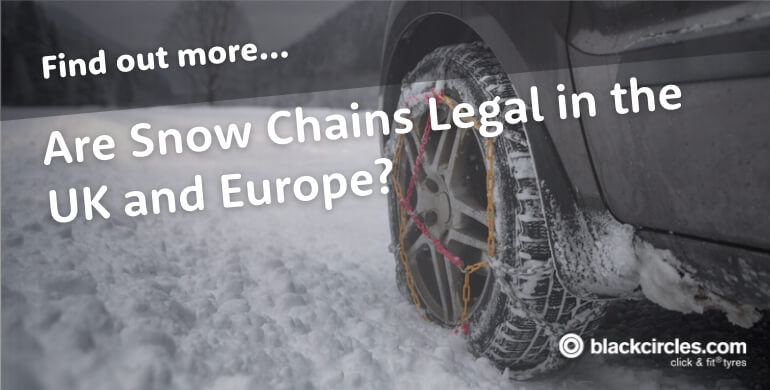
The short answer: snow chains are legal in the UK, though very few drivers here will ever need them.
In parts of Europe, they're compulsory. What changes from country to country is when you can use them. Or, when you have to carry them. There is also the question of whether winter tyres count instead. Most of the time – you will need to keep a close eye on the road signs to understand what the rules are in the region you are in.
But, let’s start with the UK. And, if you're still weighing up your tyres for the season, our guide to the
3PMSF symbol explains which tyres are rated for snow.
Are snow chains legal in the UK?
Yes. There's no UK law that requires snow chains, and conversely, none that bans them.
The
Highway Code's rules on driving in adverse weather don't mention chains or winter tyres.
Instead, they advise against driving in ice and snow unless your journey is essential. The main point of consideration is on stopping distances – and how this can be ten times greater than on a dry road.
The catch of snow chains in the UK is where you use them.
Chains are designed to bite into compacted snow and ice. On tarmac, the metal links grind against the road. This can damage both the road surface and the chains. So, the practical rule in the UK is simple: if required, fit them when the road is properly covered in snow. Then take them off as soon as you reach a cleared or gritted stretch.
It’s very important to point out though that in practice it's incredibly rare to need chains on UK roads.
Most main roads are gritted, and in most winters the snow doesn't lie deep enough. Or for long enough.
Where they can earn a place in the boot is off the beaten track - private roads, farm tracks and remote country lanes that gritters don't reach. Places such as the Scottish Highlands or the Peak District. For drivers in Scotland, we've recently looked at
whether winter tyres are worth it in more detail.
If the snow is deep enough that you'd need chains to get moving, our advice is not to drive at all unless it's an emergency.
Chains help your car grip, but they don't change how other vehicles behave on the same road. If you do get stuck, help can take far longer to reach you.
Snow chain rules in Europe by country
Across most of Europe, chains are legal on snow and ice. They can also be compulsory where a road sign or the local authority dictates.
Mountain countries go further. Several require winter equipment for a set part of the year, and some expect you to carry chains even if the road looks clear.
The table below is based on the German consumer centre
EVZ's guide to winter driving rules in Europe, with Austria checked against the
Austrian transport ministry.
Please note: rules do change, so check the official source for each country you'll drive through before you leave.
| Country
| Snow chain rules
| Winter equipment period
|
|---|
| France
| In signed mountain areas, you need four 3PMSF winter or all-season tyres. Or chains or approved snow socks. There is a Fine of €135.
| 1 November to 31 March
|
| Austria
| Chains can replace winter tyres only where the road is almost always under snow or ice, fitted to at least two drive wheels. Fine of €35, or up to €5,000 if others are endangered
| 1 November to 15 April, in wintry conditions
|
| Switzerland
| Compulsory where signs order them. Approved snow socks accepted. Fine of CHF 100
| No fixed period
|
| Italy
| Signs can require winter tyres, or chains or approved socks carried on board. Rules vary by region.
| Usually 15 November to 15 April (from 15 October in the Aosta Valley)
|
| Germany
| Compulsory where sign 268 is shown, on the driven wheels. Approved socks accepted
| Winter tyres required in snow, slush and ice, with no fixed dates
|
| Slovenia
| Summer tyres (3mm or more) are allowed only with chains or approved socks carried in the boot
| 15 November to 15 March
|
| Croatia
| Summer tyres (4mm or more) are allowed only with chains or approved socks in the boot. Fine of around €130
| 15 November to 15 April
|
| Norway
| Chains or snow socks can be used when needed.
| Studded tyre season roughly November to Easter
|
The French rules, known as the Loi Montagne, are worth a closer look – due to the fact that many UK drivers head to the Alps each year.
They apply in the mountain areas of named départements, marked by signs at the start and end of each zone.
Since 1 November 2024, only tyres with the 3PMSF symbol count as winter tyres. Therefore, if your tyre only has the symbol M+S, this does not count.
What does the snow chain sign look like?
Across most of Europe, the sign that makes chains compulsory is round, with a blue background and a white drawing of a tyre wrapped in chains.
In Germany it's
sign 268, and similar designs are used in Austria, Switzerland, France and Italy. Past that sign, you can only carry on with chains fitted.
It often comes with a panel underneath, either a distance or a word such as "obligatoire" or "obbligo", and an end-of-zone version with a red diagonal line.
Snow chains vs winter tyres vs snow socks
The main thing to point out is that although they all try to tackle similar issues, each does so in a different way.
Winter tyres. These tyres use a softer rubber that stays flexible below about 7°C. They also feature deep grooves and thousands of small sipes that grip snow and slush. They work on every road surface, dry or snowy, so you can leave them on for the whole season. Look for the 3PMSF symbol, the mountain with a snowflake inside. Many all-season tyres carry thus symbol too - which is why they count as winter equipment in France.
Snow chains. These give a lot of traction on deep or packed snow and ice. But only on those surfaces. They're slow to fit the first time and limit your speed to around 50km/h (30mph) at most. They need to be removed from your tyres when you reach clear roads.
Snow socks. Similar in nature to snows chains, these are fabric covers that slip over the tyre. They're lighter and quicker to fit. However, they wear through fast on tarmac and don't grip as well on ice. Several countries, including France, Germany and Switzerland, accept approved socks in place of chains.
In reality, when driving during a UK winter a set of winter or 3PMSF all-season tyres covers most of what you'll ever need.
Snow chain: FAQs
Do I need snow chains to drive in the UK?
No. There's no legal requirement to carry or fit snow chains anywhere in the UK. It's rare to need them at all. They're most useful on private roads and remote country lanes that don't get gritted.
Can I drive on a clear road with snow chains on?
No. Chains on bare tarmac can damage the road and wear the chains out quickly. Take them off as soon as you reach a cleared or gritted road.
Do I need snow chains to drive to the Alps?
It depends on the country and the road. France, Italy, Slovenia and Croatia can all require winter tyres or chains carried on board in winter. Carrying a set is the simplest way to stay legal.
Are snow socks legal in Europe?
Approved snow socks are accepted as an alternative to chains in several countries, including France, Germany, Spain and Switzerland.
Can I use winter tyres instead of snow chains in France?
Yes, in the Loi Montagne areas, four tyres with the 3PMSF symbol meet the rules from 1 November to 31 March.
How fast can you drive with snow chains on?
Most chains are limited to 50km/h, about 30mph, and Germany sets that as the legal maximum.