



![System.Func`2[BlackCircles.Interfaces.IECommerceModuleData,System.String]](https://images.blackcircles.com/search/feature-ev.svg)
Michelin Pilot Sport 5
Giving you sports performance designed to last, the Michelin Pilot Sport 5 allows you to enjoy each moment.
Price from
Find your size119.99to339.99
...searching


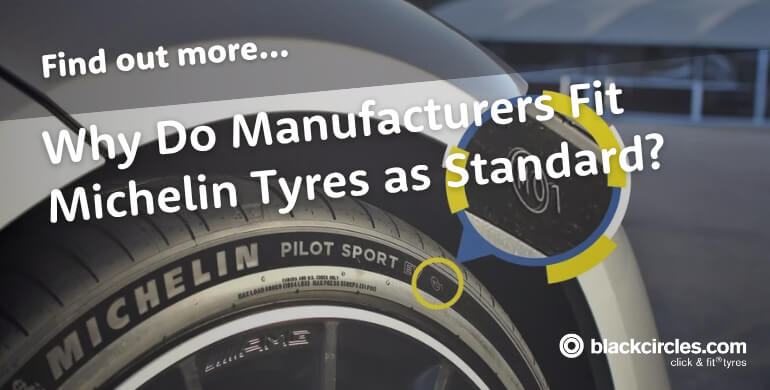
Car manufacturers fit Michelin tyres as standard when Michelin has developed a tyre specifically for the vehicle and the manufacturer has approved it through a process called homologation.
The approved tyre may be tuned for the car’s braking, steering, ride comfort, efficiency, noise levels, weight and power delivery. It normally carries a manufacturer-specific marking on its sidewall, such as MO for Mercedes-Benz, a star for BMW or T0 for Tesla.
In many cases, drivers can legally fit a suitable non-OE tyre that meets the vehicle’s required size, load index and speed rating.
However, an approved OE version may preserve the handling, refinement, efficiency or acoustic performance developed for the vehicle.
Drivers should check the vehicle handbook, manufacturer guidance, insurer requirements and the advice of a qualified tyre fitter before changing specification.
The term that you may see banded around when it comes to OE fitments by drivers is "standard fit." The term that the motoring industry uses is homologation.
Homologation means a tyre model has been formally developed for a particular vehicle and approved by that vehicle's manufacturer.
Each manufacturer sets its own criteria. These criteria exist to deliver a solution to specific engineering problems that a vehicle may present. A city runabout, a 2.5-tonne electric SUV and a rear-drive performance saloon all pose completely different questions - in terms of what is needed from a tyre to get the best out of them.
The process of developing an OE tyre is slower than you might think. From initial design, through testing, through adjustment, to final sign-off, homologation can take up to three years.
The tyre manufacturer begins with a prototype and repeatedly adjusts its compound, construction and tread design until it meets the vehicle manufacturer’s targets.
That's why the tyre on a new car is rarely a generic, off-the-shelf product. It's frequently a version of a familiar tyre line with a different compound, a different internal construction, sometimes different noise-reduction technology.
When a manufacturer sits down with a tyre engineer they come up with a list of targets they need the tyre to meet:
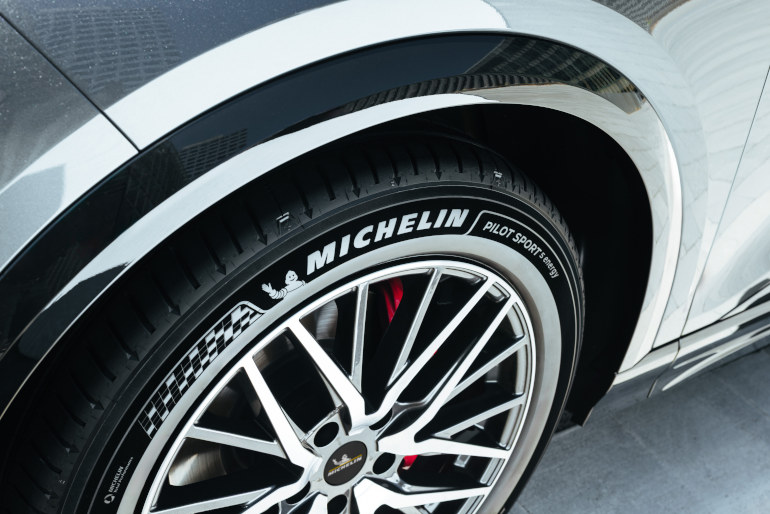
Michelin have worked with a lot of manufacturers over the years to develop OE tyres for some of the most popular cars on the market.
There are three main reasons why Michelin is such a popular tyre partner.
It's worth noting that Michelin is not the only tyre manufacturer that does this. Other brands such as Goodyear, Continental, Bridgestone and Pirelli also run substantial OE programmes.

The marking sits near the size, usually as one to three characters. Here's what the common ones mean.
| Marking | Vehicle manufacturer |
|---|---|
| MO | Mercedes-Benz |
| MO1, MO2, MO1A | Mercedes-AMG |
| AO | Audi |
| RO1, RO2 | Audi Sport (RS, R8) |
| ★ (star) | BMW |
| N0, N1, N2 (older) / NA0–NG0 (current) | Porsche |
| T0, T1, T2 | Tesla |
| K1, K2 | Ferrari |
| J, JLR, JRS | Jaguar Land Rover |
| POL | Polestar |
| GOE | Genesis |
| AM, AMV | Aston Martin |
| VOL | Volvo |
Porsche used to number its approvals by revision.
N0 was the first approved version of a tyre, N1 the next, N2 after that - and so on.
As the model range grew, sizes started to overlap between different cars, so a code that only told you which revision you had wasn't specific enough.
The current system uses a letter for the model family instead.
| Marking | Porsche model |
|---|---|
| NA0, NA1, NA2 | 911 |
| NB0 | 718 Boxster / 718 Cayman |
| NC0, NC1 | Cayenne |
| ND0, ND1 | Panamera |
| NE0 | Macan Electric |
| NF0, NF1 | Taycan |
| NG0 | Cayenne Electric |
If you're replacing a discontinued specification, Porsche's guidance is to move all four tyres to a higher-numbered specification appropriate for the car rather than mix codes across axles.
Some sidewall markings describe what the tyre does rather than who approved it, and a few are easy to mistake for approval codes.
If your car came on Michelin and you're deciding whether to stay with it, the relevant question isn't "is Michelin good" - it's which Michelin, and whether it still matches what you need from the car.





![System.Func`2[BlackCircles.Interfaces.IECommerceModuleData,System.String]](https://images.blackcircles.com/search/feature-all-season.svg)

| Michelin model | Typical OE markings | Where it appears as OE |
|---|---|---|
| Pilot Sport 5 | ★ (BMW), MO, AO | Performance saloons, hot hatches |
| Pilot Sport 4 S | NA0 (911), MO1, K1, ★ | Premium performance, track-capable |
| Pilot Sport 4 SUV | MO, AO, JLR | Premium SUVs |
| Primacy 5 | MO, AO, VOL | Saloons, estates, SUVs, some EVs |
| e.Primacy | T0/T1, POL, GOE | Tesla, Polestar, Genesis |
| Pilot Sport EV | T# (Tesla), GOE (Genesis), J (Jaguar), POL (Polestar), MO# (Mercedes), NE0 (Macan Electric) | Performance EVs |
Choosing the same approved Michelin tyre can help preserve the characteristics the vehicle manufacturer tested, including steering response, ride comfort, efficiency and cabin noise.
This can be particularly relevant for high-performance vehicles, electric cars, run-flat applications and models fitted with acoustic tyres.
A different tyre may still be appropriate when your driving needs have changed.
For example, a driver prioritising year-round usability may prefer an all-season tyre over the original summer tyre. The replacement must still meet the required dimensions, load rating, speed rating and other vehicle-specific requirements.
No. OE fitment is an engineering approval process, not an advertising placement. The tyre is developed against the manufacturer's brief and has to pass its validation testing before it can be fitted at the factory. Commercial terms exist between the two businesses, as they do with any supplier, but a tyre that fails validation doesn't get fitted regardless of price.
No. An OE marking is not a legal requirement. A tyre of the correct size, load index and speed rating is road legal and will pass an MOT. You must not fit a lower load index or speed rating than the vehicle manufacturer specifies, and tyres on the same axle must match in size and construction.
Fitting a correctly specified non-OE tyre does not in itself void either. Changing tyre size from the original specification is different - the British Tyre Manufacturers' Association recommends you notify your insurer and get their agreement, or your cover may be affected. If your car is leased or on PCP, check the contract, as some specify OE replacement.
Because they were optimised for the manufacturer's brief rather than for tread life. On performance cars in particular, that brief prioritises grip and steering response, both of which trade against longevity. It's a design decision, not a fault - and it's specific to the OE specification rather than to the tyre range it came from.
Usually yes, reflecting the additional vehicle-specific development and the separate production specification. Across our catalogue the OE-marked version of a line sells for around more than the non-marked equivalent in the same size.
Check the sidewall of your current tyres for a marking near the size, then cross-reference the door placard or the handbook, which lists the specified sizes, load indices and speed ratings. Bear in mind that if the car has changed hands, the tyres on it now may not be what left the factory.
Yes. Going above the specified speed rating is permitted. Going below it isn't.
An OE marking tells you which manufacturer approved the tyre for a specific vehicle. A technology marking tells you what the tyre does - run-flat construction, acoustic foam, reinforced sidewalls. They can appear together on the same sidewall, and a few markings do both jobs at once, such as Mercedes MOE.
It depends on the vehicle. Michelin holds approvals across a wide range of manufacturers, but so do Goodyear, Continental, Bridgestone and Pirelli, and any given model may have been homologated on one, several or none of them. The reliable way to check is by registration or tyre size, which returns the fitments actually approved and available for your vehicle.

We love to hear from our customers. Connect with us today and let’s start a conversation.
