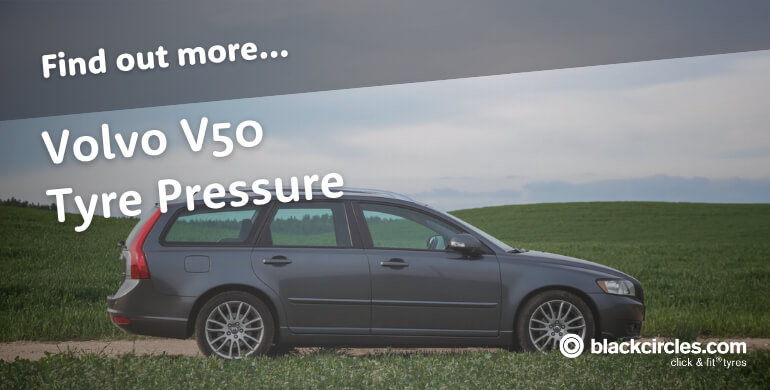
The
Volvo V50 is a compact executive estate car produced between 2004 and 2012. Known for its distinctive Scandinavian styling, class-leading safety features and practical family layout, it remains a popular choice on the used car market.
Depending on the model year and engine specification, the Volvo V50 is fitted with tyre sizes ranging from
15-inch to
18-inch alloy wheels.
Because tyre pressures fluctuate depending on the tyre size, load weight and driving speed, maintaining the correct inflation level is essential for your safety, vehicle handling and tyre longevity.
List of Volvo V50 Tyre Pressures
Below are the standard tyre pressure specifications based on manufacturer data. These values apply broadly to Volvo V50 models from around 2004 to 2012.
However, always ensure you check them against your specific model and trim. This information should be available on a sticker inside your car's door pillar. Alternatively, it may be listed in your vehicle’s handbook.
Tyre Pressure Specifications for Volvo V50
| Tyre Size
| Normal Load (Front)
| Normal Load (Rear)
| Maximum Load (Front)
| Maximum Load (Rear)
|
|---|
| 195/65 R15 | 210 kPa (2.1 bar / 30 psi)
| 210 kPa (2.1 bar / 30 psi)
| 250 kPa (2.5 bar / 36 psi)
| 250 kPa (2.5 bar / 36 psi)
|
| 205/55 R16 | 210 kPa (2.1 bar / 30 psi)
| 210 kPa (2.1 bar / 30 psi)
| 250 kPa (2.5 bar / 36 psi)
| 250 kPa (2.5 bar / 36 psi)
|
| 205/50 R17 (XL) | 220 kPa (2.2 bar / 32 psi)
| 220 kPa (2.2 bar / 32 psi)
| 250 kPa (2.5 bar / 36 psi)
| 250 kPa (2.5 bar / 36 psi)
|
| 215/45 R18 (XL) | 220 kPa (2.2 bar / 32 psi)
| 220 kPa (2.2 bar / 32 psi)
| 250 kPa (2.5 bar / 36 psi)
| 250 kPa (2.5 bar / 36 psi)
|
[Source:
Volvo V50 Owner’s Manual]
Disclaimer: The information provided in this article is intended for reference purposes only. Tyre pressures can vary depending on wheel size, trim level, load and driving conditions. Always refer to your vehicle’s official handbook or consult Volvo directly for the most accurate specifications. We accept no responsibility for any discrepancies or incorrect use of this information.
Regular Tyre Pressure Checks
Maintaining the correct tyre pressure is essential for safe and efficient driving.
If your tyres are under-inflated, this can lead to increased fuel consumption and uneven tyre wear. Over-inflated tyres, on the other hand, may reduce grip and comfort while increasing stopping distances.
It is recommended that you check your tyre pressures at least once a month – and especially before any long journeys. Always measure pressures when the tyres are cold, as readings can increase once they have warmed up through driving.
Book a Volvo MOT Online with Blackcircles.com
Keeping your Volvo V50 roadworthy is just as important as maintaining correct tyre pressures.
Book your MOT online with Blackcircles.com for a simple and convenient way to stay compliant and safe on the road.
Frequently Asked Questions
Where is the tyre pressure sticker on a Volvo V50?
You can find the official tyre pressure specification sticker on the driver’s side door pillar (B-pillar). It is fully visible on the metal frame once you open the driver’s door. This sticker lists correct pressures in both PSI and Bar (or kPa) based on tyre dimensions and loading conditions.
What is the ‘ECO pressure’ setting on a Volvo V50?
The ECO setting is a manufacturer-approved inflation pressure of 36 PSI (2.5 Bar) for lower-load scenarios. Volvo engineers determined this configuration minimises tyre rolling resistance to improve fuel efficiency and lower CO2 emissions, though it may result in a slightly firmer ride quality compared to the standard ‘comfort’ settings.
Does the Volvo V50 have a Tyre Pressure Monitoring System (TPMS)?
Whether a V50 has TPMS depends on the model year and trim level. Later facelift models (predominantly 2007–2012) were available with a factory-fitted TPMS that monitors air pressure and alerts the driver via a yellow warning symbol on the dashboard display if a sudden drop occurs. Earlier models typically required manual pressure gauge tracking.