
Join the conversation
We love to hear from our customers. Connect with us today and let’s start a conversation.
...searching


Buying a second-hand car can be one of the most cost-effective ways to get on the road, but it can also carry risks. Unlike buying new, second-hand buyers may be dealing with older vehicles, unknown repair histories, hidden faults or issues that aren't immediately obvious during a viewing.
The UK used car market remains huge. SMMT figures show that the UK used car market grew by 2.2% in 2025, reaching 7.8 million transactions.
But with millions of used cars changing hands each year, how many buyers are carrying out the checks that could help them avoid unexpected costs?
To find out, Blackcircles.com surveyed UK adults who had bought a second-hand car, asking what they checked before buying, how confident they felt, where they bought their vehicle and whether they later faced unexpected repair costs.
To show why these checks matter, the report also analyses official DVSA MOT data to reveal the faults buyers risk overlooking. This includes how MOT failure rates vary by vehicle age, postcode area and make/model, as well as the most common MOT failure categories for cars and light vehicles.
The survey shows how buyers may be leaving themselves exposed before purchase. While many are checking the visible signs, fewer are carrying out checks that could flag wider history, safety or maintenance issues.
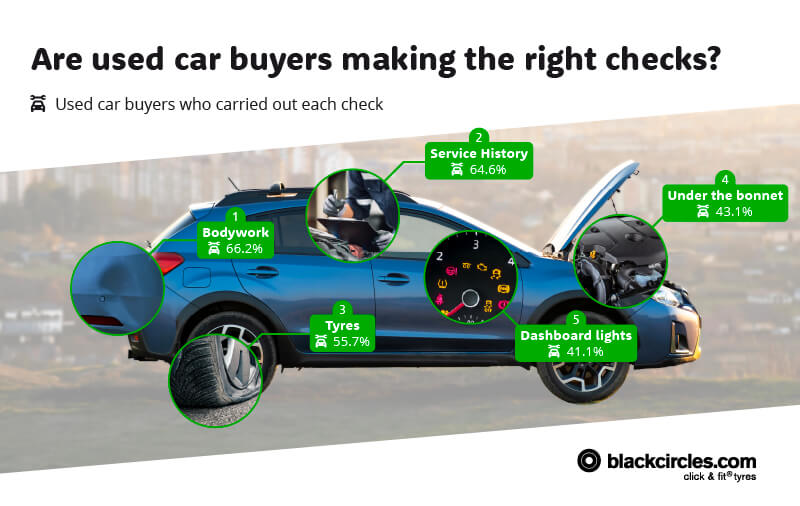
When used car buyers were asked which checks they carried out before buying their most recent second-hand car, bodywork was the most common, selected by around two-thirds of respondents (66.2%). This was followed by service history, checked by almost two-thirds (64.6%), and tyres, checked by just over half (55.7%).
Tyres were checked by 55.7% of buyers, while fewer than half checked under the bonnet (43.1%) or dashboard lights (41.1%).
Only 28.1% reported doing an HPI check, making it one of the least common checks included in the survey.
Seven in 10 used car buyers (70.8%) said they checked the vehicle's MOT history before buying. However, 14.8% said they didn't, while a further 14.4% weren't sure or couldn't remember. Combined, this means almost three in ten buyers either skipped the check or were unsure whether it had been carried out.
“A vehicle's MOT history can tell buyers a lot before they commit, from previous failures and recurring advisories to mileage records. Buyers should also check when the next MOT is due, as a car with an MOT expiring soon may need further work shortly after purchase.
“If the MOT is due soon, arranging a fresh test or asking the seller to complete one before purchasing can give buyers a clearer picture of the vehicle's condition. Buyers can also book an MOT to make sure the vehicle meets road safety and environmental standards.”
John Paterson, Head of Network at Blackircles.com
Many buyers also missed tyre checks. Just over half (56.9%) said they checked the tyre tread depth and condition before buying their most recent second-hand car. Meanwhile, 27.3% said they didn't check the tyres, and 15.7% weren't sure or couldn't remember.
Combined, this means more than two in five used car buyers (43.1%) either didn't check or couldn't remember checking the tyre tread depth and condition.
| Tyre tread and condition check | Used car buyers |
|---|---|
| Yes, checked | 56.9% |
| No, didn't check | 27.3% |
| Not sure / can't remember | 15.7% |
Just over one in five used car buyers (22.4%) said they felt very confident about what to check before buying a second-hand car. More than half (52%) said they felt somewhat confident, while around one in four (25.6%) said they were not at all confident.
| Confidence level | Used car buyers |
|---|---|
| Very confident | 22.4% |
| Somewhat confident | 52.0% |
| Not at all confident | 25.6% |
Women were more likely than men to say they weren't at all confident. Almost three in ten women (29.8%) said they weren't at all confident knowing what to check, compared with 19.9% of men.
Tyre checks also differed sharply by gender. Around two-thirds of men (67.1%) said they checked tyre tread depth and condition before buying their most recent second-hand car, compared with around half of women (49.2%).
| Gender | Checked tyre tread depth and condition |
|---|---|
| Men | 67.1% |
| Women | 49.2% |
Age also appears to play a role. Buyers aged 65+ were the least likely to say they checked the vehicle's MOT history before buying, with 60.5% saying they did so. This compares with 79.4% of those aged 35-44.
Older buyers were also more likely to lack confidence. Around one in three buyers aged 65+ (32.7%) said they weren't at all confident knowing what to check before buying a second-hand car, compared with around one in seven of those aged 25-34 (13.8%).
| Age group | Not at all confident knowing what to check |
|---|---|
| 25 - 34 | 13.8% |
| 35 - 44 | 17.4% |
| 45 - 54 | 31.4% |
| 55 - 64 | 31.3% |
| 65+ | 32.7% |
Almost three in five used car buyers (58.4%) said they bought their most recent second-hand car through a garage. A third (33.6%) bought through a private sale, while 6% bought through social media.
| Rank | Purchase route | Used car buyers |
|---|---|---|
| 1 | Through a garage | 58.4% |
| 2 | Private sale | 33.6% |
| 3 | Through social media | 6.0% |
| 4 | Other | 2.0% |
Purchase route varied by age. More than half of buyers aged 25-34 (53.2%) bought their most recent second-hand car through a private sale, while 11.9% bought through social media. By contrast, 75.4% of buyers aged 65+ bought through a garage.
That makes pre-purchase checks particularly important for private and social media sales, where buyers may have fewer protections than they would through a dealer.
“An HPI or vehicle history check can help flag issues that may not be obvious when viewing the car, including outstanding finance, write-off status, stolen vehicle records, and mileage discrepancies.
“It shouldn't replace an in-person inspection or test drive, but it can help buyers identify risks before money changes hands.”
Ray Kavanagh – Blackcircles.com CEO
Not all faults are hidden. In some cases, buyers know the car needs work before they decide to buy it.
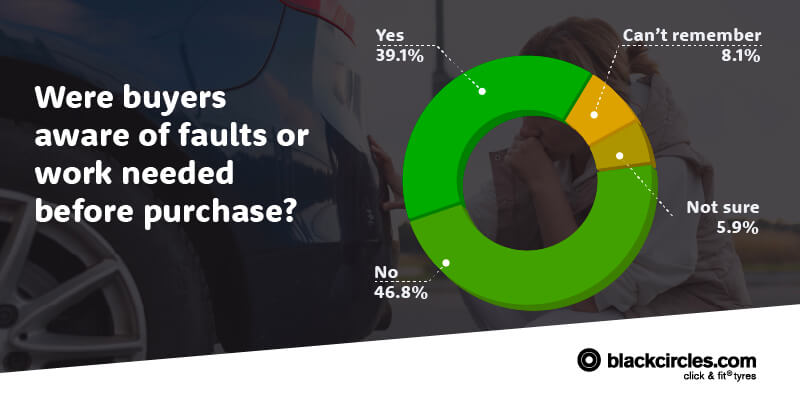
Almost two in five used car buyers (39.1%) said they were aware of faults or work that needed to be done on the vehicle before buying.
A further 46.8% said they weren't aware of any faults or required work, while 14.1% were either not sure or couldn't remember.
Buying a car that needs work isn't always a problem if the buyer understands the issue and the price reflects the likely repair cost. However, it can become expensive if the problem is underestimated or if further issues are discovered after buying.
This is why MOT history, service history, tyre condition and vehicle history checks can all be useful before committing.
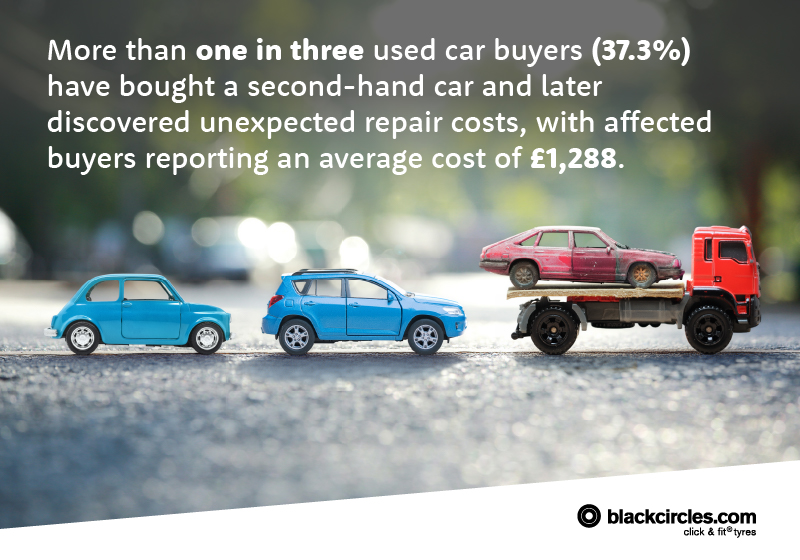
The financial risk of buying second-hand becomes clear when looking at repair costs. More than a third of used car buyers (37.3%) said they've bought a second-hand car and later discovered unexpected repair costs.
Among those affected, the average reported cost was £1,288.
| Unexpected repair costs after purchase | Used car buyers |
|---|---|
| Yes | 37.3% |
| No | 62.7% |
Younger buyers were more likely to say unexpected repair costs had caught them out. Almost half of buyers aged 25-34 (45.9%) said they'd bought a second-hand car and later discovered unexpected repair costs. Among buyers aged 65+, this fell to almost three in ten (28.8%).
| Age group | Used car buyers who discovered unexpected repair costs |
|---|---|
| 18 - 24 | 42.3% |
| 25 - 34 | 45.9% |
| 35 - 44 | 43.2% |
| 45 - 54 | 35.6% |
| 55 - 64 | 35.8% |
| 65+ | 28.8% |
Men were also more likely than women to report unexpected repair costs, with 40.7% of men saying they'd experienced them, compared with 34.8% of women.
The MOT data below doesn't show what caused these repair bills, but it does show the kind of faults buyers risk overlooking. Tyres, brakes, suspension, electrical issues and other MOT-related defects can all turn a lower purchase price into a more expensive car.
The MOT defect data shows why these missed checks matter. The most common failure categories for Class 3 and 4 vehicles include areas that buyers can check visually or have a mechanic inspect before buying. Lamps, reflectors and electrical equipment were recorded in around one in nine tests (10.9%), followed by suspension (8.7%), brakes (6.6%) and tyres (6.4%).
| Rank | Defect category | % of tests |
|---|---|---|
| 1 | Lamps, reflectors and electrical equipment | 10.9% |
| 2 | Suspension | 8.7% |
| 3 | Brakes | 6.6% |
| 4 | Tyres | 6.4% |
| 5 | Visibility | 4.5% |
| 6 | Body, chassis, structure | 3.4% |
| 7 | Noise, emissions and leaks | 3.2% |
| 8 | Steering | 2.0% |
| 9 | Seat belts and supplementary restraint systems | 1.0% |
| 10 | Road wheels | 0.4% |
These findings show why buyers should look beyond bodywork alone. While bodywork was the most commonly checked item in the survey, several MOT failure categories relate to safety-critical parts that may not be obvious without a proper inspection.
Lights, suspension, brakes, tyres and visibility should all be checked before buying, particularly on older used vehicles.
Tyres were the fourth most common MOT failure category for Class 3 and 4 vehicles, recorded in around one in 16 tests (6.4%).
However, tyre safety becomes even more important when looking at dangerous defects. Tyres accounted for three in five dangerous defect items (60.1%), while tyre defects were recorded as dangerous in 4.7% of tests.
| Tyre defect measure | |
|---|---|
| Overall % of tests involving tyre defects | 6.4% |
| Overall % of defects involving tyres | 12.9% |
| Dangerous defects % of tests | 4.7% |
| Dangerous defects % of defects | 60.1% |
| Major defects % of tests | 1.9% |
Note: These figures refer to dangerous defect items, not unique failed tests. They shouldn't be read to mean that tyres caused 60.1% of failed MOTs.
This highlights why tyre checks shouldn't be left until the next MOT. Before buying a used car, buyers should check tread depth, look for cracking, bulges or cuts, and check for uneven wear, which can show alignment, suspension or pressure issues.
If the tyres are worn, damaged or close to the legal limit, buyers should factor in the cost of replacement car tyres before agreeing a price.
Vehicle age is one of the clearest MOT risk factors for used car buyers. DVSA anonymised MOT data shows that around one in 11 Class 4 vehicles aged 3-5 years failed an MOT in 2025 (9.1%). This rose to around one in six for vehicles aged 6-10 years (15.4%), almost one in four for vehicles aged 11-15 years (23%) and around one in four for vehicles aged 16+ (26.4%).
This means Class 4 vehicles aged 16+ were almost three times as likely to fail an MOT as those aged 3-5 years.
| Vehicle age | Completed MOT tests | Failed MOT tests | MOT failure rate |
|---|---|---|---|
| 3-5 years | 5.86m | 0.53m | 9.1% |
| 6-10 years | 14.95m | 2.30m | 15.4% |
| 11-15 years | 11.39m | 2.62m | 23.0% |
| 16+ years | 7.63m | 2.02m | 26.4% |
This doesn't mean older used cars should always be avoided. However, it does show why buyers should take extra care when looking at older vehicles.
Repeated MOT failures, recurring advisories and visible tyre, brake, suspension or lighting issues can all be warning signs that further costs may be ahead.
The analysis also looked at Class 4 make/model combinations with at least 25,000 completed MOT tests, excluding obvious van and commercial-style models.
The Peugeot 307 had the highest MOT failure rate among the models analysed, with almost one in three completed MOT tests failing (30.9%).
The Citroën Xsara followed this at 30.4%, the Volkswagen Fox at 29.7%, the Peugeot 207 at 29.5%, and the Renault Clio at 29%.
| Rank | Make | Model | MOT failure rate |
|---|---|---|---|
| 1 | Peugeot | 307 | 30.9% |
| 2 | Citroën | Xsara | 30.4% |
| 3 | Volkswagen | Fox | 29.7% |
| 4 | Peugeot | 207 | 29.5% |
| 5 | Renault | Clio | 29.0% |
| 6 | Peugeot | 206 | 28.7% |
| 7 | Renault | Mégane | 28.6% |
| 8 | Vauxhall | Vectra | 28.5% |
| 9 | Renault | Scénic | 27.9% |
| 10 | Fiat | Punto | 27.7% |
However, higher failure rates are likely influenced by vehicle and model age, as well as discontinued models.
Also, the MOT failure rate shouldn't be read as a measure of how dangerous a vehicle is; it only shows the percentage of MOT tests that failed.
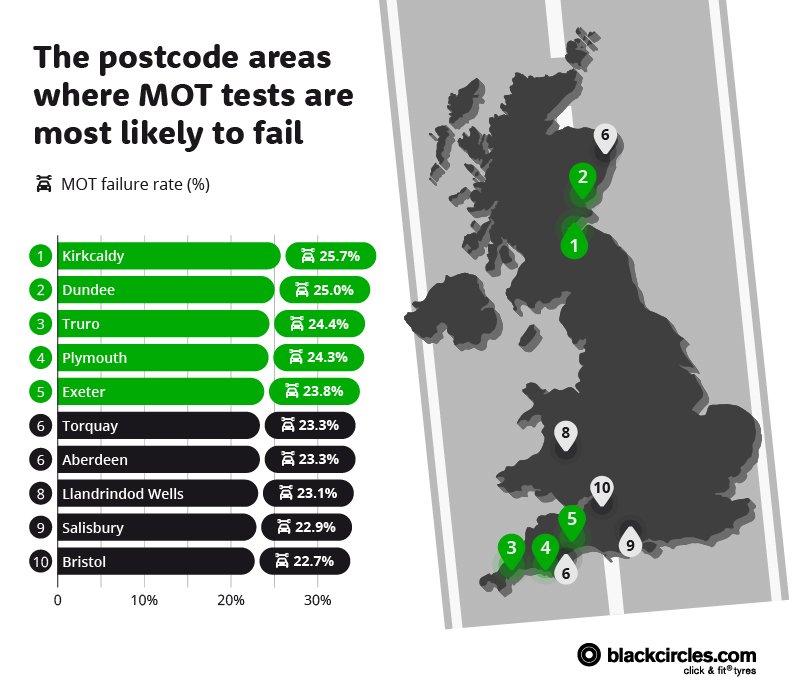 Note: these results are for broader postcode areas, rather than cities alone.
DVSA data also shows that MOT failure rates vary by postcode area.
Among Class 4 vehicles, the Kirkcaldy postcode area had the highest MOT failure rate, with around one in four of the completed MOT tests failing (25.7%).
This was followed by Dundee at 25%, Truro at 24.4%, Plymouth at 24.3% and Exeter at 23.8%.
The survey findings show that many buyers aren't checking areas that could help them identify costly or safety-related problems before buying.
The MOT data also shows that common failure categories include lights and electrical equipment, suspension, brakes, tyres and visibility, while older vehicles are significantly more likely to fail an MOT.
Before buying a used car, buyers should check the following.
Check the vehicle's MOT history, including previous failures, recurring advisories and mileage records. Repeated advisories can suggest ongoing maintenance issues.
Buyers should also review the service history and check whether the mileage appears consistent across MOT, service and advert records.
An HPI or vehicle history check can help flag outstanding finance, write-off status, stolen vehicle records and mileage discrepancies.
Check tyre tread depth and condition before buying. Look for uneven wear, cracking, cuts, bulges or damage to the sidewall.
Uneven tyre wear can indicate underlying issues, such as poor wheel alignment, suspension problems or incorrect tyre pressure.
Check all lights, indicators, brake lights and fog lights. Visibility issues are also common MOT failure categories, so buyers should check the wipers, washers, mirrors, and the windscreen condition.
Dashboard warning lights shouldn't be ignored, even if the car appears to drive normally.
The MOT data shows suspension and brakes are among the most common failure categories. During a test drive, buyers should listen for knocking sounds, pulling to one side, vibration under braking or unusual steering behaviour.
If you're unsure about a vehicle's condition, booking a professional inspection or using trusted garage services can help identify issues before they become expensive repairs.
Bodywork was the most common check carried out by survey respondents, and it remains important. Buyers should look for rust, mismatched paint, accident damage or signs of poor repair.
Cabin electronics were among the least-checked areas in the survey, but they can be expensive to fix. Buyers should check windows, locks, infotainment, heating, air conditioning and other interior controls.
Older vehicles aren't always a bad buy, but they warrant extra scrutiny. Review MOT and service history closely, and pay particular attention to tyres, brakes, suspension and dashboard warning signs before agreeing to buy.
Ray Kavanagh, CEO of Blackcircles.com, concluded with his final thoughts:
“Buying a second-hand car can be a great way to save money, but drivers must know what to check before committing to a purchase.
“Our research shows that many used car buyers are skipping checks that could help them spot problems before they buy, including MOT history, tyre condition and vehicle history checks.
“Tyres are especially important because they're one of the most common MOT failure categories and can have a direct impact on safety. Buyers should check tread depth and tyre condition carefully, looking for signs of uneven wear, cracking, bulges, or other damage.
“MOT history is also a valuable tool. Repeated advisories or prior failures can help buyers understand whether a vehicle has been well-maintained or may hide future repair costs.
“For older cars, it's worth taking extra time. The MOT data shows vehicles aged 16 years or more are almost three times as likely to fail an MOT as vehicles aged 3-5 years, so buyers should be particularly careful when reviewing older used vehicles.”
Blackcircles.com is the UK's leading online tyre retailer, helping drivers compare and buy tyres online before booking fitting at a time and location that suits them through a network of over 2,200 garages nationwide.
Alongside tyre fitting, Blackcircles offers MOTs and garage servicing to help keep cars safe, roadworthy and compliant with UK regulations.
With millions of second-hand cars changing hands each year, we created the UK Used Car Report to help buyers understand the checks that matter and the costly faults they could otherwise overlook.
We surveyed 2,001 UK adults who had bought a second-hand car.
MOT failure-rate analysis was carried out using DVSA anonymised MOT test result extracts for 2025: https://open.data.dvsa.gov.uk/mot-anonymised/index.html
The analysis focused on Class 4 vehicles. Completed MOT tests included records with result codes P, F and PRS. Abandoned and aborted outcomes were excluded. MOT failure rate was calculated as the number of failed MOT tests divided by the number of completed MOT tests.
Vehicle age was calculated by comparing the MOT test date with the vehicle's first use date.
Postcode-area rankings included only postcode areas with at least 1,000 completed MOT tests.
Make/model rankings included only make/model combinations with at least 25,000 completed MOT tests. Obvious van and commercial-style models were removed. Higher failure rates may still be influenced by vehicle age, model age and discontinued models.
Most common MOT failure reasons were sourced from DVSA's published MOT Class 3 and 4 Vehicles: initial failures by defect category table, using the latest complete full-year data available, 2024 to 2025: https://www.gov.uk/government/statistical-data-sets/mot-testing-data-for-great-britain
Defect categories were ranked by the overall % of tests, representing the percentage of MOT tests in which at least one failure item was recorded for that defect category. A failed MOT can include multiple failure items, so defect categories are not mutually exclusive, and the percentages don't add to 100%.

We love to hear from our customers. Connect with us today and let’s start a conversation.