If you are caught speeding in the UK, whether that’s through physical police presence or speeding cameras, a monetary fine and points on your licence will be issued.
Speeding is against the law and if caught braking it, you may pay the price for doing so.
This over-speeding fine guide will outline what the charges are for different offences for each UK country, how much points you may receive, and what the next steps are if you have been issued a fine.
What Are the Speeding Laws in the UK?
In the UK, breaking any sort of speed limit means you’re breaking the law.
Typically, urban roads will have speed limits up to 30mph, with the most common speed limits enforced being 20 mph and 30 mph.
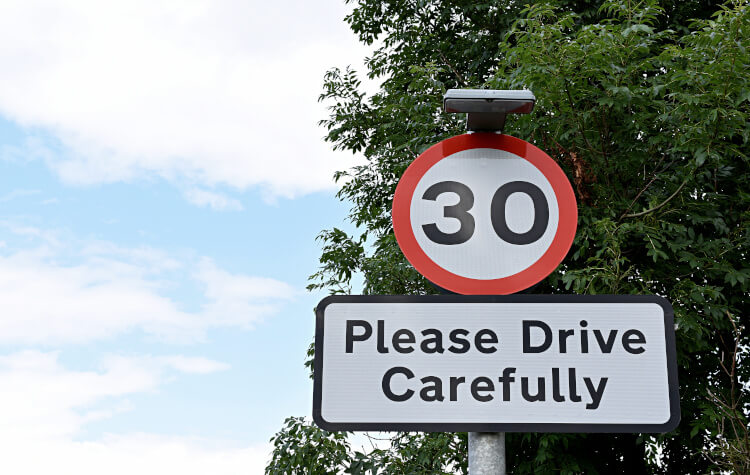
Single carriageways are usually 60 mph, dual carriageways are typically 70mph, and motorways have a maximum speed limit of 70 mph, unless otherwise stated by signage.
It’s also important to note that Wales operates under different default speed limit rules. Since September 2023, the default speed limit on restricted roads in Wales has been reduced to 20 mph, unless signs indicate otherwise.
This differs from England, Scotland, and Northern Ireland, where the default speed limit on restricted roads remains 30mph.
Drivers travelling between England and Wales should be particularly mindful of this change, as enforcement is active and penalties apply in the same way as elsewhere in the UK.
Speed limits can vary depending on road type, vehicle type, weather conditions, and local authority decisions, so drivers must always follow posted signs.
These speed limit laws are imposed by the
Road Traffic Regulation Act 1984.
Speeding Fines Breakdown
Speeding fines in the UK are not issued as a one-size-fits-all penalty.
Instead, the severity of the offence, the speed involved, and the part of the UK you were driving in will determine how much you are fined and whether penalty points or a driving ban may apply.
Below is a breakdown of how speeding fines are categorised across the UK.
England, Scotland & Wales Speeding Fine Bands Explained
In England, Scotland, and Wales, fines for breaking the speed limit are broken down into 3 different bands: A, B, and C.
These bands are used to categorise the severity of the speed limit breach, determining what penalties may be issued.
The band categories are as follows:
| Speeding Band
| Example Offence
| Speeding Fine Cost
| Penalty Points
|
|---|
| Band A
| Just over the limit (e.g. 31–40 mph in a 30 mph zone)
| £100 fixed penalty (or 25–75% of weekly income if prosecuted)
| 3 points
|
| Band B
| Significantly over the limit (e.g. 41–50 mph in a 30 mph zone)
| 75–125% of weekly income
| 4–6 points or short driving ban
|
| Band C
| Dangerously over the limit (e.g. 51 mph or above in a 30 mph zone)
| 125–175% of weekly income
| 6 points or longer driving ban
|
Northern Ireland Speeding Fines Explained
In Northern Ireland, speeding penalties are issued through Fixed Penalty Notices (FPNs) rather than the A, B and C band system used in the rest of the UK.
There are several types of fixed penalties, depending on how the offence was detected and whether penalty points apply.
| Fixed Penalty Type
| Example Offence
| Speeding Fine Cost
| Penalty Points
|
|---|
| Endorsable
| Speeding detected by a police officer
| £60–£200
| Yes (depends on severity)
|
| Conditional
| Speeding detected by a speed camera
| £60
| Yes (depends on severity)
|
I’ve Received a Speeding Fine: What Now?
If you receive a speeding fine in the UK, you’ll usually be sent a Notice of Intended Prosecution (NIP) within 14 days of the offence.
This will outline the details of the speeding offence and request that you confirm who was driving the vehicle at the time.
Once confirmed, you’ll either be offered a fixed penalty, a speed awareness course (if eligible), or asked to attend court if the offence is more serious.
If you accept a fixed penalty, you’ll normally need to pay the fine and accept the penalty points within the stated timeframe, which is typically 28 days.
Failure to respond or pay could result in the matter going to court, where higher fines and additional penalties may apply.
Learn more on paying speeding fine
Speed Awareness Courses
Speed awareness courses are an alternative to receiving penalty points for minor speeding offences and are designed to educate drivers on safe driving practices rather than punish them.
These courses are typically offered in England, Scotland, and Wales, but availability depends on the local police force and the circumstances of the offence.
You may be offered a speed awareness course if you were only slightly over the speed limit and have not attended one for a previous offence within the last three years.
Speed awareness courses typically cost in the range of £70-£100.
While you’ll still need to pay for the course, no points will be added to your licence if you complete it successfully.
Drive Safely to Avoid Fines
Speed limits are put in place to protect all road users, not just to penalise drivers.
Staying within the limit reduces the risk of accidents, keeps your insurance costs down, and helps you avoid fines and penalty points.
By paying attention to road signs, adjusting your speed for conditions, and planning your journeys properly, you can stay safe and compliant on UK roads.
UK Speeding Fines: Frequently Asked Questions
How does speeding affect my insurance?
Speeding convictions can increase your car insurance premium, as insurers see penalty points as an indicator of higher risk.
The impact depends on the severity of the offence and how many points you receive. Some insurers may also require you to declare speeding offences for up to five years.
I’m a new driver, how does this affect speeding fines?
New drivers face stricter consequences if they speed. If you receive six or more penalty points within two years of passing your test, your licence will be revoked under the New Drivers Act 1995.
You would then need to reapply for a provisional licence and retake both your theory and practical tests.
Will I lose my licence for speeding?
You could lose your licence if you commit a serious speeding offence or accumulate 12 or more penalty points within three years.
In severe cases, courts can issue an immediate driving ban even if you have fewer points. The length of the ban depends on the offence and your driving history.
How long do penalty points stay on my licence?
Penalty points for speeding typically remain on your driving record for four years from the date of the offence.
However, they are usually only valid for totting-up purposes for three years. Insurance providers may still consider them during this period.
Will I get points for doing 37 mph in a 30 mph zone?
In many cases, yes, you may receive penalty points for driving at 37 mph in a 30 mph zone.
Some drivers may be offered a speed awareness course instead, depending on eligibility and local police guidelines. If not, the usual penalty is three points and a £100 fine.
Will I get points for doing 80 mph on a 70 mph road?
Driving at 80 mph on a 70 mph road can result in penalty points, although enforcement thresholds vary.
Some drivers may receive a fixed penalty or be offered a speed awareness course if eligible. Higher speeds are more likely to result in points or court action.