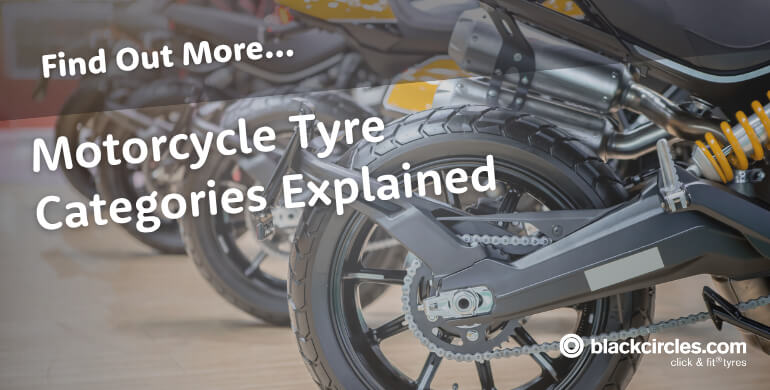
You may think that choosing the right tyre for your motorcycle is as simple as getting the right fitment and off you ride. Given you’re reading this blog, you’ll know that isn’t the case: in fact, choosing the correct tyre category is one of the most important decisions you’ll have to make.
There are four common categories you’ll see a lot on your journey – sport, sport-touring, touring and adventure – as well as some bonus types for specific jobs (cruiser, track, off-road, scooter and classic). It’s not just marketing fluff either: a tyre’s category conveys a lot, from what its rubber compound is, what it was engineered to prioritise and, therefore, what setting it’s best used in.
This guide explains what each category is built for, who it suits and how to work out which one your bike and your riding actually need.
What are motorcycle tyre categories?
A tyre category describes intended use. Manufacturers group tyres by the job they are designed to do, and that grouping is reflected in four things: the softness of the rubber compound, the amount of open space in the tread pattern, the stiffness of the carcass underneath, and the mileage the tyre is expected to deliver.
Softer compounds grip harder but wear faster. More tread void clears water and bites into loose surfaces but generates noise and reduces the rubber in contact with tarmac. A stiffer carcass gives sharper steering but transmits more of the road surface to the rider. Every category is a different balance of those trade-offs, which is why there is no single best motorcycle tyre, only the best tyre for a given bike and a given kind of riding.
Two things are commonly mistaken for categories but are not. Radial and bias-ply (also called crossply or diagonal) describe how the tyre is built internally, not what it is for. Most modern sports and sport-touring tyres are radial; many cruisers, classics and smaller-capacity bikes run bias-ply. Your bike was designed around one or the other, so match what the manufacturer specifies rather than treating it as a preference.
Tube-type and tubeless are the same story. It is a construction difference determined by your wheels, not a category, and the two are not interchangeable. Spoked wheels on many adventure and classic bikes need tubes; cast wheels almost always run tubeless.
Motorcycle tyre categories at a glance
The table below is a rough guide to how the four main categories compare. Individual tyres vary – you may find that a premium sport tyre out-grips a budget touring tyre – but the pattern holds.
| Category
| Best for
| Wet grip
| Mileage
| Comfort and noise
|
|---|
| Sport | Fast road riding and occasional track days
| Good
| Lowest
| Firm, quiet
|
| Sport-touring | Mixed year-round UK riding
| Excellent
| Medium to high
| Balanced, quiet
|
| Touring | Motorways, high mileage, two-up riding
| Excellent
| Highest
| Softest, quiet
|
| Adventure | Big trail bikes, road-biased or split use
| Varies with the split
| Medium
| Firm, noisier
|
Warm-up time splits the same way: sport-touring, touring and adventure tyres all come up to temperature quickly, while sport tyres take longer before they deliver their full grip.
Sport motorcycle tyres
Sport tyres are built for grip and steering response on dry and damp tarmac. They use soft, fast-warming compounds – often with a harder centre and softer shoulders – and a stiff carcass that holds its shape under hard braking and mid-corner load. Tread patterns are relatively closed, with just enough grooving to shift water.
They suit riders on Supersports and naked sports bikes who ride quickly on good roads and may take the bike to a track day two or three times a year. Some manufacturers also badge a more road-focused street tyre – Michelin’s Pilot Street range is the obvious example. These sit just below full sport rubber, trading a little dry grip for longer life and a lower price, and are a common fit on smaller-capacity naked and street bikes.
The trade-off is cost per mile. Sport tyres wear noticeably faster than touring rubber, and a rear may need replacing in well under half the mileage a touring tyre would give. They also need more heat in them before they work properly, worth remembering on a cold, damp start.
Above standard sport tyres sits the hypersport tier: road-legal tyres with track-derived compounds and construction, often with reduced tread depth. They’re more expensive and wear faster again, since the compound assumes high temperatures and repeated hard cornering. On a UK road ridden mostly at legal speeds, most riders get more from a standard sport or sport-touring tyre and never notice the ceiling they’ve given up.
Sport-touring motorcycle tyres
Sport-touring is the category most UK riders should look at first, and it’s improved more than any other over the last decade. The design goal is sports-level grip in real-world conditions with enough life to be practical, and dual-compound construction makes that possible: a harder compound down the centre for motorway miles, softer compound on the shoulders for cornering grip.
Tread patterns carry more siping and grooving than sport tyres, which is why sport-touring rubber tends to be the strongest all-round performer in the wet. They also warm up quickly, working properly a mile or two into a cold commute rather than after ten.
For mixed riding in Scotland and the north of England – a motorway slog, damp B-roads and standing water under trees, all on one ride – sport-touring is difficult to beat. It’s the right answer for weekday commuters who ride for fun at the weekend, and for anyone who wants one tyre to do everything without thinking.
The compromise is at the extremes: a dedicated sport tyre still gives drier grip on a hot track day; a dedicated touring tyre still lasts longer on pure motorway. Neither gap matters for most riders.
Touring motorcycle tyres
Touring tyres prioritise mileage, stability and comfort. Compounds are harder, particularly across the centre of the tread, which is why touring tyres routinely outlast every other road category. Carcass construction is tuned for load-carrying and straight-line stability rather than quick direction changes, and the ride is usually the most absorbent of any category.
This is the right choice for high-mileage commuters, heavyweight tourers and anyone who rides two-up with luggage. If you cover long distances on motorways and A-roads, a touring tyre costs less per mile than anything else and gives up very little in the wet, since water clearance is a design priority rather than an afterthought.
If you ride with a pillion or full panniers, check two things. The first is the load index and speed rating stamped on the sidewall, which must meet or exceed what your bike’s manufacturer specifies. The second is
tyre pressure, which almost always needs increasing for two-up or heavily loaded riding. Getting either wrong costs you grip, stability and tyre life at once.
Touring also suits smaller-capacity and learner bikes. A 125 won’t trouble a tyre’s grip limits, so longevity, wet-weather security and predictable behaviour matter more than ultimate cornering performance.
Adventure motorcycle tyres
Adventure tyres are designed for large trail and adventure bikes, and they are the broadest category of the four because the bikes are used so differently. Some never leave tarmac. Others spend half their life on gravel and forest track. The category is therefore split by the ratio of road to off-road capability the tyre is designed for.
Understanding the road and off-road split
| Split
| Designed for
| On-road behaviour
|
|---|
| 90/10 | Almost entirely road use, occasional gravel or firm track
| Close to a sport-touring tyre; quiet and grippy in the wet
|
| 80/20 | Mostly road with regular light off-road use
| Slightly more tread noise, still strong on tarmac
|
| 50/50 | Genuine mixed use, green lanes and trails
| Noticeably noisier, reduced wet tarmac grip, shorter life
|
| 20/80 | Predominantly off-road with road linking sections
| Blocky and vocal; road grip and mileage are compromised
|
Two questions come up constantly about this category, and both have straightforward answers.
The first is whether adventure tyres are any good on UK roads. Road-biased adventure tyres are genuinely good on tarmac. A 90/10 or 80/20 tyre on a big adventure bike will handle wet British roads confidently and last well, and for the overwhelming majority of adventure bike owners it is the correct choice. The mistake is fitting a 50/50 knobbly to a bike that only ever sees the M74 because it looks the part.
The second is noise. Yes, the more aggressive splits are noisier than road tyres, and the tread blocks can generate a hum that rises and falls with speed. That is the direct cost of the open tread pattern that makes them work off-road. If road noise bothers you and you rarely ride off tarmac, move up the scale towards 90/10.
Beyond the big four
Four categories cover most road riding, but not all of it. These are the others worth knowing.
Cruiser and custom tyres
Cruiser tyres are built for weight, comfort and mileage rather than cornering. Compounds are hard, profiles are broader and flatter than sports tyres, and construction is tuned to carry a heavy bike with a relaxed steering geometry. Compared with a touring tyre, a cruiser tyre gives up cornering grip and steering speed in exchange for durability and a softer ride at low speeds. Many are bias-ply. On older bikes, a fresh set of cruiser tyres often reduces vibration noticeably, simply because modern construction is more uniform than the rubber the bike may have been running. Custom and bobber builds draw from the same ranges, and the same two rules apply: match the construction type the bike was designed around, and check the load index carries the finished weight – particularly if the bike has been rewheeled.
Track tyres
Track tyres and race slicks assume conditions that do not exist on the public road: tyre warmers before you set off, high and sustained operating temperatures, and a dry, clean surface. Slicks are not road legal, as they have no tread. Treaded track tyres may carry an E-mark and be technically legal, but that does not make them a sensible road choice. Cold, they offer far less grip than a road tyre, and they have little capability in standing water. If you do two or three track days a year, a good sport tyre is the better compromise. If you are running dedicated track rubber, keep a second set of wheels for the road. Wet-weather race tyres, usually sold as rain tyres, are the other end of the same category: deep-cut treads on a very soft compound, built for a soaked circuit rather than a British A-road. They are not a wet road tyre, and they tear themselves apart on dry tarmac.
Off-road and dual-sport tyres
Motocross, enduro, trial and supermoto tyres are all built around a specific competition surface. Motocross tyres use tall, widely spaced blocks for soft ground; enduro tyres compromise slightly towards durability and road-legality; trial tyres run very low pressures with a soft, conforming carcass; supermoto tyres are effectively sport tyres on small-diameter rims. Dual-sport tyres bridge the gap for road-registered trail bikes. Check for an E-mark before using any of them on the road, and expect short life and reduced wet tarmac grip from anything at the aggressive end. Anything stamped NHS or “not for highway service” is not road legal at all, whatever else it says on the sidewall.
Scooter, moped and commuter tyres
Small-wheel tyres for scooters, mopeds and urban commuters are a category in their own right. They are designed for stop-start traffic, frequent braking, painted road markings, drain covers and tram lines, so wet grip at low speed and resistance to kerbing matter far more than high-speed stability. Urban and commuter patterns typically carry deep water-clearing grooves and hard-wearing compounds.
Classic and retro tyres
Owners of older bikes are often stuck between period-correct appearance and modern performance. Classic and retro ranges exist precisely for this: original sizing and tread appearance, with contemporary compounds and construction underneath. It is usually the best of both, and a substantial safety improvement over genuinely old rubber.
How the major brands split their motorcycle tyre ranges
Manufacturers use their own range names rather than the generic category labels, which makes cross-shopping harder than it needs to be.
The lists below map the main ranges from three of the biggest names in
motorcycle tyres onto the categories above.
Michelin motorcycle tyre ranges
Pirelli motorcycle tyre ranges
- Sport: Diablo Rosso series (
Rosso IV)
- Sport-touring: Angel series (
Angel GT)
- Touring: Angel GT variants (
Angel GT A, for heavier bikes)
- Adventure: Scorpion Trail series (
Scorpion Trail II)
- Cruiser: Night Dragon series
Bridgestone motorcycle tyre ranges
Which motorcycle tyre category should you choose?
Work from how you actually ride rather than what your bike is capable of. Most riders overestimate how much performance they need and underestimate how much wet-weather ability and mileage they want.
- Mostly commuting, motorways and A-roads: touring, or sport-touring if you want more cornering grip at the weekend.
- Year-round riding on Scottish or northern B-roads: sport-touring. Best all-round wet grip, quick warm-up, sensible mileage.
- Fast weekend rides plus two or three track days a year: sport. Accept the shorter tyre life as the cost of the grip.
- Dedicated track riding: track tyres on a second set of wheels, road tyres for getting there.
- Big adventure bike that rarely leaves tarmac: road-biased adventure at 90/10, or a sport-touring tyre if your size is available.
- Adventure bike used on green lanes and gravel: 80/20 for occasional use, 50/50 if off-road is genuinely half your riding.
- Two-up with luggage, or a heavyweight tourer: touring, with the load and speed ratings checked and pressures adjusted.
- Cruiser or custom: cruiser tyres, matching the original construction type.
- 125cc learner or small commuter: touring or commuter patterns. Longevity and wet security over outright grip.
- Classic or retro bike: a classic range with original sizing and a modern compound.
If two categories both look plausible, choose the one better suited to the worst conditions you ride in rather than the best. Nobody has ever regretted having more wet grip than they needed.
Finding the right motorcycle tyre category for your bike
Getting the category right is the single most useful thing you can do for how your bike feels and how much your tyres cost you over a year.
Be honest about the riding you actually do, choose for the worst weather you ride in rather than the best, and stay within the size, load and speed ratings your manufacturer specifies. For most UK riders, that points to a sport-touring or touring tyre, with sport rubber for those who ride hard on good roads and road-biased adventure tyres for big trail bikes that live on tarmac. Whichever category you land on, a
quick pre-ride check is still what keeps it working as intended.
When you search for motorcycle tyres at Blackcircles.com, you’ll find a Road Type filter at the top of the results page. It’s the quickest way to turn the decision above into an actual shortlist. Choose Sport / Touring for road-focused riding, On / Off Road for adventure and dual-sport rubber, Hypersport / Race at the track-focused end, or Custom / Cruiser, Classic / Lightweight and Scooter for those bikes.
Search by your registration or tyre size at
Blackcircles.com to see the motorcycle tyres available for your bike, with fitting at a local garage at a time that suits you.