
Join the conversation
We love to hear from our customers. Connect with us today and let’s start a conversation.
...searching
An MOT failure can feel daunting, but the good news is that the rules around retesting are fairly clear once you know them.
In many cases you won’t have to pay the full MOT fee again, and sometimes the retest may even be free.
What matters is where you have the repairs done, how quickly you return to the test centre, and what the failed items were in the first place.
When a vehicle fails, the garage will issue a VT30 Refusal of MOT Test Certificate.
This lists the reasons for the failure and whether the defects are classed as dangerous, major, minor or advisory.
You’ll need this VT30 if you return for a retest, as it tells the tester exactly what needs to be checked again.
If your car fails, you have three main routes to a retest:
If you choose to leave your vehicle at the same garage that carried out the test, they can complete the repairs and retest it within ten working days. This counts as a partial retest and there is no extra fee in this scenario.
You can also take the car away for repairs elsewhere.
If you return to the same test centre before the end of the next working day, you may qualify for a free partial retest. But only if the failure was for specific, limited items (see the table below).
If you return within ten working days, the car will still only need a partial retest, but the garage can charge a reduced fee for this.
If you have repairs and the retest carried out at a different garage, this becomes a full retest.
The tester has to carry out the complete MOT again, and you’ll pay the full MOT fee.
As mentioned, there are several scenarios for an MOT restest and how it affects the cost.
These are highlighted below in the following diagram.
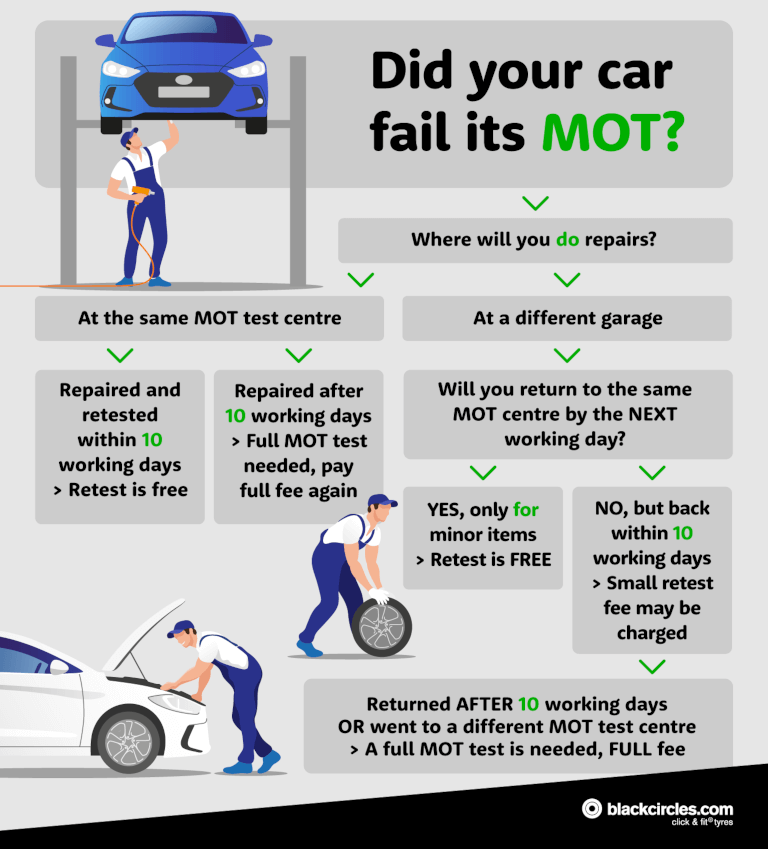
If you fix the car quickly and bring it back to the same centre the next working day, you won’t be charged again for a retest. Provided the failure was limited to certain parts.
| Item examples (not full list) |
|---|
| Lamps (excluding headlamp aim) |
| Mirrors, wipers, washers, windscreen glass |
| Wheels and tyres (cars and most vehicles) |
| Fuel filler cap, horn, registration plates, rear reflectors |
| Seatbelts (excluding anchorages), seats, sharp edges |
| Bonnet, bootlid, tailgate, tailboard, doors and hinges |
| Electrical wiring, trailer sockets, VIN |
This rule is designed for minor, straightforward fixes - things like a failed wiper blade or broken lamp that can be sorted quickly.
Anything more substantial will usually fall under the ten-day partial retest rules or require a full retest.
This is where it can get confusing.
Whether you can drive your car after a fail depends on both the type of defect and whether your previous MOT is still valid.
This means timing your MOT can make life easier.
Booking up to a month before your old certificate runs out keeps the same renewal date. This gives you breathing space to get any faults fixed.
These rules come directly from DVSA guidance and apply across the UK.
If you believe your car failed unfairly, you can appeal by sending a DVSA complaint form within 14 days and arranging a paid retest within 5 days.
If your appeal succeeds, the fee is refunded.
However, it is important to note that while the appeal is pending you cannot repair the car. This can lead to added downtime.
Retests aren’t there to punish you with extra cost.
They’re meant to ensure that only the failed items are checked again if repairs are made promptly, which keeps the process fair and affordable.
Knowing the timelines and conditions - next-day, ten-day, same centre vs different centre - helps you avoid paying twice for a full MOT unnecessarily.

We love to hear from our customers. Connect with us today and let’s start a conversation.