Over the past two decades, if you owned a high performance vehicle the advice you may have heard was buy summer tyres - and if you drive through the winter, buy a second set of winter tyres.
There was a belief amongst some that all-season tyres were for hatchbacks and estate cars. That if you put them on something with real power and you would be missing out on the kind of performance required to get the most out of a fast car.
That advice is now out of date. The tyre that has done most to debunk this way of thinking is the
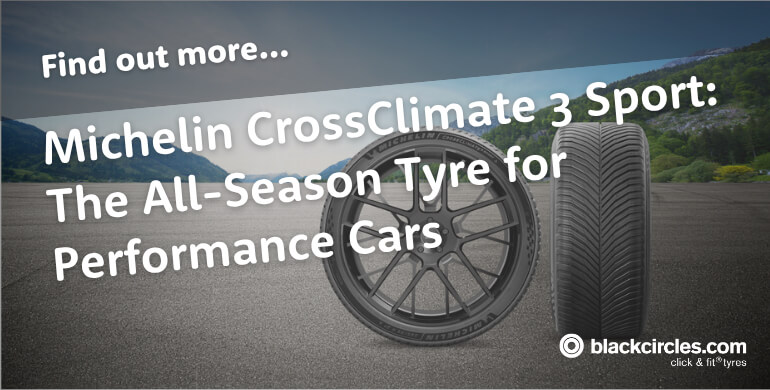
Michelin CrossClimate 3 Sport.
This is not a softened summer tyre or a sharpened touring tyre. It is an ultra-high-performance all-season tyre - built for cars that are fast.
All season tyres: designed to cope with various weather conditions and deliver a reliable performance throughout the different seasons.
EV approved tyres: electric vehicle (EV) tyres are a category of car tyre that has been developed by several manufacturers to meet the specific requirements of an electric vehicle.
The Michelin CrossClimate 3 Sport is a premium all-season tyre developed for sporty and high-performance vehicles, delivering sharp handling, outstanding control, and year-round safety.
Michelin's product page now lists fitments from 18 to 23 inches as the range has filled out through 2026.
Within the construction of the tyre there are two key pieces of Michelin engineering working to produce its high performance.
Thermal Adaptive Tread Compound 2.0. This is the compound that means the tyre can deliver the required levels of performance across a wide temperature range, rather than being optimised for just one end of it.
Dynamic Response Technology. A reinforcement layer in the crown that sharpens the response between the steering wheel and the front axle.
And in terms of the tyre's winter capability, it has earned the 3PMSF snowflake marking, with an A rating for wet grip on the European tyre label.
Michelin CrossClimate 3 Sport vs summer tyres: how big is the gap?
This is the question that perhaps matters most to high-performance owners. And, luckily, there is an unusually clean answer. In 2025 Tyre Reviews tested the new CrossClimate 3 Sport and CrossClimate 3 against the Pilot Sport 5 and Primacy 5.
In that 2025 comparison the numbers came out like this in the dry:
Dry performance, 225/40 R18
Michelin Pilot Sport 5
Michelin CrossClimate 3 Sport
Michelin CrossClimate 3
Braking, 100–0 km/h
36.8 m
38.4 m
39.7 m
Handling lap
1:16.9
1:18.84
1:21.0
An all-season tyre stopping just 1.6 metres further than a dedicated performance summer tyre from 100 km/h, and achieving a two per cent slower lap time, is not a compromise most would notice on the road.
In a
2026 run of the same test, which extended the field up to the Pilot Sport Cup 2 R semi-slick, there was a result to make people sit up and seriously take notice. The CrossClimate 3 Sport beat the Primacy 5, a summer tyre, around the dry handling lap.
2nd, behind Continental AllSeasonContact 2 at 89 ft
How does the CrossClimate 3 Sport perform in the wet?
Dry pace is the easy part. Wet grip is where all-season tyres have historically been caught out. But again, the CrossClimate 3 Sport has bucked trends with good performances.
Against its own stablemate in that 2025 Tyre Reviews comparison, it gave up around four metres in wet braking to the Pilot Sport 5 and was nearly seven seconds slower around the wet handling lap.
Measured against other all-season tyres, though, it is top of the class. In
Tyre Reviews' ten-tyre test for 2026/27 it recorded the best wet braking and the best rolling resistance in the field. For the highest subjective dry handling score the tyre finished second overall.
Are all-season tyres good enough for a UK winter?
A case against all-season tyres has often come in regard to the performance in snow. Although they do perform better than a summer, they lack the same levels when compared to dedicated winter tyres.
In many respects however, that is the wrong test for most of the UK.
The Met Office's provisional figures for
winter 2025/26 put the UK mean temperature at 4.94°C, with England at 5.69°C, Wales at 5.52°C and Scotland at 3.49°C.
We have a very specific kind of weather. It’s what makes old Blighty a unique place - cold enough that a summer compound is working well outside its best range, wet enough that grip matters constantly - and almost never snowy enough to justify a dedicated winter tyre.
Essentially the climate in the UK is the exact gap an all-season tyre is designed to fill.
From a legal perspective, there is no UK law requiring winter tyres – like you find in some other European countries. This is why so many people have, historically, run summer tyres year-round by default. Tyres like the CrossClimate 3 Sport are changing this though.
The long-run cost of all-season tyres
Fit dedicated summer tyres in the warmer months and dedicated winter tyres in the colder, and you are buying two full sets, potentially every year.
However, a single set of
CrossClimate 3 Sport removes this need for two sets of tyres. Keeping the car on a tyre rated A for wet grip in every month of the year rather than only half of them.
There is a running cost in its favour too. In most sizes, the tyre mainly achieves a B for rolling resistance on the European label. And in the Tyre Reviews' ten-tyre group it recorded the best rolling resistance in the field. This is a measured advantage that shows up as fuel used on a ICE cars and as range on an EV. Every mile the tyre is on the vehicle.
That is where the premium position earns itself back: not in the price at the checkout, but in buying one set instead of two and running it efficiently while it is on the car.
Is the Michelin CrossClimate 3 Sport worth it?
The Michelin CrossClimate 3 Sport is the first all-season tyre a performance car driver can fit without feeling they have settled for something less, when compared with a top of the range dedicated summer tyre.
It has won an independent all-season test outright on dry braking, cornering speed and subjective handling. On top of this it took best wet braking and best rolling resistance in a ten-tyre field.
And we've not even covered the fact that an electric performance car maker chose it as original equipment – the Alpine A390. That is also a worthy of note.
To ensure we are balanced, it is important to recognise what you give up. Which is wet pace against a proper summer tyre.
Set against that is what you stop paying for: a second set of tyres, two changeovers a year and somewhere to store the ones you aren't using. Judged over the life of the tyre rather than the price on the day, that is where the case for it is strongest.
If you drive something quick, you drive it all year, and you would rather own one set of tyres than two, this is now the tyre to beat.
If your priority is snow, or your wheels are smaller than 18 inches, buy the
standard CrossClimate 3.
Every performance figure above comes from independent testing — Tyre Reviews and AutoView — and links to it. Michelin's own claims about its tyres are drawn from michelin.co.uk and labelled as Michelin's claims. Climate figures are Met Office provisional statistics.
PayPal Credit and PayPal Pay in 3 are trading names of PayPal UK Ltd, 5 Fleet Place, London, United Kingdom, EC4M 7RD. Terms and conditions apply. Credit subject to status and approval, 18+ UK residents only. PayPal Credit and PayPal Pay in 3 are a form of credit, so carefully consider whether the purchase is affordable and how you will make the repayments. PayPal Pay in 3 is a credit agreement. See product terms for more details and FAQs. Learn more about PayPal Credit.Learn more about PayPal Pay in 3.





![System.Func`2[BlackCircles.Interfaces.IECommerceModuleData,System.String]](https://images.blackcircles.com/search/feature-all-season.svg)
![System.Func`2[BlackCircles.Interfaces.IECommerceModuleData,System.String]](https://images.blackcircles.com/search/feature-ev.svg)


