Growing uncertainty around summer flights and travel costs is pushing holidaymakers to look closer to home for their next break.
And, in Great Britain, a road trip can be one of the most flexible ways to travel. Road trips give you time to explore at your own pace, whether you’re planning on packing up the car for a long weekend, heading off on a walking holiday or planning a longer stay in a campervan.
However, some parts of the country are better suited to road trips than others, and it’s not just about finding somewhere scenic.
The best road trip destinations also need practical essentials, like fuel stations, campsites, safer roads, attractions, and places to stop along the way.
To reveal the best counties for a road trip,
Blackcircles analysed counties across Britain, looking at the number of fuel stations, campsites, tourist attractions, walking trails and reported road collisions.
Remember: Before you head off on a road trip, it’s important you conduct the right vehicle checks, including topping up coolant and screenwash, and making sure your car or
campervan tyres are up to standard.
Key findings
- Devon is the best county for a road trip, with Cumbria and North Yorkshire rounding out the top 3 – each location boasts over 1,000 walking opportunities and more than 300 campsites.
- Gwynedd is the best county in Wales for a road trip, while the Highlands are the best place in Scotland.
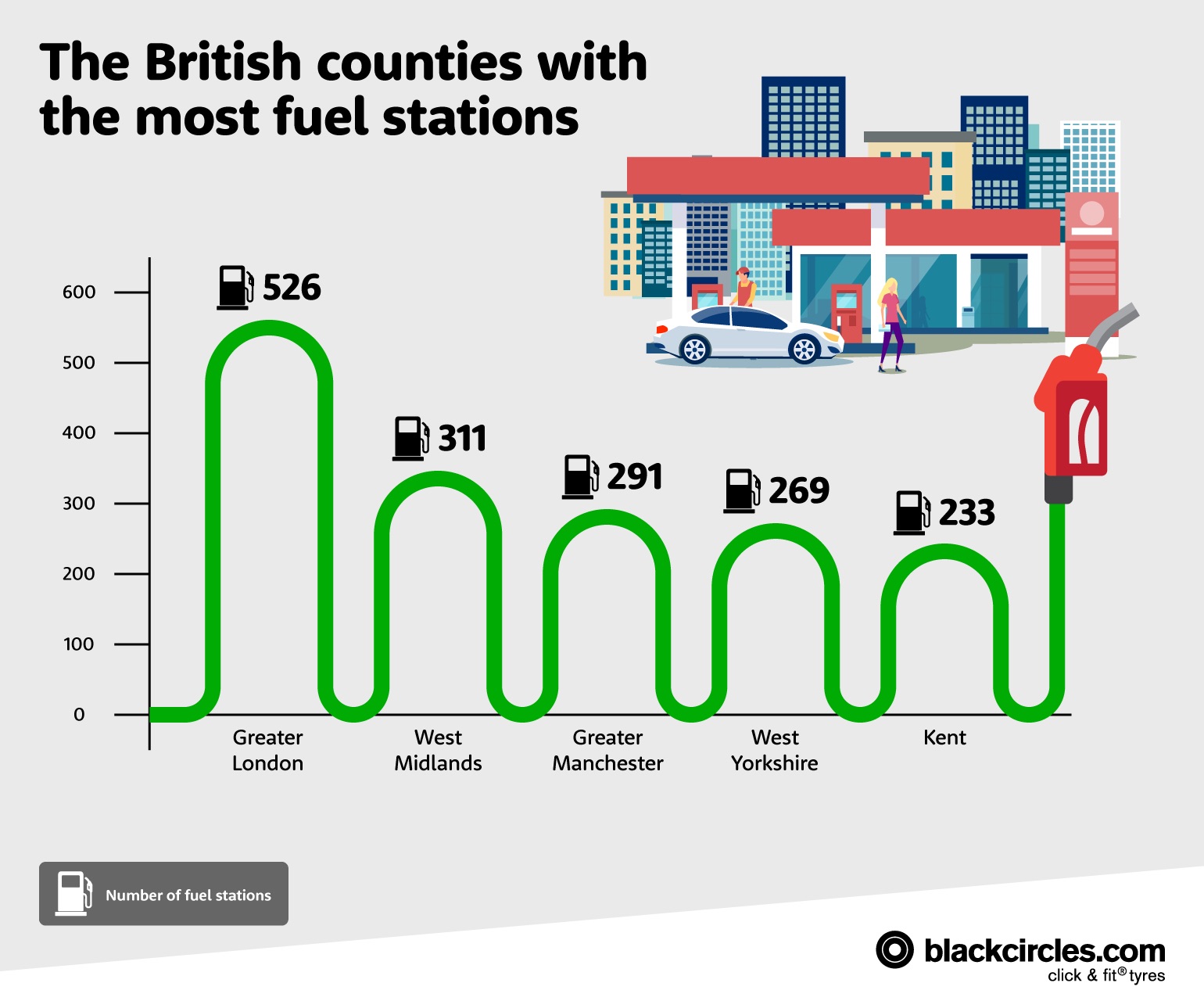
- With 526 fuel stations, Greater London has the most in Britain
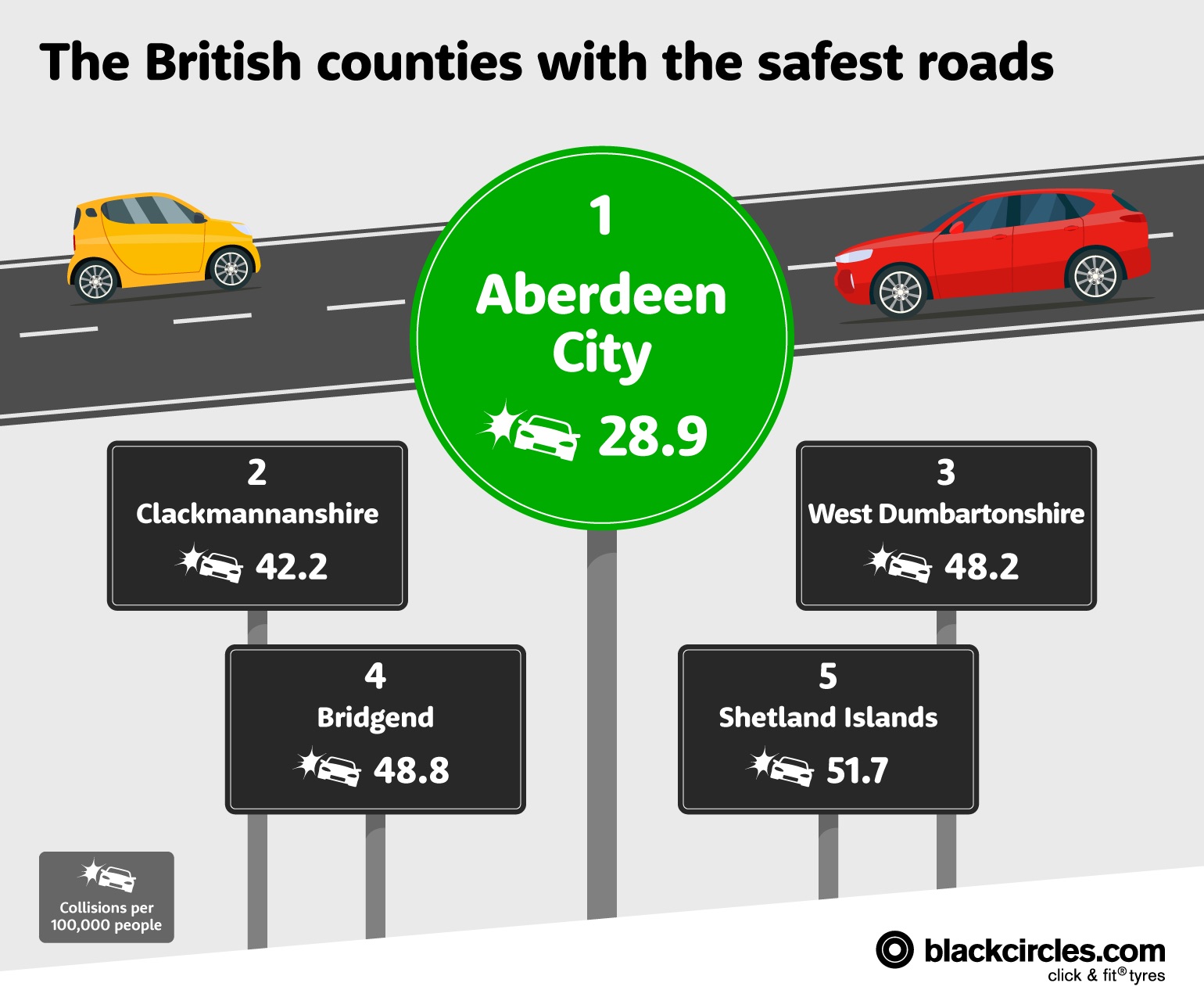
- Aberdeen City has the safest roads in the study, with 28.9 reported road collisions per 100,000 people.
- 7 of the top 10 counties for road safety are in Scotland; meanwhile, no English counties feature in the top 40.
The best British road trip locations
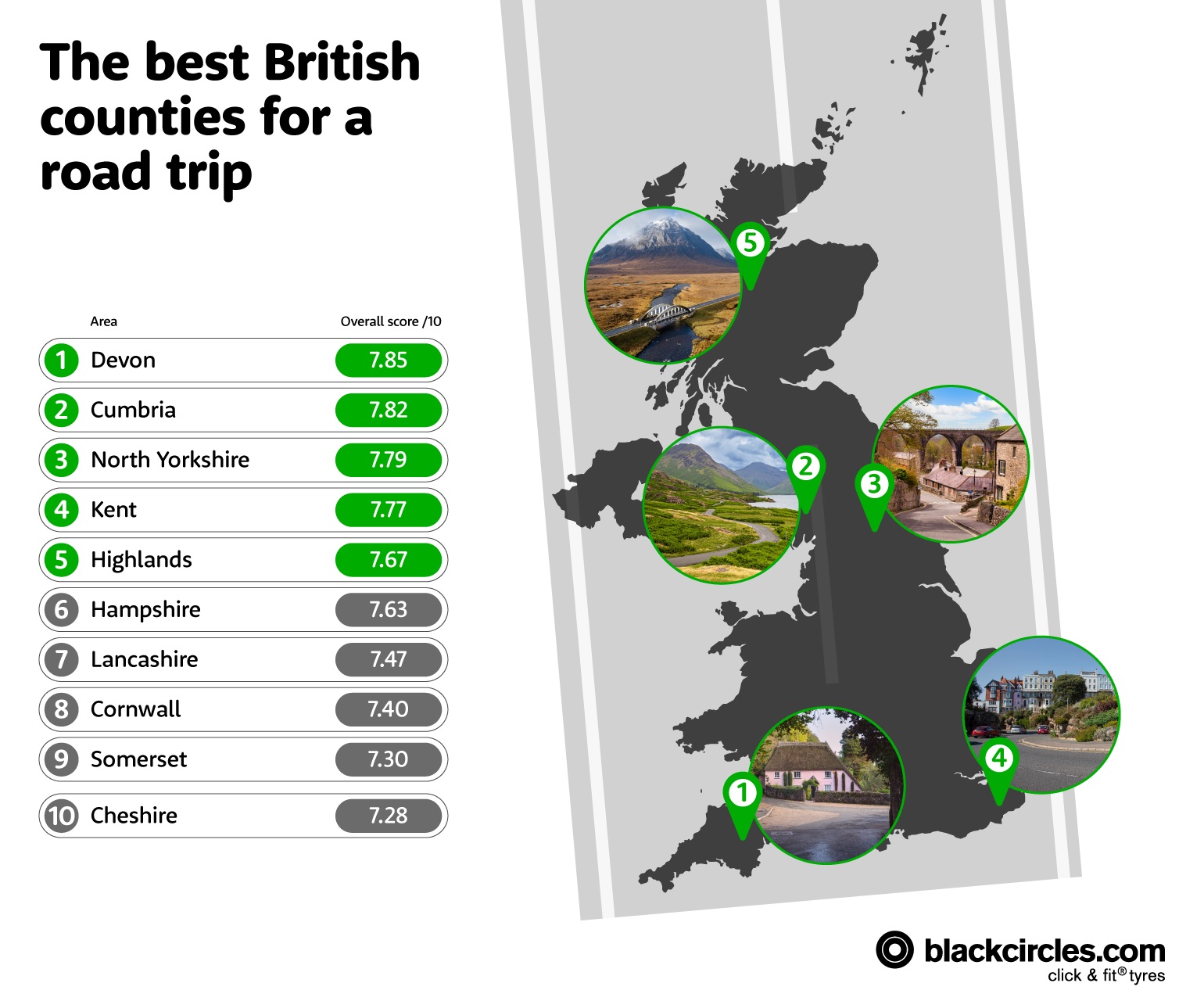
The best road trips balance scenery, convenience and safety. While some counties stand out for their campsites and walking routes, others perform strongly for practical motoring factors such as fuel stations and road safety.
To find the best counties for a British road trip, each area was scored across five categories: fuel stations, campsites, tourist attractions, road safety and walking trails. Each factor was normalised and combined to create an overall road trip score out of 10.
| Rank
| County
| Region
| Fuel stations
| Campsites
| Tourist attractions
| Road collisions per 100,000 people
| Walking trails
| Overall score /10
|
|---|
| 1
| Devon
| South West
| 182
| 388
| 278
| 222.8
| 1,007
| 7.85
|
| 2
| Cumbria
| North West
| 116
| 349
| 166
| 155.5
| 2,300
| 7.82
|
| 3
| North Yorkshire
| Yorkshire and The Humber
| 166
| 512
| 344
| 256.6
| 1,365
| 7.79
|
| 4
| Kent
| South East
| 233
| 321
| 236
| 204.0
| 769
| 7.77
|
| 5
| Highland
| Scotland
| 76
| 186
| 234
| 115.0
| 1,285
| 7.67
|
| 6
| Hampshire
| South East
| 217
| 130
| 265
| 221.1
| 1,302
| 7.63
|
| 7
| Lancashire
| North West
| 206
| 228
| 157
| 210.9
| 819
| 7.47
|
| 8
| Cornwall
| South West
| 96
| 441
| 224
| 161.7
| 557
| 7.40
|
| 9
| Somerset
| South West
| 166
| 203
| 212
| 227.6
| 648
| 7.30
|
| 10
| Cheshire
| North West
| 138
| 92
| 191
| 129.4
| 525
| 7.28
|
1. Why Devon is the best road trip destination in Britain
Devon ranks as the best county in Britain for a road trip, with an overall score of 7.85 out of 10, over 1.5x more than the average score (4.98).
The county performs strongly across all of our road trip factors, with 388 campsites and caravan sites, 278 tourist attractions, and over 1,000 walking trails, including a large section of the 630-mile Salt Path, which inspired the book and film of the same name.
There are 182 fuel stations across Devon, too, giving drivers plenty of options when planning longer journeys across the county.
With coastal routes and countryside drives to national parks and seaside towns, Devon has a strong mix of practical facilities, stop-off points and scenery, like the Valley of Rocks in Exmoor.
For drivers heading away for a longer break, especially those travelling by campervan, the number of campsites also makes it one of the most convenient places to explore by road.
2. A huge number of walking trails puts Cumbria second in our list
Cumbria is second, predominantly for its outstanding outdoor offering, which shouldn’t be surprising given that the county is home to the Lake District.
It’s the sheer number of walking routes that make Cumbria a ramblers' paradise, with trails like Scafell Pike and Helvellyn among the more challenging. In total, the county has 2,300 of them – the highest number of any county in the study – over 50% more than second-placed Derbyshire (1,519) and 6x more than the average (355).
Cumbria also has 349 campsites and caravan sites, including in popular Lake District destinations like Keswick and Windermere, making it a strong choice for drivers planning a walking holiday, camping trip or longer staycation.
Cumbria also performs well for road safety, with 155.5 reported road collisions per 100,000 people, which is lower than several other counties in the top 10.
Despite not finishing in the top 20 for fuel stations (116), this is still 45% higher than the average of 80, cementing Cumbria’s place as one of the best road trip destinations in Britain.
3. North Yorkshire has the most campsites in Britain and plenty of tourist attractions
North Yorkshire rounds out the top 3 and has the highest number of campsites and caravan sites in our study, with 512 – more than 6 times higher than the average of 85 and giving road trippers plenty of options for overnight stays.
North Yorkshire also has 344 tourist attractions, including various activities in and around York, like the City Walls, Railway Museum and original filming locations from Harry Potter.
With national parks, market towns, coastal routes and countryside drives, North Yorkshire offers plenty for road trippers to explore. And, with 166 fuel stations, staycationers can plan longer journeys with confidence.
The best places for a road trip in Scotland and Wales
While Devon tops the overall ranking, Scotland and Wales are home to some stunning road trip locations, with excellent walking and camping opportunities.
If you’re considering a road trip to Scotland or Wales, we ranked the best counties to help you plan…
Gwynedd is the best place in Wales for a road trip, scoring 7.09 out of 10
Gwynedd is Wales’ best county for a road trip, performing particularly well for campsites and outdoor routes, scoring above average for campsites (329) and walking trails (642).
The county also records 71.2 road collisions per 100,000 people, well below the average of 129.9, making it one of the safer counties analysed.
Gwynedd has a strong balance of scenery, including the mountains of Eryri (Snowdonia) National Park, road safety and camping infrastructure – making it a top spot for weekends and longer breaks.
The Highlands is the best place in Scotland for a road trip, scoring 7.67 out of 10
With popular walking trails and attractions, like Ben Nevis (Scotland’s highest mountain) and Loch Ness, it’s no surprise that the Highlands are the best place in Scotland for a road trip, with an overall score of 7.67 out of 10.
The area ranks fifth overall across Great Britain and performs strongly across several road trip factors.
Home to the NC500, the Highlands have long been a favourite for touring visitors, and there’s plenty to do and see, with the Highlands scoring above average in tourist attractions (234), walking trails (1,285) and campsites (186).
The Highlands also have a relatively low collision rate, with 115.0 reported road collisions per 100,000 people, over 10% less than the average (129.9). For drivers planning a longer Scottish road trip, this combination of attractions, walking routes and safer roads makes it one of the strongest destinations in Britain.
Aberdeen City has the safest roads in Great Britain
| Rank
| County
| Region
| Road collisions per 100,000 people
|
|---|
| 1
| Aberdeen City
| Scotland
| 28.9
|
| 2
| Clackmannanshire
| Scotland
| 42.2
|
| 3
| West Dunbartonshire
| Scotland
| 48.2
|
Road safety is one of the most important practical factors for any road trip. While scenic routes and attractions may shape where drivers want to go, safer roads can make the journey more comfortable and reduce the risk of disruption.
Aberdeen City has the safest roads in our study, with 28.9 reported road collisions per 100,000 people – that’s over 100 less than the average (129.9).
Scotland dominates the top 10, with 7 counties listed, including Clackmannanshire in second (42.2) and West Dunbartonshire in third (48.2).
Welsh roads are also well-represented in the top 10, with Bridgend in 4th (48.8), Neath Port Talbot in 8th (53.8), and Swansea in 9th (54.9).
Interestingly, no English counties feature in the top 40, highlighting a clear regional divide in road safety performance. Greater Manchester is the highest-ranked at 41st place, with 92.8 road collisions per 100,000 people.
Greater London has the most fuel stations in Britain
| Rank
| County
| Region
| Fuel stations
|
|---|
| 1
| Greater London
| London
| 526
|
| 2
| West Midlands
| West Midlands
| 311
|
| 3
| Greater Manchester
| North West
| 291
|
Fuel station access is one of the most practical factors for road trippers, especially those covering long distances or travelling through rural areas.
Greater London has the most fuel stations in the study, with 526. The West Midlands ranks second, with 311, followed by Greater Manchester, with 291.
English counties dominate the top 50 of our rankings. In fact, only four Scottish counties are in the top 50, with the Highlands finishing highest at 44th, with 76 fuel stations – four fewer than the average (80).
Meanwhile, only two Welsh counties feature – Powys in 47th (55) and Carmarthenshire in 50th (42).
While larger urban areas naturally have more fuel stations, this still matters for road trip planning. Roadtrippers heading to more rural or remote areas should check their route in advance, especially if travelling early in the morning, late at night or in a vehicle that uses more fuel than usual.
This is particularly important for campervan drivers, who may be travelling longer distances with a heavier vehicle. Planning fuel stops before setting off can help avoid unnecessary detours and reduce the risk of running low in remote areas.
North Yorkshire has the best access to campsites of any county in Great Britain
| Rank
| County
| Region
| Campsites
|
|---|
| 1
| North Yorkshire
| Yorkshire and The Humber
| 512
|
| 2
| Cornwall
| South West
| 441
|
| 3
| Devon
| South West
| 388
|
For drivers planning a longer road trip, especially those travelling in a campervan or towing a caravan, access to campsites can make a big difference.
Each of these counties scored well above the average of 85 campsites, but our research reveals that North Yorkshire has the most campsites and caravan sites of any county analysed, with 512. The top three are completed by two counties in the South West, as Cornwall has 441 campsites, while Britain’s best county for a road trip, Devon, ranks third with 388.
Cumbria has the most walking trails of any county in Britain
| Rank
| County
| Region
| Walking trails
|
|---|
| 1
| Cumbria
| North West
| 2,300
|
| 2
| Derbyshire
| East Midlands
| 1,519
|
| 3
| North Yorkshire
| Yorkshire and The Humber
| 1,365
|
Walking trails are another important factor for road trippers, especially those using their vehicle to explore rural areas, national parks and coastal routes.
Cumbria has the most walking trails of any county in our research, with 2,300 – that’s nearly 2,000 more than the average of 355. Elsewhere, Derbyshire ranks second, with 1,519, followed by North Yorkshire, with 1,365.
With so many listed walking trails, it’s no surprise that Cumbria ranks 2nd overall. When you’re planning your Lake District road trip, remember that rural trips can place extra demand on vehicles. Uneven roads, steep inclines, changing weather and heavier loads can all affect tyre performance, so you need to carry out basic checks before travelling.
Greater London has the most tourist attractions in Britain
| Rank
| County
| Region
| Tourist attractions
|
|---|
| 1
| Greater London
| London
| 579
|
| 2
| North Yorkshire
| Yorkshire and The Humber
| 344
|
| 3
| Devon
| South West
| 278
|
It’s not surprising that the capital has the most tourist attractions, with 579 galleries, museums, theme parks, zoos, and more, with London scoring over 6x higher than the average (91). Devon and North Yorkshire also rank in our top three, with 278 and 344 attractions respectively.
If you’re planning a visit to Greater London, you must also consider the practical side of doing so – congestion charges, parking and traffic can add all time and cost to your journey.
For attraction-led road trips, southern counties such as Kent, Surrey, and Oxfordshire may offer a stronger balance of places to visit, campsites, fuel stations and accessibility for cars or campervans.
Essential vehicle checks you should do before heading off on a road trip
Ray Kavanagh, CEO at
Blackcircles, explains the checks you need to make before heading on a road trip and the importance of doing so…
“Road trips are a great way to explore Britain, but they can also place more strain on your vehicle than everyday driving. Longer journeys, heavier loads, rural roads and changing weather conditions can all affect how your car performs, so it’s important to carry out a few basic checks before setting off.
1. Check your tyres
“Tyres should be one of the first things drivers check. Make sure they are inflated to the correct pressure, including any adjustment needed for extra passengers, luggage or camping equipment. Under-inflated tyres can increase fuel consumption and cause uneven wear, while overloading a vehicle can put additional pressure on the tyres and suspension.
2. Measure your tread depth
“You should also check your tread depth and look for any visible signs of damage, such as cuts, cracks, bulges or objects lodged in the tyre. The legal minimum tread depth in the UK is 1.6mm, but drivers should not wait until tyres are at the limit before replacing them, especially before a long journey.
“In terms of motorhome and campervan tyres, it’s especially important to make sure they’re suitable for the weight and use of the vehicle. These are often loaded with luggage, equipment, water tanks and passengers, all of which can affect tyre pressure and performance.
3. Ensure you have enough oil, coolant, and screenwash
“Drivers should also check their oil, coolant, screenwash, lights and wipers before leaving. If the car pulls to one side, vibrates at speed, or the tyres are wearing unevenly, this could point to an alignment or suspension issue that should be looked at before a long trip.
4. Think about keeping emergency supplies
“It’s also worth keeping an emergency kit in the vehicle, including a warning triangle, torch, phone charger, water, basic first aid supplies and details of your breakdown cover.
“A few minutes of preparation before you leave can help reduce the risk of problems once you’re on the road.”
Methodology
Blackcircles is the UK’s leading online tyre retailer, helping drivers compare and buy tyres online before booking fitting at a time and location that suits them from a network of over 2,000 garages nationwide.
In addition to tyre fitting, Blackcircles offers MOTs and vehicle servicing to help keep cars safe, roadworthy, and compliant with UK regulations.
To reveal the best counties for a UK road trip, each county in Great Britain was scored across five categories: fuel stations, campsites, tourist attractions, road safety and walking trails.
Fuel stations
The number of fuel stations in each county was sourced from OpenStreetMap using the tag amenity=fuel.
Campsites
The number of campsites and caravan sites in each county was sourced from OpenStreetMap using the tags tourism=camp_site and tourism=caravan_site.
Tourist attractions
The number of tourist attractions in each county was sourced from OpenStreetMap using the tags tourism=attraction, tourism=museum, tourism=theme_park, and tourism=zoo.
Road safety
Road safety data was sourced from the
Department for Transport’s reported road accidents, vehicles and casualties tables for Great Britain, using RAS0403.
The total number of reported road collisions in each local authority was aggregated to county level and normalised per 100,000 residents.
Walking trails
The number of publicly listed trails for each county was sourced from
AllTrails.
All data was standardised to a consistent set of counties. Where necessary, local authorities were grouped into broader areas, such as Greater London, the West Midlands and Greater Manchester, to ensure fair comparisons.
Each factor was then normalised on a scale from 0 to 10. An overall index score out of 10 was calculated for each county by taking the average of the five normalised category scores.
Frequently Asked Questions
What’s the best UK road trip route for couples or a romantic getaway?
The Cotswolds’ honey-stone villages, the Lake District’s lakeside inns, and Highland glens all make romantic road trips. Pick routes with boutique stays and fewer long driving days, so you spend more time exploring together.
What are the best UK road trip destinations for families with children?
Devon and Cornwall are ideal, with plenty of campsites, beaches, and family attractions close together. Plan shorter driving days, build in regular rest stops, and check tyre pressures before setting off with extra passengers and luggage.
Can I do a UK road trip in an electric car?
Yes, the UK’s charging network covers most road trip routes, including motorways and rural areas. Plan your stops using an EV charging app in advance, especially in remoter counties like the Highlands with fewer fuel stations.
How much does a UK road trip cost, and can I book accommodation as I go?
Costs vary with fuel, campsites, and attractions, but budgeting for fuel and pitch fees keeps trips affordable. Many campsites take walk-ups outside peak season, though booking ahead is safer in popular counties like Devon and Cumbria.
What is a good 7-day UK road trip itinerary?
Try a week-long loop through Devon, Cornwall, and Somerset for coastline and countryside, or tackle the NC500 in the Highlands for a full week of dramatic scenery, small villages, and quieter roads.
Is the NC500 worth doing, and what stops should I include?
Yes, the NC500 is one of Britain’s best scenic routes. Key stops include Applecross, Durness, and Ullapool, alongside Highland attractions and walking trails. Allow a full week and check fuel stations in advance, as they’re sparser.
What’s the best UK road trip for winter driving, and is wild camping legal?
Winter road trips favour lower, milder routes like Devon and Kent over exposed Highland passes. Wild camping is only legal in most of Scotland; elsewhere, stick to registered campsites and check local rules before parking overnight.
Is the Isle of Skye or the Cotswolds worth visiting on a road trip?
Both are excellent choices. Skye offers dramatic coastal scenery and quieter roads, well suited to a campervan, while the Cotswolds is ideal for shorter countryside breaks with honey-stone villages and easy stops along the way.
Can I visit National Trust sites, and is breakdown cover worth it on remote routes?
Yes, many road trip counties, including Devon and Cumbria, have National Trust properties worth building into your route. Breakdown cover is especially worthwhile in remoter areas like the Highlands, where help can take longer to arrive.
What are the best coastal road trip routes, and are there any charges to plan for?
Cornwall, Pembrokeshire, and the Norfolk coast all offer strong coastal driving routes. If your trip passes through Greater London, factor in the congestion charge, and check for tolls or restrictions on other routes in advance.