If you have gone looking for the correct tyre pressure for your
Volkswagen Polo and found half a dozen different answers, there is a reason for that. Published figures for the Polo range from the high twenties to the low forties in psi, and a good number of them are wrong for your car.
The reason is straightforward: Volkswagen does not publish a tyre pressure table for the Polo at all. The owner’s manual carries no list of figures. What it says instead is that the correct pressure for your car is printed on a label fitted to the vehicle, and that you should always use the pressure specified on that label.
That is actually good news, because it means there is a single authoritative answer for your Polo – it is just on your car rather than on a website. This guide shows you where to find it, how to read it, and how to check your pressures properly once you have it.
Where to Find Your VW Polo Tyre Pressure Label
The location depends on which generation of Polo you have.
Polo Mk6 (2017 onwards)
On the sixth-generation Polo, the label is fitted either on the driver’s door pillar or inside the fuel tank flap. Open the driver’s door and look at the upright pillar the door closes against. If there is nothing there, open the fuel flap and check the inner face.
Polo Mk5 (2009 to 2017)
On the fifth-generation Polo, the label is inside the tank flap. Open the fuel filler flap and read the label on the inner face.
Polo Mk4 (2002 to 2009) and earlier
On older Polos, check the tank flap first and the driver’s door area second. Labels on cars of this age are frequently faded, painted over or missing entirely – if yours is unreadable, skip ahead to the section on what to do about it.
How to Read Your VW Polo Tyre Pressure Label
The label does not use plain words. It uses a standard set of markings, which is why so many owners misread it.
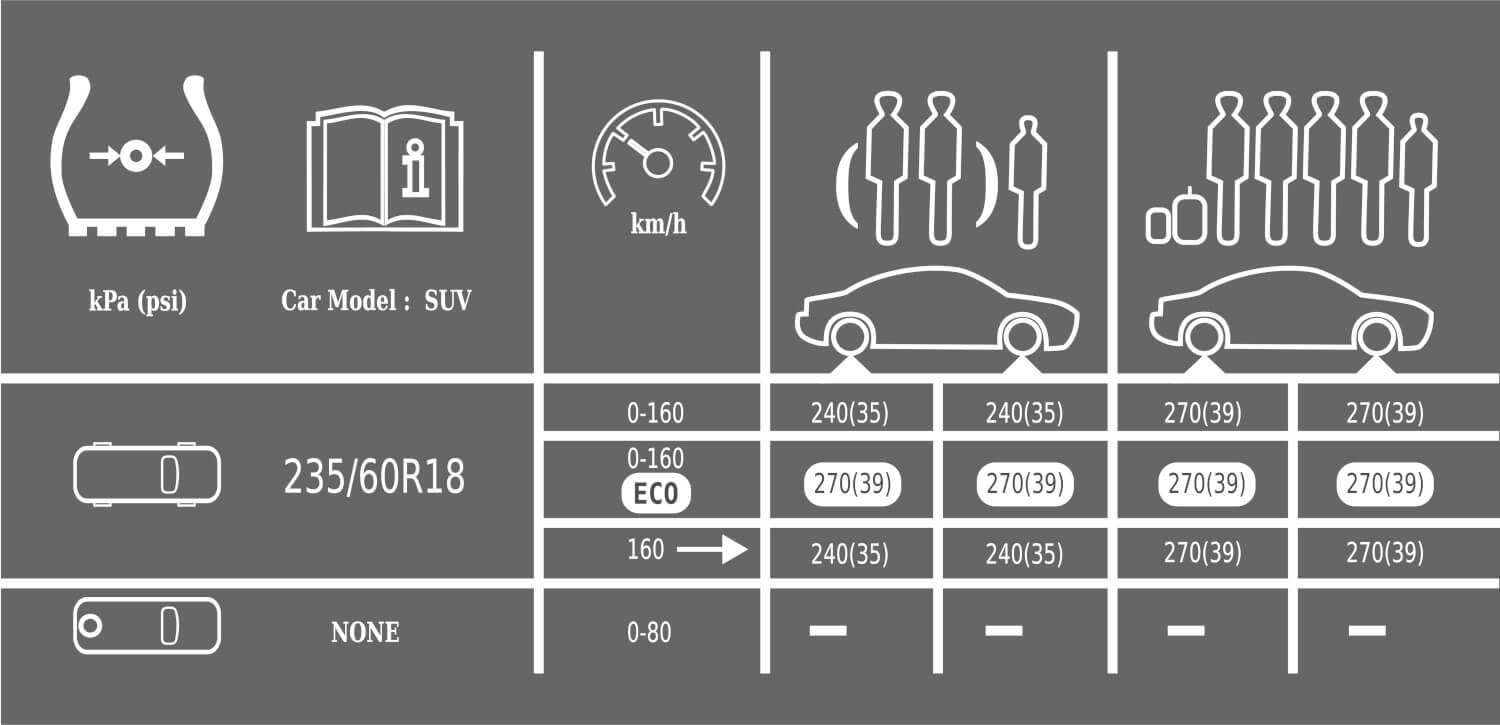
An example pressure label. Layouts vary widely between manufacturers and markets – this one is a generic illustration, and the sizes and figures shown are not VW Polo values. Always read the label fitted to your own car.
The pictograms, and what they actually mean
Rather than words, the label uses icons. The ones you will see on a Polo label are:
- A tyre cross-section with inward arrows – this is the pressure section, with the units alongside it, usually kPa with psi in brackets, or bar.
- An open book with an information symbol – a pointer to your handbook for anything the label does not cover.
- A car outline with two or three human figures – partial load. Everyday driving.
- A car outline with a full set of figures, usually alongside luggage – full load.
- Small arrows or markers beneath each car outline pointing at the front and rear wheels – these tell you which figure is the front axle and which is the rear.
- A wheel icon on its own row, often marked with a dash or a single high figure – the spare wheel.
Some labels add further columns. An ECO marking indicates a higher pressure intended to reduce rolling resistance and improve fuel economy. Certain labels also band figures by speed. Neither of these is the same as the comfort pressure described below.
If your label and your gauge do not use the same units, the conversion is straightforward: one bar is exactly 100 kPa, and roughly 14.5 psi. So a label reading 220 kPa is 2.2 bar, or about 32 psi.
Volkswagen’s own handbook annotates the label as follows.
| Marking
| What it shows
|
|---|
| A
| Tyre pressure for the tyres on the front axle
|
| B
| Tyre pressure for the tyres on the rear axle
|
| 1
| A reminder to check the tyre pressure when the tyres are cold
|
| 2
| Tyre pressure for partial load
|
| 3
| Comfort tyre pressure for partial load (on some vehicles only)
|
| 4
| Tyre pressure for full load
|
| 5
| Tyre pressure for the spare wheel
|
To use the label: find the row matching the tyre size actually fitted to your car, then read across to the column for the load you are carrying. Take the front figure from A and the rear figure from B – they are frequently different, because the Polo carries more weight over its front axle.
Important: the label may list additional tyre sizes that are not approved for your particular Polo, and its appearance varies between vehicles. Do not simply pick the closest-looking size. To confirm which sizes are approved for your car, check your V5C registration certificate or EC Certificate of Conformity, or ask an authorised Volkswagen retailer.
Disclaimer: the guidance in this article is drawn from Volkswagen Polo owner’s manual information and is intended for reference purposes only. Label layouts, markings and figures vary by generation, model year, trim and market. The pressure label on your own vehicle always takes precedence, and an authorised Volkswagen retailer can confirm the correct specifications for your car. We accept no responsibility for any discrepancies or incorrect use of this information.
Partial Load, Full Load and Comfort Pressure Explained
Most of the confusion around VW Polo tyre pressure comes from these columns. They are not alternatives to choose between on preference – they describe how the car is loaded.
Partial load
Everyday driving: a driver, perhaps one passenger, and a light boot. This is where most Polos should sit most of the time.
Full load
Every seat occupied and luggage on board. Use these figures for holidays, airport runs with a packed boot, roof boxes, or any time the car is close to its capacity. Volkswagen is explicit that pressures must be adjusted to the corresponding load condition – and underinflation under load is the more dangerous of the two mistakes, because it lets the tyre flex and overheat.
Comfort pressure
Some Polos show a third figure, a comfort tyre pressure for partial load. It is a slightly softer setting that allows increased driving comfort, at the cost of fuel consumption, which may increase when running it. It applies to partial load only. If ride quality matters more to you than the last few miles per gallon, it is a legitimate choice rather than a compromise.
It is worth not confusing this with an ECO marking, which some labels carry and which works in the opposite direction. An ECO figure is higher than the standard pressure, because raising pressure reduces rolling resistance and improves economy. A comfort figure is lower than standard, because softening the tyre improves ride. One trades comfort for fuel, the other trades fuel for comfort.
Whichever column you use, set the pressures back down once the car is empty again – and never exceed the maximum pressure printed on the tyre sidewall. Over-inflation is less immediately dangerous than under-inflation, but it shrinks the contact patch, firms up the ride and wears the centre of the tread faster than the shoulders.
Why Your Label May Not Match the Figures You Found Online
It is common to read your own label, compare it with a guide online, and find the two do not agree. Neither is necessarily wrong.
The most frequent cause is column confusion. Because the label carries several columns, people compare a full load figure against someone else’s partial load figure. Reported readings for the same 15-inch Polo tyre range from around 28 psi to 38 psi purely on that basis.
The second cause is that Volkswagen tends to specify relatively high pressures. Higher pressure lowers rolling resistance, which helps official fuel economy and emissions figures. The trade-off is that pressures at the top of the range can wear the centre of the tread faster than the shoulders – which is why some owners run the comfort figures instead where their car offers them.
Either way, the answer is the same: your label, your tyre size, your load.
What to Do If Your Polo’s Tyre Pressure Label Is Missing
On older and higher-mileage cars, the label is often gone or illegible. You have three routes.
- An authorised Volkswagen retailer can confirm the correct figures from your vehicle identification number, and can usually supply a replacement label.
- Your owner’s handbook covers the wheels and tyres section, and Volkswagen publishes handbooks for recent Polos on its own website by model and edition.
- Your V5C registration certificate lists the tyre sizes approved for the car, which is what a fitter needs in order to establish the correct pressures.
What is not a good route is picking a figure from a general online chart and applying it. Getting this wrong by a few psi in the wrong direction, on a fully loaded car, is exactly the scenario Volkswagen warns causes tyres to overheat and fail.
How to Check Your VW Polo Tyre Pressure Properly
Volkswagen advises checking tyre pressures at least once a month, and before every long journey. Include the spare – it is filled to the highest pressure permissible for the vehicle, which is why its figure looks so high next to the road tyres.
Always check when the tyres are cold. The specified figures apply to cold tyres, and a warm tyre reads higher. In practice that means the car should not have covered more than a mile or two at low speed in the previous three hours.
Ambient temperature matters as well. Air contracts as it cools, so pressures fall in cold weather – in the region of 1 psi for every 5°C drop. That is why warning lights so often appear on the first properly cold morning of autumn, and it is usually a genuine drop rather than a fault.
This matters most before a long motorway run. Check cold on the driveway rather than at the services, because tyres that have been turning at speed will read high, and topping up from that reading leaves you under-inflated once they cool.
This produces the single most consequential mistake owners make. Never let air out of a warm tyre to bring it back down to the figure on the label. Once it cools, that tyre is underinflated – and Volkswagen’s own warning is that low pressure can raise tyre temperature enough that the tread peels off and the tyre bursts.
Two practical points:
- Do not press the gauge onto the valve at an angle. Careless handling of a pressure gauge can damage the valve itself.
- Refit the valve caps afterwards, and use caps matching the factory specification. Missing or unsuitable caps let dirt into the valve.
The VW Polo Tyre Pressure Warning Light
Volkswagen calls the system the Tyre Pressure Loss Indicator. A warning means at least one tyre has dropped below the reference value the system has stored.
Because it works from stored references rather than reading each tyre directly, inflating the tyres is only half the job. Volkswagen’s guidance is that after adjusting pressures you should follow the instructions for setting the monitoring system – in other words, save the new values.
On Mk6 Polos this is done through the infotainment system, under the vehicle or car settings menu. On many Mk5 Polos it is a physical button, usually on the centre console or beside the gear lever: inflate all four tyres correctly first, then hold the button with the ignition on until you get a confirmation.
Two things worth knowing. New tyres can expand slightly when first driven at speed, which is enough to trigger a single one-off warning – that is expected rather than a fault. And the values need re-saving whenever you switch between summer and winter wheels, which is a common reason a light appears shortly after a seasonal change.
If the warning returns within days of a reset, stop resetting it and have the tyres inspected. A light that keeps coming back is reporting a slow puncture, a leaking valve, or a poor seal at the rim.
Some loss is normal: a tyre in good condition sheds around 1 psi a month by itself. Losing noticeably more than that week after week points to a leaking valve core, corrosion where the tyre seals against an alloy rim, or a slow puncture – none of which the airline will fix.
Does Your Tyre Brand or Type Change the Recommended Pressure?
No. The figures are set by Volkswagen for the axle weights and the approved tyre sizes, not by whoever made the tyre.
Fit
Michelin,
Continental,
Goodyear,
Pirelli or a budget brand in the correct size, and your label figures still apply. The same holds for season: Volkswagen states that the pressures on the label apply to all-season, summer and winter tyres alike in the factory-fitted sizes.
The exception is size, not brand. If the tyre size fitted to your car differs from the label or type plate specification, the correct pressure has to be determined separately. Ask your fitter or a Volkswagen retailer to confirm the right settings.
Getting Your VW Polo Tyre Pressure Right
There is no single VW Polo tyre pressure to memorise, and any guide offering you one number is guessing. The correct figure is the one on your own car’s label, for the tyre size actually fitted, at the load you are carrying today.
In practice it comes down to four habits. Find your label – door pillar or tank flap depending on generation. Match your tyre size to the partial or full load column depending on how the car is packed. Check all four tyres cold, at least monthly and before long journeys. And save the new values so the Tyre Pressure Loss Indicator is working from an accurate baseline.
Get those right and your Polo steers more precisely, stops in a shorter distance, uses less fuel and wears its tyres evenly. Get them wrong and you pay for it in all four at once.
And if the tread is already close to the legal limit, correct pressures will not rescue it – which is the point at which pressure stops being the thing to fix.
Buy VW Polo Tyres Online with Blackcircles.com
Correct tyre pressure only works on tyres with tread left to give. If yours are approaching the limit, browse
tyres for your Volkswagen Polo and have them fitted at one of over 2,200 garages across the UK, at a time that suits you.
You can also
book your MOT online with Blackcircles.com to keep your Polo road-legal and safe.
Need new VW Polo tyres?
Enter your registration and postcode and we’ll show you the best tyres for your VW Polo
VW Polo Tyre Pressure FAQs
Why does my Polo’s label list tyre sizes my car does not have?
Volkswagen uses shared labels across specifications, so yours may show sizes that are not approved for your particular Polo. Check your V5C registration certificate or EC Certificate of Conformity for the sizes actually approved, or ask an authorised Volkswagen retailer.
Why is the spare wheel pressure so much higher than my road tyres?
Because the spare or temporary spare is filled to the highest pressure permissible for the vehicle, so it is ready whatever the car is carrying when you need it. Check it monthly with the others – a flat spare is a poor discovery at the roadside.
Can I use the comfort pressure all the time?
Where your label offers it, yes – but for partial load only, not for a fully laden car. Bear in mind fuel consumption may increase when running comfort pressures, so you are trading economy for ride quality.
How high can I safely inflate my Polo’s tyres?
Never above the maximum pressure printed on the tyre sidewall. That is a limit set by the tyre manufacturer, not a target. Your everyday setting should always come from the vehicle label for your load condition.
Why should I not let air out of hot tyres?
Because the label figures apply to cold tyres. A warm tyre reads higher simply because the air inside has expanded. Bleeding it down to the cold figure leaves it underinflated once it cools, which is the condition that causes overheating and tyre failure.
Do I need to reset anything after switching to winter wheels?
Yes. Set the correct pressures for the new wheels, then save the values again so the monitoring system has an accurate reference. Skipping this is a common reason the warning light appears soon after a seasonal wheel change.
Can checking my tyre pressure damage the valve?
It can if you are rough with the gauge. Volkswagen specifically warns against positioning a pressure gauge at an angle to the valve stem. Seat it square, take the reading, and screw the cap back on afterwards.
My tyres are new and the warning light came on once. Is something wrong?
Probably not. New tyres can expand slightly when first driven at high speed, which is enough to trigger a single pressure warning. Check the pressures cold, save the values again, and only investigate further if it recurs.
Does my Polo GTI need different pressures?
Usually yes, and usually higher, because the GTI carries more weight and runs a lower-profile tyre on a larger wheel. The label itself is in the same place as on any Polo of the same generation, and reads exactly the same way – so use the figures on your own label rather than a standard Polo figure.
Will correct tyre pressure actually save me money?
Yes, twice over. Underinflated tyres increase fuel consumption directly, and they wear out faster because the tread scrubs unevenly. Correct pressures return both the fuel and the full service life of the tyre.