If you've ever driven past a flash of white light and spent the next mile wondering what just happened, you're not alone. Rather than a single speed camera device, the UK has an entire family of enforcement technology designed to make our roads safer.
From radar boxes that have barely changed since the early 1990s to newer AI-assisted systems that can flag speeding, mobile phone use and seatbelt offences in the same pass, the police employ a plethora of different camera types in Britain.
Officially, they’re actually called safety cameras rather than speed cameras, and there are somewhere between 15 and 18 distinct variants in regular use across England, Scotland and Wales, depending on how narrowly you define each variant. Some flash, some don't. Some photograph your number plate, others photograph your face. This guide breaks down each one, how it measures your speed, and what to expect if you drive past one too quickly.
If you're more interested in what happens after a camera catches you,
our guide to UK speeding fines covers the penalty bands, points and court process in full.
At a glance, the main speed camera types UK drivers encounter are:
1. Gatso camera
2. Truvelo camera
3. Truvelo D-Cam
4. SpeedCurb
5. Watchman
6. DS2
7. SPECS
8. VECTOR
9. Temporary average speed cameras (roadworks)
10. HADECS3 (smart motorway)
11. Mobile speed camera vans
12. Handheld and tripod LIDAR
13. Community Speed Watch devices
14. Red light cameras (RLC)
15. Combined red light and speed cameras
16. AI-assisted multi-offence cameras
17. ANPR-linked enforcement cameras
Keep scrolling to find out how each one works.
How many speed cameras are there in the UK?
There's no single official register, but independent research gives a reasonable picture. The RAC Foundation, an independent road safety research charity, has tracked fixed and average speed camera provision across Great Britain for over a decade, and industry estimates put the number of fixed roadside cameras at around 7,000, on top of an expanding network of average speed camera zones covering more than 250 miles of road.
That figure doesn't include mobile camera vans, handheld laser devices, or the growing number of temporary average speed systems used through roadworks — so the true number of individual enforcement points in operation on any given day is considerably higher.
Fixed-point speed cameras
Fixed-point cameras simply measure your speed at a single, specific spot in the road.
Gatso camera
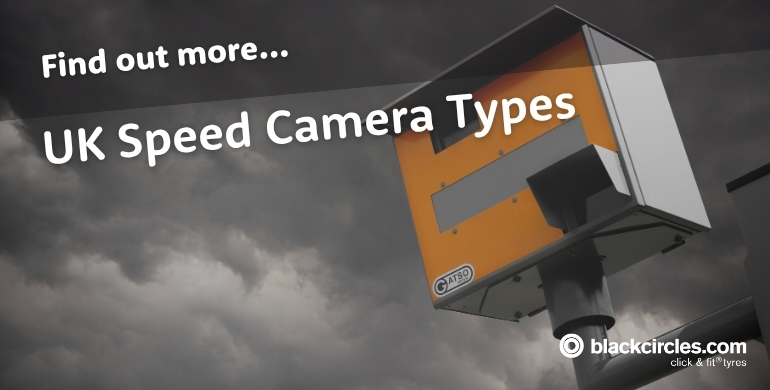
The Gatso is the camera most people picture when they think of UK speed enforcement: a grey or yellow box on a pole, usually with a distinctive rear-facing lens. It was also the UK's first speed camera, installed on the A316 at Twickenham Bridge in 1992.
Gatso cameras use rear-facing radar to measure a vehicle's speed as it passes, then photograph the back of the car — meaning they capture the number plate but not the driver's face. Because the radar has to detect the vehicle head-on to get an accurate reading, Gatsos can only catch traffic travelling in one direction unless a second unit is fitted. White lines painted on the road surface act as secondary, non-radar evidence of the speed recorded.
Truvelo camera
The Truvelo works the opposite way round. It's a forward-facing camera, meaning it photographs the front of an approaching vehicle — capturing both the number plate and the driver. Rather than radar, Truvelo cameras rely on piezoelectric sensors embedded in the road surface, which detect a vehicle's speed as it crosses two or more sensor strips a fixed distance apart. Three painted road markings back up the reading.
Because it uses an infrared flash rather than a visible white flash, a Truvelo camera can be considerably harder to spot at the roadside than a Gatso, and it doesn't dazzle oncoming drivers at night.
Truvelo D-Cam
The digital successor to the classic Truvelo, the D-Cam can be configured to face forward or backward, monitor several lanes at once, and — because it's fully digital — doesn't rely on getting film physically collected and developed, unlike some of the earliest Gatso units.
SpeedCurb
Less common today, SpeedCurb is a fixed camera system that uses road-surface sensor strips similar to Truvelo, rather than radar, and is typically deployed at accident hotspots where a highly accurate, tamper-resistant reading is required.
Watchman and DS2
Two older fixed-camera systems still found in a small number of locations. Watchman combines front-facing photography with automatic number plate recognition (ANPR), while DS2 is an earlier point-sensor design that has been largely superseded by newer Truvelo and Gatso variants as forces upgrade their equipment.
Average speed cameras
Average speed systems don’t capture your speed is at any single point, they calculate your average speed between two or more fixed cameras a known distance apart.
SPECS
SPECS cameras use ANPR to read your number plate at the first camera, log a timestamp, then read it again at the next camera further down the road. Dividing the known distance by the time taken gives an average speed for that stretch. Because it relies on number-plate recognition rather than radar or road sensors, SPECS doesn't use a visible flash, it operates using infrared illumination, day and night.
VECTOR
VECTOR is a more advanced average speed system built for multi-lane roads and motorway roadworks, where several cameras are needed to cover every lane simultaneously. Like SPECS, it works via ANPR and infrared illumination rather than a flash, and is one of the systems most deployed through temporary contraflows.
Temporary average speed zones (roadworks)
Increasingly, the yellow-and-black SPECS or VECTOR-style camera columns you see through motorway roadworks are temporary installations, moved from site to site as works progress. The RAC Foundation's research found that permanent average speed camera zones were associated with a 36% average reduction in fatal and serious collisions, and a 16% reduction in injury collisions of all severities, at the sites studied.
Smart motorway and variable speed cameras
HADECS3
The Highways Agency Digital Enforcement Camera System 3 — HADECS3 for short — is the camera used to enforce variable speed limits on England's smart motorways. Rather than one fixed threshold, HADECS3 automatically adjusts what counts as "speeding" in real time to match whatever limit is currently displayed on the overhead gantry signs above the carriageway. It uses dual radar units to cover every lane of the carriageway simultaneously and confirms the current speed limit via a system that reads the gantry signage electronically before enforcing it.
HADECS3 units are noticeably smaller than a Gatso or Truvelo and were, for a time, painted grey rather than yellow — a decision that proved controversial enough that National Highways later committed to repainting camera housings on the strategic road network in bright yellow to improve visibility, a change confirmed by the then Transport Secretary in 2015.
Mobile and handheld speed cameras
Not every camera is bolted to a pole. A significant proportion of UK speed enforcement — arguably the largest single category by number of deployments — comes from mobile units.
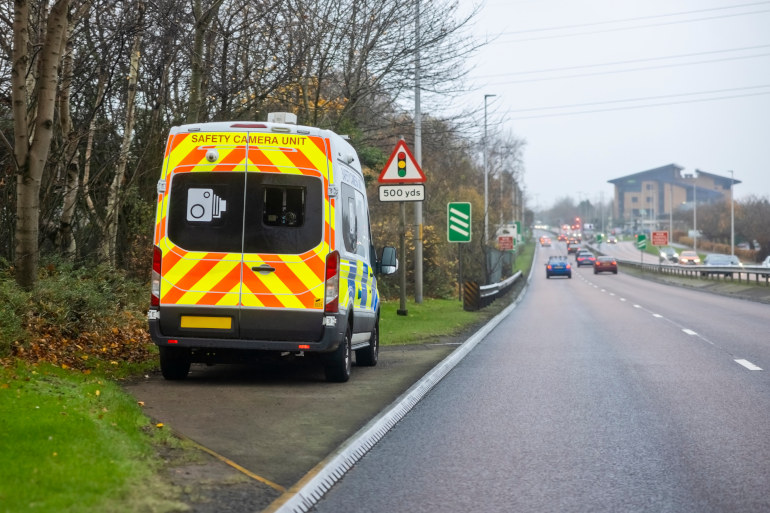
Mobile camera vans
Marked or liveried vans parked at the roadside, typically at locations with a known history of speeding or collisions, using radar or laser technology operated by a police officer or an accredited camera partnership operator. They must be parked legally and clearly signed to warn approaching drivers.
Handheld and tripod-mounted LIDAR devices
Officers also use handheld laser (LIDAR) speed guns, which fire a narrow laser beam at an approaching vehicle and calculate speed from the time it takes the beam to return. These are considerably more precise over long distances than radar and are often used from a stationary vehicle, a bridge, or a roadside tripod.
Community speed watch
While not strictly an enforcement camera in the legal sense, Community Speed Watch schemes use radar or laser speed-check devices operated by trained volunteers alongside the police. Vehicles recorded speeding don't receive a fine or points directly — instead, registered owners typically receive an advisory letter, with repeat offenders passed to the police for further action.
Red light and combined enforcement cameras
Red light cameras (RLC)
These trigger when a vehicle crosses the stop line after the lights have turned red, using sensors embedded in the road at the junction rather than a speed measurement. They photograph the rear of the vehicle as it passes through.
Combined red light and speed cameras
Many junction cameras now combine both functions in a single housing to check whether a vehicle ran the red light and whether it was speeding on approach, using the same sensor and camera hardware to enforce both offences.
New and emerging speed camera types
The new speed camera types most talked about at the moment fall into two categories: newer variants of existing technology, and multi-offence AI cameras that go beyond speed alone.
• Digital, multi-lane successors to older single-point cameras, like the Truvelo D-Cam, which can monitor several lanes and switch between forward- and rear-facing operation from the same unit.
• AI-assisted enforcement cameras, increasingly trialled by UK police forces, which use artificial intelligence and high-resolution imaging to detect several offences in a single pass — commonly speeding alongside mobile phone use, seatbelt non-compliance, or vehicle tax status via ANPR — without necessarily flashing at all.
• Expanding average speed networks, with more police forces and National Highways favouring permanent SPECS/VECTOR-style zones over single-point cameras, partly on the strength of the collision-reduction evidence referenced above.
Which speed cameras flash?
This is one of the most common questions drivers have, and the honest answer is: it depends on the technology, not just the camera's age.
| Camera type
| Does it flash?
| Why
|
| Gatso
| Yes. Bright white flash
| Uses radar plus a physical flash to photograph the rear plate, day or night
|
| Truvelo / Truvelo D-Cam
| Uses an infrared flash, not a visible one
| Avoids dazzling drivers at night; the flash isn't visible to the naked eye
|
| SPECS / VECTOR (average speed)
| No
| Relies on ANPR and infrared illumination rather than a flash
|
| HADECS3
| Yes, similar to a Gatso
| Radar-based, so uses a visible flash to capture the image
|
| Mobile radar vans
| Often yes, depending on the unit
| Many mobile units use the same radar-and-flash technology as a Gatso
|
| Handheld LIDAR
| Generally no
| Laser-based devices typically don't need a visible flash to capture a usable image
|
| Red light cameras
| Yes, typically
| Most use a visible flash to capture a clear plate image at night
|
If you're dazzled by a flash at the roadside, it's worth remembering that a single flash isn't automatically proof you've been caught — some systems fire twice to confirm speed via two readings, and not every flash results in a fixed penalty notice being issued.
Are all these cameras legally enforceable?
Yes, provided the specific device model has been through the Home Office's type-approval process. Under UK law, evidence of a speed measured by an unapproved device generally isn't admissible in court.
The Home Office publishes the technical requirements that speed, traffic light and lane-enforcement cameras must meet before police forces or safety camera partnerships can use them for prosecutions, covering everything from radar accuracy tolerances to image integrity.
Speed camera types UK: the bottom line
Whether it's a decades-old Gatso, a forward-facing Truvelo, or an AI-assisted camera trialling multiple offences at once, every device on this list exists for the same stated purpose: reducing speed-related collisions. The evidence from independent research bodies like the RAC Foundation and RoSPA broadly supports that average and fixed speed cameras are associated with meaningful reductions in serious and fatal collisions at the sites where they're deployed — even if public opinion on individual camera placements remains mixed.
Knowing which type you've passed won't change the outcome if you were speeding, but it does explain why some cameras flash and others don't, why some catch your face and others only your plate, and why slowing down just before a yellow box isn't the safeguard some drivers assume it to be. Ultimately, the safest solution to avoiding speed camera fines is to not exceed the speed limit.
Frequently asked questions
How many different types of speed camera are there in the UK?
Depending on how narrowly you count separate models and variants, there are between 15 and 18 distinct types of speed and safety camera in regular use across the UK, ranging from fixed-point cameras like Gatso and Truvelo to average speed systems like SPECS and mobile units operated by police forces.
What is the new speed camera called?
There isn't one single "new" speed camera replacing all others. Instead, UK police forces and National Highways are expanding two things: digital multi-lane cameras such as the Truvelo D-Cam, and AI-assisted enforcement cameras capable of detecting speeding alongside other offences, such as mobile phone use, in a single pass.
Is a Gatso or a Truvelo camera more accurate?
Both are Home Office type-approved and must meet the same accuracy tolerances to be used as evidence in court. Truvelo's road-sensor system is sometimes cited as marginally more precise because it doesn't rely on a radar signal, but in practical terms both are treated as equally reliable once approved.
Do speed cameras always flash when they catch you?
No. Radar-based cameras like Gatso, HADECS3 and many mobile units use a visible flash, while camera systems that rely on ANPR or infrared, such as SPECS, VECTOR and Truvelo, don't produce a visible flash at all.
Can you be caught by more than one speed camera type on the same journey?
Yes. It's entirely possible to pass a fixed Gatso, drive through a SPECS average speed zone, and pass a mobile camera van on the same stretch of road, particularly on major A-roads and motorways with roadworks.