
Join the conversation
We love to hear from our customers. Connect with us today and let’s start a conversation.
...searching



There are plenty of ways to see London. From the London Eye to the top of The Shard, the capital isn't short of places offering a view from above. But floating over the city in a 75-metre-long airship is something a little different.
Back in July, I had the opportunity to join Goodyear for a flight aboard its iconic Blimp, alongside my colleague David. What was originally scheduled to be a 90-minute flight turned into over two hours in the air, giving us a unique perspective of London and a better understanding of how these aircraft operate.
And to think, when the invitation first arrived, I wasn't entirely convinced it was genuine.
When an email landed in my inbox inviting David and me aboard the Goodyear Blimp, my first thought was that it might be a scam.
It's not every day you're offered the chance to fly over London in one of the world's most recognisable aircraft. The whole thing sounded almost too good to be true.
I wasn't quite sure what to expect. Part of me wondered whether the experience would be a little more makeshift than the invitation suggested.
As it turned out, the operation was far more impressive than I'd imagined.
Our flight was scheduled for Wednesday 8th July, departing from Damyns Hall Aerodrome in Upminster, Essex. We would be joining a small group of guests, including media representatives and content creators, for an afternoon above the capital.
You don't fully appreciate the size of the Goodyear Blimp until you're standing beside it.
At approximately 75 metres long and 17.4 metres tall, it's considerably larger than it appears when floating above a sporting event.
The aircraft is technically a Zeppelin NT, rather than a traditional blimp. The distinction comes down to its construction.
A conventional blimp is non-rigid, relying on internal gas pressure to maintain its shape. The Zeppelin NT uses a lightweight internal structure, giving it greater stability and allowing for a more advanced propulsion system.
Before boarding, we were taken through a safety briefing covering the aircraft, emergency procedures and the rather unusual process of getting on and off.
Fortunately for us, the Blimp had been brought down for refuelling, meaning boarding was relatively straightforward.
We would later discover that this isn't always the case.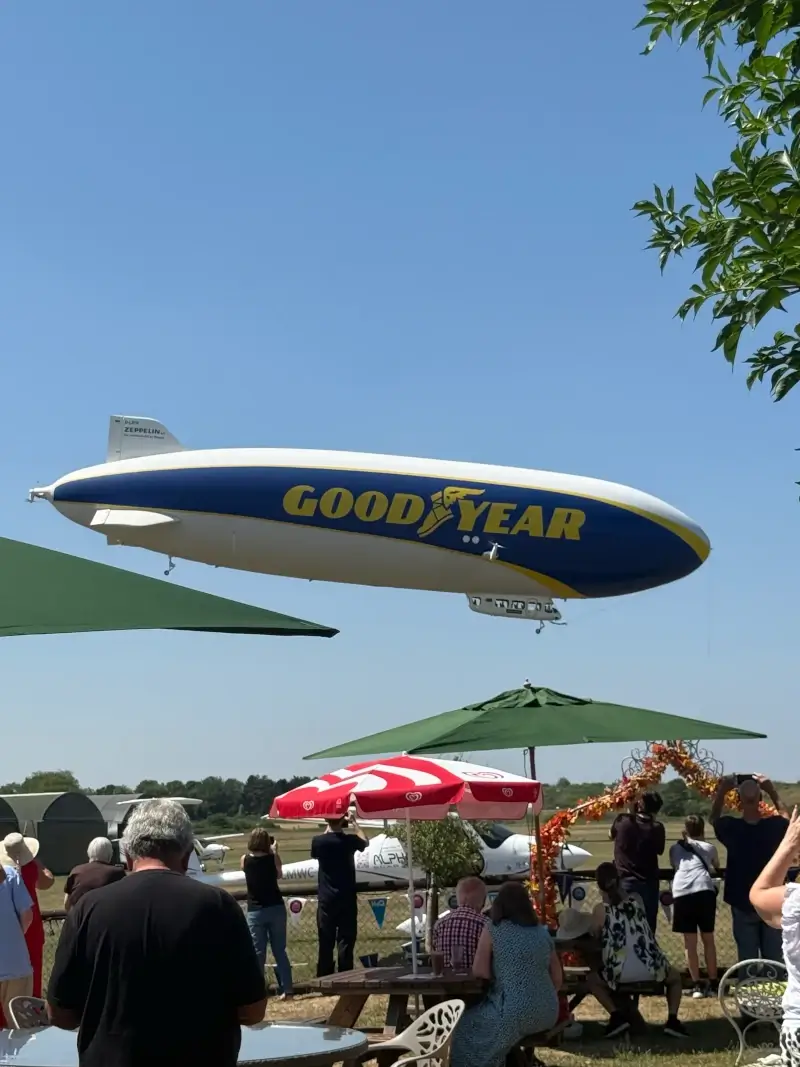
One of the most memorable parts of the experience came before we'd even reached London.
If you're used to flying on commercial aircraft, take-off normally involves building up speed along a runway before climbing into the air.
The Goodyear Blimp does things differently.
With helium providing the lifting force and three engines controlling its movement, the aircraft can climb almost vertically.
Watching the ground disappear beneath us without the usual acceleration of an aeroplane was a strange experience.
Once airborne, we were soon encouraged to get out of our seats and move around the cabin.
The gondola accommodates up to 14 passengers, with large windows providing views in almost every direction.
Being able to move freely between the windows made a big difference. Rather than being restricted to whichever side of the aircraft you happened to be sitting on, you could follow the scenery as it passed beneath you.
And with London coming into view, there was plenty to look at.
I've visited London plenty of times, but seeing it from the Goodyear Blimp gave me a different appreciation for the city.
The first thing that stood out was the scale of everything.
From above, the River Thames provides a natural route through the capital, winding between historic buildings, residential areas and the modern developments that have transformed London's skyline.
Landmarks such as Tower Bridge, the Houses of Parliament and The Shard are among the sights that make the capital so recognisable from the air.
But it wasn't simply the landmarks that made the experience worthwhile.
It was the ability to take everything in at a much slower pace than you'd normally associate with flying.
The Zeppelin NT has a maximum speed of around 125 km/h (78 mph), although sightseeing flights are generally operated at a more relaxed pace.
That slower movement gives you time to appreciate the layout of the city, pick out familiar locations and notice details you'd normally miss.
It's easy to understand why airships have been used for aerial filming and sports broadcasting for so many years.
For David and me, it was an opportunity to enjoy London from a perspective neither of us had experienced before.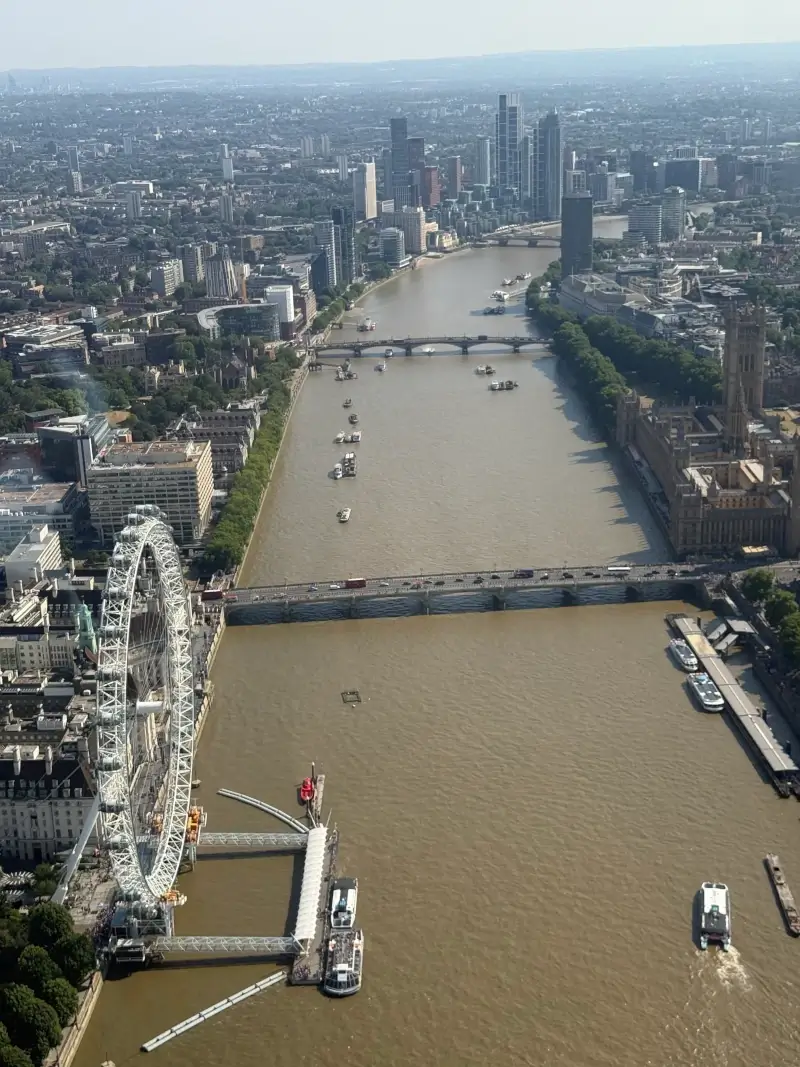
Something I found particularly interesting was learning about the crew and the level of coordination involved in operating the aircraft.
Our flight had two pilots, supported by a Goodyear representative who accompanied the passengers.
The Goodyear Blimp is operated by Deutsche Zeppelin-Reederei GmbH (DZR), a German company specialising in Zeppelin NT operations.
Although the aircraft appears to float effortlessly through the sky, there's considerably more involved in flying it than you might expect.
The Zeppelin NT uses three 200-horsepower engines, with a propulsion system that allows the pilots to control the direction of thrust.
This gives the aircraft some unusual capabilities, including hovering and rotating around its vertical axis.
Wind conditions, weight distribution and airspace restrictions all play an important role in flight planning.
One interesting detail we learned from the crew was that flying over London had generally been relatively straightforward.
The notable exception was the Formula 1 weekend.
With an influx of private aircraft travelling into London, the additional air traffic meant the Blimp had to be diverted.
It's an interesting reminder that even an aircraft travelling at a relatively leisurely speed still has to operate within the same wider aviation network as other aircraft.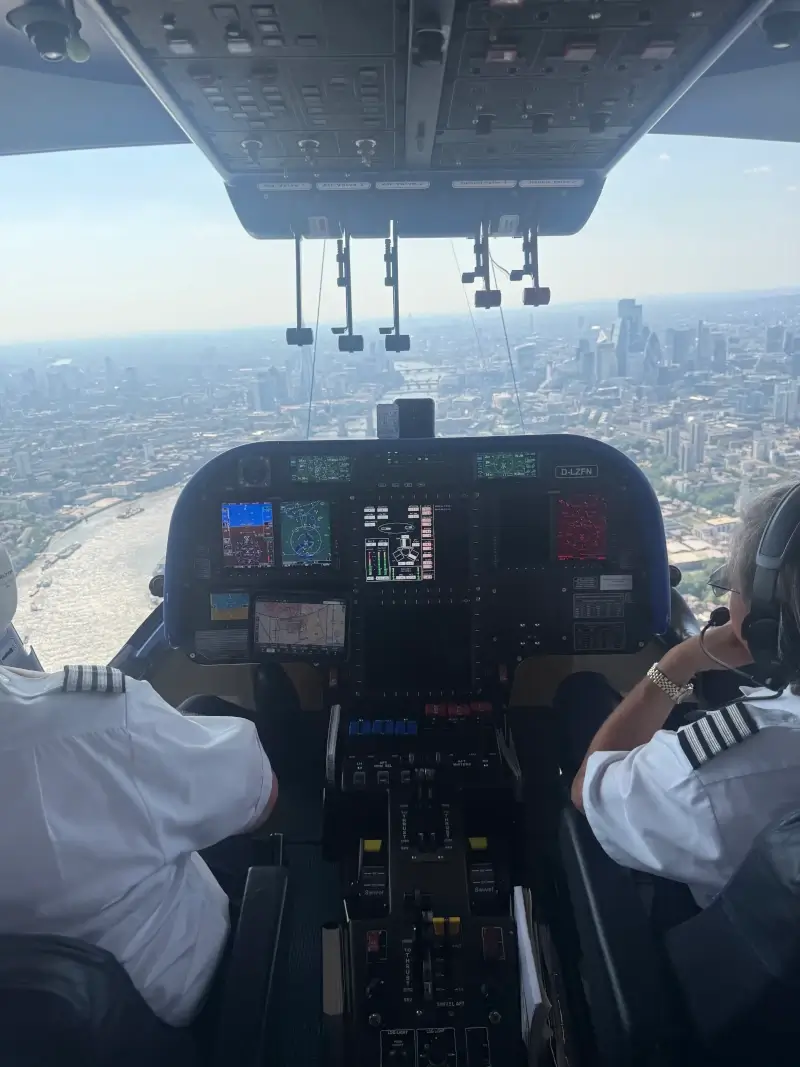
Of everything I learned during the flight, the process of boarding and disembarking was probably the most surprising.
Unlike a commercial aeroplane, which can sit on the ground while passengers get on and off, an airship has to carefully manage the relationship between its weight and the lifting force generated by the helium.
When the Zeppelin NT is operating close to the ground without being fully secured, changing the number of people aboard can affect that balance.
This is where the one-on, one-off procedure comes in.
As one passenger leaves the aircraft, another boards to replace their weight.
It's a carefully coordinated process involving the pilots and ground crew, helping to maintain the aircraft's balance during passenger exchanges.
Because our aircraft had been grounded for refuelling, we hadn't experienced this when boarding.
The group scheduled to fly after us, however, would be using the traditional passenger exchange method.
And that's where our afternoon took an unexpected turn.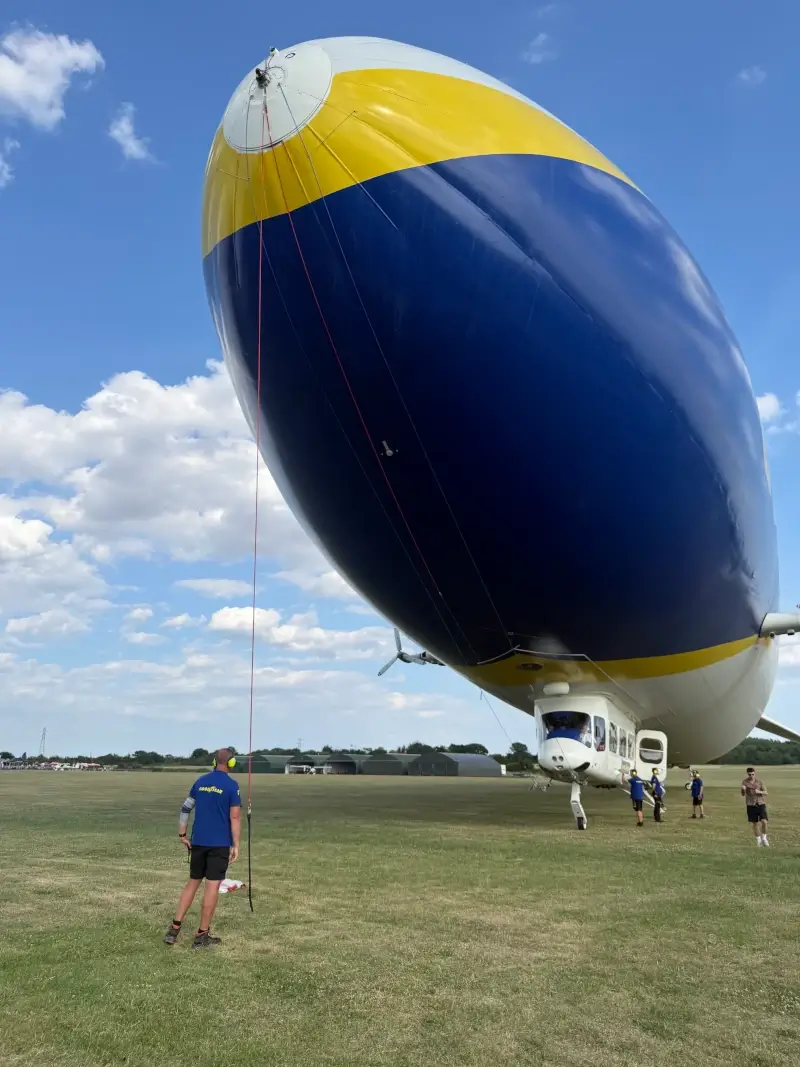
Our flight was originally scheduled to last approximately 90 minutes.
But as we approached the end of our time in the air, we learned that someone booked onto the next flight was stuck in traffic.
Normally, this would be an inconvenience.
For us, it turned out to be quite the opposite.
Because passengers needed to be exchanged in a controlled way, we had to wait until the next group was ready before disembarking.
The result was an additional 30 minutes in the air.
Instead of our planned 90-minute experience, we ended up spending around two hours aboard the Goodyear Blimp.
Considering we were floating above London, it wasn't exactly the worst place to be delayed.
It's probably the only time I've been grateful for London's traffic.

The Goodyear Blimp has been around in various forms for more than a century, but the modern Zeppelin NT is a surprisingly advanced aircraft.
Here are a few facts worth knowing.
It's not actually a traditional blimp
Despite the name, the modern European Goodyear Blimp is a Zeppelin NT, a semi-rigid airship built by Zeppelin Luftschifftechnik in Germany. Its internal structure distinguishes it from the original non-rigid Goodyear airships.
It carries more than 8,000 cubic metres of helium
The Zeppelin NT has an envelope volume of approximately 8,425 cubic metres.
Helium is lighter than air and non-flammable, providing the lifting force needed to keep the aircraft airborne.
It can stay in the air for up to 22 hours
Depending on operating conditions, the Zeppelin NT can remain airborne for up to 22 hours. That's a considerable amount of flying time for an aircraft that looks as though it's barely moving.
It has three engines
Each engine produces approximately 200 horsepower, with the propulsion system providing the control needed for precise manoeuvres. This includes the ability to take off almost vertically, hover and rotate in place.
Goodyear has been flying airships since 1925
Goodyear celebrated 100 years of its Blimp heritage in 2025. The first Goodyear-branded airship, Pilgrim, took flight in 1925, beginning a legacy that would see the aircraft become a familiar sight at major events around the world.
The Blimp has a long history in the UK
Goodyear's airships have appeared above several major British events over the decades. These include the 1980 FA Cup Final, Live Aid in 1985 and royal occasions.
The aircraft has also become closely associated with motorsport, providing aerial coverage of races and sporting venues across Europe and beyond.
A few months on, it's still an experience that stands out from the summer.
From initially questioning whether the invitation was genuine to standing beside the enormous aircraft at Damyns Hall, there was plenty about the day that surprised me.
The almost vertical take-off was unlike anything I'd experienced before. The views over London were impressive, and being able to move around the cabin made the flight feel very different from conventional air travel.
But what I found equally interesting was the engineering and coordination involved behind the scenes.
The passenger exchange process, the specialist crew and the way the aircraft handles all gave me a greater appreciation for something I'd previously only ever seen from the ground.
And, of course, there was the unexpected extra half-hour in the air.
For an aircraft that's been turning heads for more than 100 years, the Goodyear Blimp still manages to offer something genuinely unusual.
I'm glad that suspicious-looking email turned out to be real.

We love to hear from our customers. Connect with us today and let’s start a conversation.