


Michelin Primacy 5
The Michelin Primacy 5 tyre has been designed with safety and longevity in mind. So you can drive with confidence every day.
Price from
Find your size97.99to333.04
...searching


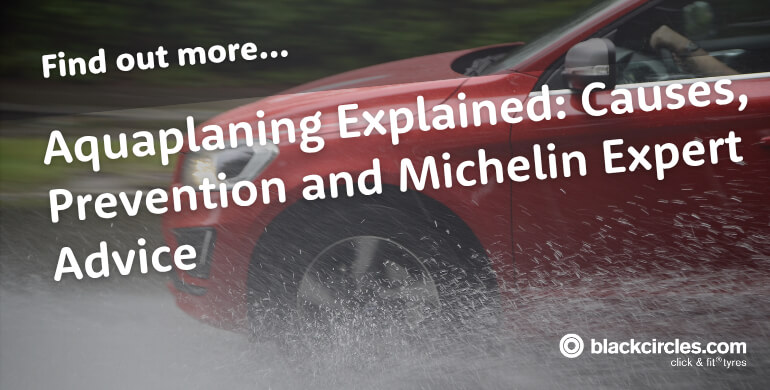
Driving in heavy rain can be challenging, particularly when standing water collects on the road. One of the biggest risks is aquaplaning, also known as hydroplaning, which can cause drivers to temporarily lose traction and control of their vehicle.
But what exactly causes aquaplaning? Can your tyres help reduce the risk? And what should you do if your car starts to aquaplane?
To help drivers understand the risks, Blackcircles.com spoke to Joe Brammer, Technical Manager at Michelin, who explains how aquaplaning happens, the role tyre technology plays in maintaining wet grip, and the steps drivers can take to stay safer on wet roads.
Aquaplaning occurs when a layer of water builds up between a vehicle's tyres and the road surface, reducing or completely interrupting contact with the road. This can cause a temporary loss of traction, making steering, braking and acceleration less effective.
Joe Brammer, Technical Manager at Michelin, explains:~
“Aquaplaning happens when a tyre can’t disperse the water on the road surface quickly enough. Water begins to build up between the tyre and the road surface, reducing the tyre’s contact with the road and, in extreme cases, causing it to lose contact altogether which can result in temporary loss of traction.
The risk increases with the amount of water on the road and with vehicle speed, because the faster you travel, water builds faster than the tyres can disperse it. Adjusting speed to suit the road conditions when there’s heavy rain or standing water is important.”
Aquaplaning is most likely to occur during heavy rainfall or when driving through standing water. The risk increases as vehicle speed rises, because tyres must disperse water more quickly to maintain contact with the road.
However, aquaplaning isn't limited to motorway driving. It can happen on a variety of roads whenever water builds up faster than the tyres can disperse it.
This is why adapting your speed to wet road conditions is one of the most important ways to reduce the risk.
Aquaplaning happens when the amount of water beneath a tyre exceeds its ability to disperse it effectively.
Several factors can increase the likelihood of this happening:
These factors can combine to make aquaplaning more likely. For example, a vehicle travelling at speed through standing water on worn or under-inflated tyres may be particularly vulnerable.
Although aquaplaning is often associated with high-speed driving, it can also occur at lower speeds when conditions are sufficiently unfavourable.
Tyres play a crucial role in reducing the risk of aquaplaning because they are responsible for maintaining contact between the vehicle and the road.
A tyre's tread pattern is designed to move water away from the contact patch, helping the rubber maintain grip on wet surfaces.
According to Joe Brammer:
“A tyre’s tread pattern plays an important role in helping to manage water on the road surface. The grooves are designed to channel and evacuate water from beneath the tyre, while the tread edges and sipes help cut through the remaining water film to maintain contact with the road.
At Michelin, tyres are engineered to deliver strong wet weather performance throughout their service life, right down to the legal limit of 1.6mm. Michelin’s EverGrip technologies are specifically designed to help maintain grip on wet roads as the tyre wears, ensuring sufficient water evacuation.
By combining tread designs, that includes full depth sipes and tread grooves with advanced compounds, Michelin tyres provide high levels of wet grip from the first mile to the last, helping drivers retain confidence and control in wet conditions.”
Three important elements of tyre design contribute to wet weather performance:
Together, these features help tyres maintain traction when driving on wet roads.
Tyre tread depth has a significant impact on how effectively a tyre can disperse water.
As a tyre wears, its grooves generally become shallower, reducing the volume of water they can accommodate and evacuate.
This means a worn tyre may be more susceptible to aquaplaning, particularly in heavy rain or standing water.
In the UK, the legal minimum tread depth for car tyres is 1.6mm across the central three-quarters of the tread, around its entire circumference.
However, meeting the legal minimum doesn't mean a tyre will perform as well in standing water as it did when new.
Tyre design and how performance changes with wear are therefore important considerations when choosing replacement tyres.
Michelin develops tyres with a focus on maintaining performance throughout their usable life, rather than concentrating solely on how they perform when new.
One example is Michelin EverGrip technology, which uses innovative tread designs to help maintain wet grip and support effective water evacuation as the tyre wears.
Depending on the tyre, this can include evolving tread patterns and specially designed grooves that help manage water throughout the tyre's service life.
The Michelin Primacy 5 demonstrates how this technology is used in practice. Featuring the latest generation of Michelin EverGrip and EverTread technologies, the tyre has an optimised tread pattern designed to maintain effective water evacuation as it wears.
According to Michelin, the Primacy 5 delivers a 4% shorter wet braking distance when new and maintains the same wet braking performance when worn compared with its predecessor, the Michelin Primacy 4+, highlighting how these technologies can help maintain wet grip throughout a tyre's usable life.
However, even tyres designed for long-lasting wet grip cannot eliminate the risk of aquaplaning. Water depth, vehicle speed, tyre condition and road conditions all remain important factors.
Yes. Incorrect tyre pressure, particularly under-inflation, can increase the likelihood of aquaplaning when driving through standing water.
When tyres are under-inflated, their shape and contact with the road change. This can affect their ability to manage water effectively.
Our Michelin expert explains:
“Yes. Tyre pressure is an important factor, which is why drivers should regularly check their tyres and keep them at the vehicle manufacturer’s recommended pressure. Aquaplaning occurs when the pressure generated by the standing water becomes sufficient for the tyre to lift from the road. Under-inflation can increase the risk, particularly when there is significant water on the road as the tyre does not have enough pressure to push and cut through standing water and disperse it effectively. It is therefore important to always maintain inflation pressures to the vehicle manufacturers suggestions.”
Maintaining the correct tyre pressure is therefore an important part of reducing aquaplaning risk.
Drivers should check their tyre pressures regularly, ideally when the tyres are cold, and inflate them according to the vehicle manufacturer's recommendations.
These pressures can usually be found in the vehicle handbook, inside the driver's door frame or on the fuel filler flap.
It's important to remember that over-inflating tyres is not a solution to aquaplaning. Drivers should always use the recommended pressures for their vehicle and load.
If your vehicle begins aquaplaning, the most important thing is to remain calm and avoid sudden movements. Allowing the vehicle to slow down gradually can help the tyres regain contact with the road.
Joe Brammer recommends:
“The key is not to panic or make sudden movements. Ease off the accelerator, keep your steering smooth and allow the vehicle to slow down progressively. Avoid sudden changes of direction or abrupt braking because you want the vehicle to remain as stable as possible while the tyres regain grip.”
If you experience aquaplaning, follow these steps:
Once the tyres regain grip, continue driving cautiously, reduce your speed and allow more space between your vehicle and the one ahead.
Enter your registration and postcode and we’ll show you Michelin tyres to fit your car
Sudden driver inputs can make the situation more difficult to control, particularly when grip returns.
Avoid:
Aquaplaning can happen suddenly, but there are several warning signs that drivers may notice.
These include the steering feeling unusually light, the vehicle becoming less responsive to steering inputs, or the engine revs rising without a corresponding increase in speed.
In some cases, drivers may also feel the rear of the vehicle beginning to slide sideways.
These symptoms can have other causes, but when they occur on a wet road, aquaplaning is one possibility.
If you notice any of these signs, avoid sudden movements and allow the vehicle to slow down gently.
Although aquaplaning cannot be completely prevented, there are practical steps drivers can take to reduce their risk.
Joe Brammer, Technical Manager at Michelin, recommends focusing on three important habits: maintaining your tyres, adapting your speed to the road conditions and anticipating standing water ahead.
Inspect your tyres for wear or damage, check tread depth and maintain the vehicle manufacturer's recommended inflation pressures.
Well-maintained tyres are essential for managing wet road conditions. Regular checks can also help identify potential problems before they affect tyre performance.
Slow down when driving in heavy rain, particularly where standing water is present.
Lower speeds give tyres more opportunity to disperse water and maintain contact with the road.
Even if you're driving within the posted speed limit, you may need to travel more slowly when road conditions deteriorate.
Scan the road for puddles, standing water and changes in the road surface.
Planning ahead helps drivers avoid sudden steering or braking movements that could increase the risk of losing control.
By combining these habits with tyres designed to deliver reliable wet weather performance, drivers can help reduce the likelihood of aquaplaning.
Choosing tyres designed for strong wet weather performance is an important step in reducing the risk of aquaplaning.
Tyres play a vital role in maintaining contact with the road, particularly when driving through standing water. Their tread patterns, grooves and rubber compounds all influence how effectively they manage water and maintain grip.
When comparing tyres for wet weather driving, it's worth considering several factors:
It's important to remember that wet braking performance and aquaplaning resistance are related but distinct characteristics. A tyre's wet grip label does not directly measure its resistance to aquaplaning.
Michelin develops tyres designed to deliver strong performance in a range of driving conditions. For motorists looking to improve their confidence on wet roads, the following three options are worth considering.
The Michelin Primacy 5 is a summer tyre designed for drivers who prioritise safety, comfort and long-lasting performance.
Featuring Michelin EverGrip and EverTread technologies, the Primacy 5 is engineered to maintain strong wet braking performance as the tyre wears.
Its tread design helps manage water beneath the tyre, making it a relevant choice for everyday driving in wet conditions.
For drivers concerned about aquaplaning and maintaining wet road grip over the life of their tyres, the Michelin Primacy 5 is worth considering.


The Michelin Pilot Sport 5 is designed for motorists who enjoy responsive handling but still want strong performance when roads are wet.
Its Dual Sport Tread Design incorporates features intended to support both wet grip and dry handling. Michelin's Dynamic Response Technology also helps deliver precise steering responses.
For drivers looking for a performance-oriented summer tyre that can handle changing road conditions, the Pilot Sport 5 combines sporty driving characteristics with wet weather capability.


The Michelin CrossClimate 3 is an all-season tyre designed to perform across changing weather conditions, including wet roads, cold temperatures and occasional snow.
Its directional tread pattern helps evacuate water from the contact patch, while its all-season compound is designed to provide grip across a wide temperature range.
For UK motorists who want a versatile tyre without switching between summer and winter tyres, the Michelin CrossClimate 3 is another option to consider.
No tyre can completely eliminate the risk of aquaplaning, but choosing the right tyres can help reduce the likelihood of it happening.
Premium tyre manufacturers such as Michelin invest heavily in research, design and innovative technologies to improve wet weather performance. Specially designed tread patterns and grooves help channel water away from the tyre, allowing it to maintain better contact with the road and reducing the risk of aquaplaning.
Michelin also develops technologies such as EverGrip, designed to help maintain wet grip performance as tyres wear.
However, factors such as vehicle speed, water depth, tyre pressure and tread depth all play an important role. Even the most advanced tyres should be combined with regular maintenance and sensible driving in wet conditions.
Looking for tyres you can rely on in wet weather? Explore the range of Michelin tyres at Blackcircles.com, where you can compare options, find the right tyres for your vehicle and book fitting at a time and location that suits you.

There is no single speed at which aquaplaning begins. The risk depends on factors including water depth, tyre tread depth, tyre pressure and road conditions. Although the risk generally increases with speed, aquaplaning can occur at relatively low speeds when conditions are unfavourable.
There is no universal minimum water depth that guarantees aquaplaning. Even relatively shallow standing water can cause problems, depending on speed, tyre condition and road surface characteristics. Deeper water generally increases the risk because tyres must displace more water to maintain contact with the road.
Aquaplaning and hydroplaning refer to the same phenomenon: a loss of tyre contact with the road caused by a layer of water. Aquaplaning is the term more commonly used in the UK, while hydroplaning is widely used in the United States.
The four-second rule is a method of maintaining a safer following distance in wet conditions. Choose a fixed roadside object and count the seconds between the vehicle ahead passing it and your own vehicle reaching it. In wet weather, the UK Highway Code recommends allowing at least twice the normal stopping distance, so a gap of at least four seconds is a useful minimum. More space may be needed in particularly poor conditions.
New tyres generally have deeper tread grooves, giving them greater capacity to evacuate standing water. However, aquaplaning resistance also depends on tyre design, pressure, speed and road conditions. Some tyres, including Michelin tyres featuring appropriate EverGrip technologies, are designed to help maintain wet performance as they wear.
Yes. Four-wheel drive can help distribute driving power between the wheels, but it cannot prevent water from separating the tyres from the road. Four-wheel-drive vehicles can still aquaplane and lose steering or braking traction in standing water.
No. An anti-lock braking system (ABS) helps prevent wheel lock-up during braking, but it cannot prevent aquaplaning. When tyres lose contact with the road, there may be insufficient grip for ABS to work effectively. Drivers should avoid abrupt braking if aquaplaning occurs.
Potentially, yes. Aquaplaning does not automatically remove a driver's responsibility for a collision. Liability depends on the circumstances, including whether the driver was travelling at an appropriate speed, the condition of their tyres and whether reasonable precautions were taken. Individual cases are assessed on their specific facts.
Aquaplaning can occur on any wet road, but motorway speeds can increase the risk because tyres must disperse water more quickly. Standing water in wheel tracks or poorly drained sections of road can be particularly hazardous. Drivers should reduce their speed when conditions deteriorate, even if the posted speed limit is higher.
It's best to avoid large areas of standing water where possible, provided you can do so safely. Water may be deeper than it appears and could conceal potholes or other hazards. Never make sudden steering movements to avoid a puddle, and do not enter floodwater when its depth or safety is uncertain.
Michelin tyres feature tread designs and technologies engineered to support wet grip and water evacuation. Some Michelin tyres also use EverGrip technology to help maintain wet performance as they wear. However, no tyre can completely prevent hydroplaning, particularly in deep standing water or at excessive speeds.
The best Michelin tyre depends on your vehicle and driving requirements. The Michelin Primacy 5 is designed for everyday comfort and long-lasting wet braking performance, the Pilot Sport 5 combines sporty handling with wet grip, and the CrossClimate 3 offers versatility across changing seasonal conditions. These are different tyre categories rather than a ranking of aquaplaning resistance.

We love to hear from our customers. Connect with us today and let’s start a conversation.
