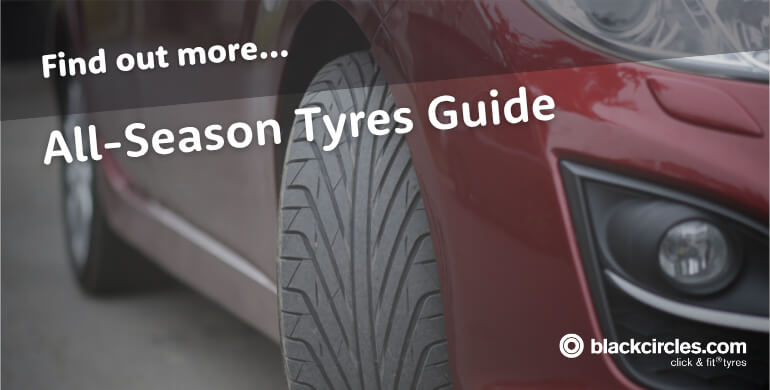
All-season tyres are a single set of tyres designed to be used year-round. They use compounds which a adapt to the conditions - alongside hybrid tread patterns to combine both summer grip in warm weather with traction in cold, wet and snowy conditions.
In the UK, where full winters are rare but cold, wet weather is normal. All season tyres therefore remove the need to swap tyres twice a year.
For a robust performance throughout the winter months, make sure to look models with the 3PMSF snowflake symbol - which confirms it has been tested for winter capability.
What are all-season tyres?
All-season tyres are built to deliver dependable performance across the full range of temperatures and weather a UK driver meets in a year.
The compound. All-season compounds are designed to remain flexible as temperatures fall. Without going soft and wearing quickly in summer heat. Premium models now go further – Michelin’s Thermal Adaptive Tread Compound in the CrossClimate 3, for example, is formulated to change behaviour as road temperature changes.
The tread pattern. All-season treads borrow biting edges and sipes from winter designs and combine them with the large, stiff tread blocks and water-clearing grooves of a summer tyre. Directional V-shaped patterns are common because they clear water and slush effectively while keeping the shoulder blocks solid enough for cornering in dry conditions.
You may also see them called all-weather tyres or four-season tyres.
In the UK market these terms are used interchangeably.
For most UK drivers, yes. The UK’s winter is defined less by deep snow than by cold, wet, unpredictable weather. A week in January can bring frost, standing water, slush and mild rain in turn. That variability is exactly what an all-season tyre is designed for. It is the reason the segment has grown fast over the past 10-15 years.
The 7°C figure is a rule of thumb - not a hard fact.
It comes from the point at which a traditional summer compound begins to lose flexibility and, with it, grip. It has never been a single fixed number, and it varies by tyre.
It is worth understanding for what it actually tells you: as the road gets colder, a summer tyre’s grip falls away faster than an all-season or winter tyre’s does.
Modern compounds have narrowed that gap in both directions. Treat the 7°C as a signpost rather than a switching point. The more useful question is not the temperature on a given morning, but what your tyres are being asked to do across a whole year.
What does the 3PMSF marking mean?
3PMSF stands for Three-Peak Mountain Snowflake.
It is a snow performance standard defined under UNECE Regulation 117, and it applies across Europe and the UK.
To carry the symbol, a tyre must pass a standardised snow traction test against a reference tyre.
Three Peak Mountain Snow Flake Symbol
This is the marking that matters. The older M+S (Mud and Snow) marking is self-declared by the manufacturer and involves no mandatory testing.
Almost every all-season tyre sold as a premium or mid-range product in the UK now carries 3PMSF.
So if you are wondering ‘are all season tyres good in snow?’, the snowflake is the thing to check on the sidewall.
All Season Tyres When Driving Abroad
Since 1 October 2024, only tyres bearing the 3PMSF symbol count as winter tyres in Germany and Austria during wintry conditions. Therefore driving on M+S-only tyres in winter conditions there risks a fine and can complicate an insurance claim after a collision.
Winter tyre rules vary country by country across Europe, so check the requirements for each country on your route before you travel.
There is no UK law requiring winter or all-season tyres at any time of year.
Best all-season tyres in 2026
The segment has moved on significantly. Several models that dominated recommendations two or three years ago have now been replaced by newer generations.
The picks below draw on independent group tests, including the Auto Express 2026 all-season test (six tyres in 225/45 R17, published November 2025, run in association with Blackcircles.com), the Tyre Reviews and AutoView 2026 tests, and Auto Bild’s 2025 group tests.
Premium all-season tyres
Pirelli Cinturato All Season SF3
Winner of the Auto Express 2026 all-season test, scoring 100% overall. The
Pirelli Cinturato All Season SF3 took first place in dry braking, snow traction, snow handling and curved aquaplaning, and was never far from the top in anything else.
The
Michelin CrossClimate 3 launched in July 2025 as the replacement for the CrossClimate 2, which had held the benchmark position in this category for four years.
Michelin claims a 4% improvement in wet grip and around 15% longer service life over the CrossClimate 2, achieved through the Thermal Adaptive Tread Compound, a refined V-shaped tread that keeps draining water as it wears, and MaxTouch construction for more even wear.
The genuinely new idea in this segment: a 3PMSF-certified all-season tyre aimed at performance cars and heavier, high-torque EVs. The
Michelin CrossClimate 3 Sport uses Michelin’s Dynamic Response Technology – a hybrid aramid and nylon belt – for sharper steering response.
It won AutoView’s 2026 all-season test outright in 255/45 R19, leading dry braking and cornering speed with the joint-lowest measured noise.
Second overall in the Auto Express 2026 test at 99%, and second in AutoView’s. The
Continental AllSeasonContact 2 is built on consistency and efficiency: best snow braking and best wet handling in the Auto Express test, and the lowest rolling resistance of the premium group in Tyre Reviews’ testing – which makes it a strong choice for
EV drivers protecting range.
Third in the Auto Express 2026 test by a tenth of a percent, and the wet-weather specialist of the group: the
Bridgestone Turanza All Season 6 came first in wet braking, straight aquaplaning and the wet circle. It replaces the WeatherControl A005 EVO in Bridgestone’s UK range and has also won Auto Bild group tests in 225/40 R18.
The newest arrival in the segment, launched in May 2026 and replacing the long-serving Vector 4Seasons Gen-3. Goodyear has moved to a new naming convention and a new patented tread pattern, with WeatherReady technology, Dry Contact Plus and 3D Blade Sipes.
Early independent testing puts it at the front of the field on snow and strong in wet lateral grip.
Fourth in the Auto Express 2026 test at 97.7%, and the second-cheapest tyre in it. Traditionally the
Vredestein Quatrac’s strength is snow, and that held true again. It was also a previous Auto Bild all-season test winner in 225/50 R17. The
Quatrac Pro+ covers larger and higher-speed fitments, and the
Quatrac Pro EV is tuned for electric vehicles.
The
Kumho Solus 4S HA32 is one of the most popular all-season tyres among Blackcircles.com customers, with balanced wet, dry and snow performance at a
mid-range price.
The
Rotalla RA03 is a
budget all-season option with 3PMSF certification. Independent testing consistently shows the biggest performance gaps between budget and premium all-season tyres appear in braking distances.
Most premium ranges include SUV-specific fitments with reinforced construction for the extra weight and load.
Michelin’s CrossClimate SUV covers this, and the CrossClimate 3 and Turanza All Season 6 both offer SUV-appropriate sizes within their standard ranges.
All-season tyres combine the strengths of both summer and winter tyres into a single, versatile package.
No seasonal swaps. One set used year-round. No twice-yearly appointment and no need for tyre storage.
Better cold-weather safety than summer tyres. On a frosty morning or a wet, cold commute, an all-season tyre with 3PMSF certification has a meaningful advantage in braking and traction.
Genuinely competitive performance. The current generation is close enough to specialist tyres in most conditions that the compromise is far smaller than it was five years ago.
Quiet and comfortable. Most modern all-season tyres are refined enough for daily commuting and motorway mileage.
What are the disadvantages of all-season tyres?
All-season tyres are a compromise by design, and it is worth being clear about where that shows.
They don’t beat specialists at their own game. A good summer tyre will out-brake and out-handle an all-season on warm dry roads. A good winter tyre will comfortably beat one on packed snow and ice.
Rolling resistance sits above a dedicated summer tyre. This has a small effect on fuel consumption or EV range, though the best models have closed much of this gap.
Do you have to fit all four?
It is recommended, yes. Mix tyre types across an axle and you create inconsistent grip levels, which affects braking balance, stability and how the car behaves at the limit.
Mixing all-season and summer tyres is not illegal in the UK, but it is not advisable and it undermines the point of fitting all-season tyres in the first place. Fit a matched set of four. If you are replacing only two, make sure both are on the same axle and are the same make and model.
How long do all-season tyres last?
Expect similar or slightly better mileage than a comparable summer tyre, and considerably better than a winter tyre used year-round. Manufacturers now compete directly on this: Michelin’s stated 15% mileage improvement for the CrossClimate 3 over the CrossClimate 2 reflects how much wear performance has become a selling point.
Actual life depends on driving style, load, alignment, pressures and the roads you use. The legal minimum tread depth in the UK is 1.6mm across the central three-quarters of the tyre, but grip in the wet and on snow drops off well before that – many manufacturers and safety bodies recommend replacing at 3mm. See our
tyre safety advice for further details.
Frequently Asked Questions
Are all-season tyres worth it in the UK?
For most drivers, yes. The UK’s mild but changeable winters play to their strengths, and avoiding two seasonal changeovers a year saves money, time and storage space.
Are all-season tyres legal in the UK?
Yes, all year round. There is no UK legal requirement to fit any particular type of tyre seasonally.
Are all-season tyres good in snow?
In light snow and slush, yes – provided they carry the 3PMSF snowflake symbol, which confirms they have passed a standardised snow traction test. In deep snow or on ice, a dedicated winter tyre is significantly better.
Can I use all-season tyres all year?
Yes. That is what they were designed for, and it is the main reason to buy them.
What is the difference between M+S and 3PMSF?
M+S is a self-declared marking with no mandatory test behind it. 3PMSF requires the tyre to pass a regulated snow traction test under UNECE Regulation 117. Only 3PMSF is meaningful evidence of winter capability – and since October 2024 it is the only marking accepted in Germany and Austria.
Do all-season tyres wear out faster?
No. A modern all-season tyre wears at a rate comparable to a summer tyre, and far more slowly than a winter tyre used through summer.
Are all-season tyres suitable for electric vehicles?
Yes, and manufacturers increasingly design for it. EVs are heavier and deliver instant torque, so look for models rated as EV-suitable – the Continental AllSeasonContact 2, Michelin CrossClimate 3 and Bridgestone Turanza All Season 6 all are.
Which is the best all-season tyre?
The Pirelli Cinturato All Season SF3 won the Auto Express 2026 all-season test outright. The Michelin CrossClimate 3, Continental AllSeasonContact 2 and Bridgestone Turanza All Season 6 are all within a point of it, each with a different strength – so the better question is which one suits your priorities.
Do I need winter tyres if I have all-season tyres?
For UK driving, generally no. If you regularly drive in sustained snow and ice, or travel to Alpine regions in winter, a dedicated winter tyre is still worth having.
PayPal Credit and PayPal Pay in 3 are trading names of PayPal UK Ltd, 5 Fleet Place, London, United Kingdom, EC4M 7RD. Terms and conditions apply. Credit subject to status and approval, 18+ UK residents only. PayPal Credit and PayPal Pay in 3 are a form of credit, so carefully consider whether the purchase is affordable and how you will make the repayments. PayPal Pay in 3 is a credit agreement. See product terms for more details and FAQs. Learn more about PayPal Credit.Learn more about PayPal Pay in 3.