
Join the conversation
We love to hear from our customers. Connect with us today and let’s start a conversation.
...searching


Given Britain saw 164 rainy days last year, aquaplaning is an unsurprisingly common phenomenon on our roads. But what is it? And how can you avoid it?
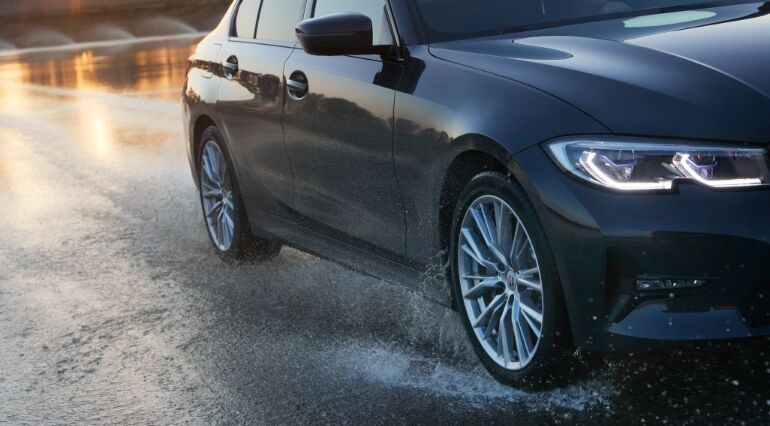
Aquaplaning, hydroplaning… whatever you call it, the end result is the same: a temporary but total loss of control on wet roads. And, if becoming a passenger behind your own steering wheel wasn’t already scary enough, it’s a situation which can often occur at motorway speeds. Yikes.
So how do you avoid this dreaded four-wheel skid? From changing your driving style to fitting the right Bridgestone rubber, we explain how to stay in control when the heavens open.
Enter your registration and postcode and we’ll show you the best tyres for your car
You’ve probably experienced its knuckle-clenching effects at some point in your driving career, but what causes cars to careen out of control when hitting standing water?
It’s simple physics. Every road legal tyre has a tread pattern designed to expel water and keep the rubber in contact with the road. When this tread pattern fails to evacuate water quickly enough — due to insufficient depth, excessive speed, or poorly designed grooves — your tyres lose contact with the road and begin to skim along the water’s surface – rendering your brakes, steering, and accelerator, useless for a moment.
And the consequences? Well, they range from a rapidly rectified moment of terror to a complete insurance write-off.
Luckily, there’s plenty you can do to reduce the risk of aquaplaning in your car. The first and most effective step is to adapt your driving style to the conditions. Sounds obvious, but it’s often tricky to tell just how deep standing water is, or when you’ll meet a hidden puddle around a blind bend. When in doubt, reduce your speed and avoid any harsh inputs.
If you’re still unfortunate enough to experience an aquaplaning situation — you’ll likely notice a lightening of the steering and an increase in revs — resist the urge to slam the brakes. Instead, gently ease off the throttle and maintain straight steering until your tyres regain control.
It’s not just about your driving style, though. Ensuring your car is adequately prepared for the sodden British weather, can go a long way in preventing any aquaplaning incidents. Your tyre pressures, for one, need to be correct to ensure the tread works as designed. And, more importantly, the depth of that tread needs to be sufficient to force the water out — tyres approaching the legal 1.6mm limit will start to lose their aquaplane resistance.
Once you’ve got the fundamentals in check, fitting a tyre like Bridgestone’s versatile Turanza 6 can act as an additional safety net against aquaplaning. Featuring best-in-class wet performance, this touring tyre employs a combination of cutting-edge technologies designed to combat aquaplaning and enhance grip on sodden roads.
Most notably, a new divergent shoulder lug design channels water away from underneath the tyre. Meanwhile, double angle 3D washboard sipes use an interlocking mechanism to find traction and provide exceptional wet cornering and braking performance.
But don’t think such wet-weather ability has compromised the T6 in the dry, as we highlighted in motorway mile munchers, the Turanza also benefits from a notable reduction in rolling resistance and comes out on top in dry braking comparisons.
So there you have it, now you know how to avoid a potentially dangerous aquaplaning incident. Is it time to upgrade your tyres for something better geared to tackle Britain’s ever-changing climate? Let us know if you’ll be choosing Bridgestone’s wet-weather master, the Turanza 6.
Hero image credit: Shutterstock
We love to hear from our customers. Connect with us today and let’s start a conversation.