Graduated Driver Licensing (GDL) goes live in Northern Ireland on 1 October 2026, following the Regulations approved by the Assembly on 23 June. The Department for Infrastructure calls it the most significant reform to driver licensing and testing in almost 70 years.
From 1 October, new car learners face a six-month minimum learning period and a logged Programme of Training before their test, then a two-year R plate period with new blue plates and night-time passenger limits once they pass.
The scheme is aimed at 17–23-year-olds, but it applies to all
learner drivers, regardless of age, whose provisional car or motorcycle entitlement starts on or after 1 October 2026. If your provisional entitlement started before then, you have until 31 March 2027 to book and pass your test under the current system.
Below, we cover every GDL rule, the transition deadline and who can supervise – plus the tyre checks every R-plate driver should be doing on Northern Ireland’s wet, unlit country roads.
What are the new graduated driving licence rules?
The headline reforms are a mandatory minimum learning period before testing, a structured training programme recorded in a Logbook, a longer post-test restriction period and night-time passenger limits for new drivers under 24. The 45mph speed limit for learner and R-plate drivers is also scrapped.
There’s no upper age limit for GDL. Every new learner follows the same training and R plate rules, but the night-time passenger limit only applies to new drivers under 24.
| GDL rule
| What it means
|
|---|
| Minimum learning period
| Car learners must hold provisional entitlement for at least six months before taking the practical test. This doesn’t apply to motorcycle (Category A) learners.
|
| Programme of Training
| 14 mandatory modules (plus one optional motorway module) must be completed, recorded in the GDL Logbook and signed off before the test.
|
| Two-year R plates
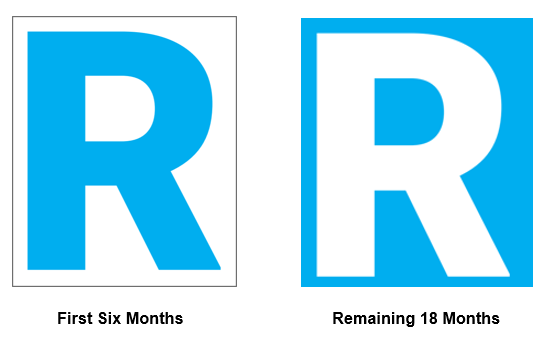
| New drivers display R plates for 24 months after passing, up from 12 months – a blue R on white for the first six months, then a white R on blue for the remaining 18.
|
| Night-time passenger limit
| For six months after passing, drivers under 24 can carry no more than one passenger aged 14–20 between 11pm and 6am. Exemptions apply.
|
| 45mph limit removed
| Learner and R-plate drivers can now drive at the normal posted speed limit.
|
The GDL Programme of Training and Logbook
The
Programme of Training is split into four sections. For cars, there are 14 mandatory modules plus an optional Module 15 covering motorway driving. Motorcycle learners complete 10 mandatory modules plus an optional motorway riding module.
The 14 GDL modules for car learners
| Module
| Title
| What it covers
|
|---|
| 1
| The driver
| Driver attitude, driver health, driver licensing
|
| 2
| The vehicle
| Vehicle maintenance, vehicle checks, vehicle documentation
|
| 3
| The law
| The law and you, the Highway Code
|
| 4
| Risk and hazard awareness
| Static hazards, developing hazards, emergencies
|
| 5
| Controls and checks
| Getting in and seated, hand controls, foot controls, ancillary controls, starting the engine, mirrors, basic vehicle safety checks
|
| 6
| Driving on the road
| Moving off and stopping, junctions, roundabouts, traffic controls, positioning, speed
|
| 7
| Road sharing
| Awareness and anticipation, changing position, safety margins, communication, overtaking
|
| 8
| Vulnerable and other road users
| Children, pedestrians, cyclists, motorcyclists and mobility scooters, car drivers, buses and coaches, HGVs, horse riders and animals
|
| 9
| Speed awareness
| Speed limits, road and traffic conditions, rural roads, the consequences of speeding
|
| 10
| Manoeuvring your vehicle
| Reversing into a side road, reverse parking, turning your vehicle around
|
| 11
| Driving in adverse weather
| Preparation, rain and wet roads, snow and icy conditions, fog, crosswinds, bright sunshine and heat
|
| 12
| Night-time driving
| Driver eyesight, vehicle lights, driving at night, built-up areas, encountering other traffic
|
| 13
| Driver distraction and in-car technology
| Driver distraction, collision avoidance and mitigation systems, driver information systems, sat nav, the consequences of distraction
|
| 14
| Eco-safe driving and the environment
| The environment, the journey, eco-safe driving
|
| 15 (optional)
| Motorway driving
| Motorway signs and signals, driving on a motorway – ADI only for learners
|
Every mandatory module has to be completed, recorded in the Logbook and signed off by a supervising driver or an Approved Driving Instructor (ADI). A final sign-off is also needed before you can sit your practical test. If the Logbook isn’t complete, you can’t take the test – and from 1 April 2027, you won’t be able to book one either.
How to set up your GDL account
From 1 October 2026, learners can create a GDL account online or through the GDL mobile app on the App Store and Google Play. The account costs £17. You’ll still need a Northern Ireland provisional licence first – see nidirect’s guide to
applying for a provisional driving licence.
Already learning? The 31 March 2027 transition deadline
GDL is mandatory for anyone whose provisional entitlement begins on or after 1 October 2026. If your provisional entitlement started before that date, you have until 31 March 2027 to book and pass your practical test under the current system.
If you fail and retake your test on or after 1 April 2027, you’ll have to enrol in the GDL scheme. For new learners, the earliest possible test date is six months after first provisional entitlement – so a learner starting on 1 October 2026 can test from 1 April 2027 at the earliest.
Changes to the practical driving test
From 1 April 2027, the practical test will include elements linked to GDL:
- The independent driving section extends to roughly 20 minutes.
- Sat nav use is introduced.
- ‘Show me, tell me’ vehicle safety questions are asked and answered on the move.
The overall pass standard stays the same.
Supervising driver rules under GDL
Parents, guardians or any other qualified driver can still help a learner practise. To act as a
supervising driver, you must be at least 21 and have held a full NI driving licence for at least three years.
Supervising drivers oversee practice during the six-month learning period and can sign off Logbook modules. Learners can use a supervising driver, an ADI or a mix of both. Learners must be supervised at all times until they pass – and motorway driving is only allowed with an ADI.
Looking for an instructor? Use nidirect’s
find a driving or motorcycle instructor tool.
GDL rules after you pass: R plates and passenger limits
The R plate period doubles to two years and is split into two stages, each with its own plate colour:
- First six months: a blue R on a white background. This is when the night-time passenger restrictions apply, and the plate tells police you’re in that period.
- Remaining 18 months: a white R on a blue background.
Why has the R plate period doubled to two years?
The first two years after passing are when new drivers are most at risk. According to the
NI Road Safety Strategy annual report, novice drivers within two years of their test were involved in collisions that killed or seriously injured an average of 144 people a year over 2022–2024.
The two-year period also lines up with the existing new-driver probation rules, under which a licence can be revoked if a driver builds up six or more penalty points within two years of passing. GDL doesn’t impose a speed restriction on R-plate drivers, but the plate tells other road users the driver is still inexperienced.
GDL exemptions
The night-time passenger limit doesn’t apply to immediate family members, or when someone aged 21 or over who has held a full licence for three years is in the front passenger seat. Learners who can evidence entitlement to Carer’s Allowance are exempt from the six-month minimum learning period, but must still complete the Programme of Training and Logbook.
There’s no general exemption for driving to work or college. Driving alone, or with passengers outside the 14–20 age range, isn’t restricted. But if you’re under 24 and need to give friends aged 14–20 a lift between 11pm and 6am in your first six months, you’ll need a qualifying adult (21+, full licence for three years) in the front passenger seat, or the passengers must be immediate family.
How will GDL be enforced?
Enforcement falls primarily to the police, supported by guidance from the Department for Infrastructure and driving instructors. Day to day, parents and supervising drivers are likely to be the ones keeping an eye on the new rules.
Breaking GDL restrictions, such as not displaying the correct R plate or carrying unauthorised passengers at night, can lead to a fine of up to £1,000 and penalty points. The legal framework for GDL comes from Part 2 (Learner and New Drivers) of the
Road Traffic (Amendment) Act (Northern Ireland) 2016. The Regulations bringing it into force were
approved by the Assembly on 23 June 2026, confirming the 1 October start date.
Why is GDL being introduced?
According to the
Department for Infrastructure, 164 people were killed or seriously injured in 2024 in collisions where a car driver aged 17–23 was responsible.
The DfI cite Transport Research Laboratory (TRL) findings that GDL schemes reduce collisions involving young drivers by between 5% and 40%, depending on how strong the scheme’s components are.
Rural roads: where young NI drivers are most at risk
According to
NISRA analysis published in March 2026, young car drivers aged 17–23 were involved in collisions accounting for 30% of all people killed or seriously injured on Northern Ireland’s rural roads each year – 142 of 476. That compares with 14% on urban roads. The new Programme of Training covers rural roads (Module 9), rain and wet roads (Module 11) and night-time driving (Module 12).
The same analysis found that more than a third (37%) of serious casualties among young passengers travelling with a 17–23-year-old driver happened between 11pm and 6am – exactly the window GDL now restricts.
Why tyre grip matters on wet, unlit country lanes
On a rural road at night, a new driver has less time to spot a hazard and fewer chances to correct a mistake. Standing water, mud from farm traffic and autumn leaves all cut the grip available, and the only thing between the car and that surface is four patches of rubber roughly the size of your hand.
Two things decide how much of that grip you keep:
- Tread: the grooves channel water away from the contact patch. As tread wears, there’s less room to clear water, and the risk of aquaplaning rises.
- Compound: the rubber blend determines how well a tyre bites on cold, wet tarmac. It’s the main reason two tyres with the same tread depth can stop very differently in the rain – and it’s what the wet grip rating on the tyre label measures.
Tyre checks for R-plate drivers: the ACT checklist
The six-month learning period is the ideal time to make tyre checks a habit. Supervising drivers and parents should run through these checks with the learner, not for them – it takes five minutes and ties straight into the vehicle checks covered in Module 2 and the basic vehicle safety checks in Module 5. October is also Tyre Safety Month, so there’s no better time to start.
| Check
| What to do
| When
|
|---|
| A – Air pressure
| Check pressures when tyres are cold, using the figures in your vehicle handbook (often also on the driver’s door sill or fuel flap). Adjust for heavy loads if the handbook says so.
| At least once a month and before long journeys
|
| C – Condition
| Look for cuts, bulges, cracking on the sidewall and embedded stones, nails or glass. Any bulge or deep cut means the tyre needs checking by a professional before you drive further.
| Every week, and after hitting a pothole or kerb
|
| T – Tread
| The legal minimum is 1.6mm across the central three-quarters of the tread, around the whole tyre. Use a tread depth gauge or the 20p test: if the outer band of the coin is visible, get the tyre checked.
| Every week, and during each Logbook practice session
|
Log your tyre checks alongside your Logbook sessions. By the time the learner passes, checking their own tyres will be second nature – and they’ll have a habit that keeps them safer for the full two-year R plate period and beyond.
Buying tyres for your first car: the tyre label explained
Every new tyre sold in the UK carries a label that makes comparing tyres simple. It rates three things:
- Wet grip (A–E): how well the tyre brakes on wet roads. A is best. For new drivers on rural NI roads, this is the rating to prioritise.
- Fuel efficiency (A–E): how much energy is lost as the tyre rolls. Better ratings mean lower running costs, handy on a first-car budget.
- External noise (A–C, plus a decibel figure): how loud the tyre is to people outside the car.
You may also see a mountain-and-snowflake symbol for tyres rated for severe snow, and an ice grip symbol. For the full breakdown, read our guide to
tyre labels explained.
Blackcircles.com shows the label rating next to every tyre, so you can compare wet grip before you buy, then book fitting at a local garage at a time that suits you.
Tyre fitting in Northern Ireland
Blackcircles.com works with partner garages right across Northern Ireland, from
Belfast to Antrim, Ballymena and beyond. Order online, choose your nearest garage and pick a fitting slot –
find a tyre fitter in Northern Ireland.