
Join the conversation
We love to hear from our customers. Connect with us today and let’s start a conversation.
...searching
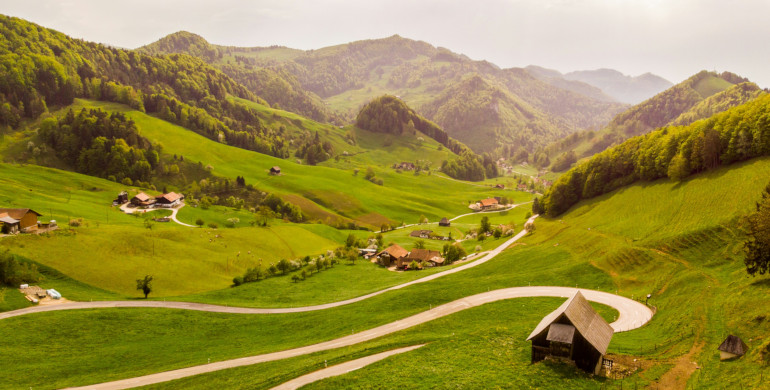
Every year, many Brits embark on scenic drives through Switzerland. A country that is famous for breathtaking views, picturesque lakes, and charming towns. Plus... of course, chocolate.
If you're getting ready for your own adventure in Switzerland, read on to learn about the essential rules and regulations that apply when driving in this beautiful country.
At a basic level, to drive in Switzerland you need to be over 18 and hold a full, valid driving licence.
If you have a driving licence that has been issued within an EU or EEA country (this includes the UK), you can drive without any additional permits.
An International Driving Permit (IDP) is not required for UK drivers unless you plan on staying in the country for more than 12 months.
If you’re driving your own car in Switzerland, you need to ensure you have the following documentation:
In addition to the necessary documentation, make sure your car is equipped with the following items:
When driving in Switzerland, you must have a vignette (a toll sticker) if you want to use motorways.
The sticker costs around CHF 40 and is valid for the entire calendar year. You can purchase it at the border, at petrol stations, or online before your trip. Display the vignette on the inside of your car’s windscreen.
Vehicles registered in the UK must display the ‘UK’ national identifier mark on the rear of the car. If you have a number plate that already includes the UK identifier and a Union flag, you do not need a separate sticker.
Switzerland is a right-hand drive country. Here are some specific rules you need to know:
Speed limits: The standard speed limits in Switzerland are as follows:
Roundabouts: Give way to vehicles already on the roundabout.
Bus and tram priority: Buses and trams have the right of way. Trams are a common feature in cities, and drivers must always yield to them.
Right-hand priority: At intersections, vehicles coming from the right generally have priority unless signs indicate otherwise.
Overtaking: Overtake on the left, and avoid doing so near pedestrian crossings.
Swiss seatbelt laws are straightforward: if seat belts are fitted in the car, they must be worn by all passengers. Fines for not wearing a seatbelt start at CHF 60.
Speeding fines in Switzerland can be hefty. Depending on the extent of the speed violation, penalties can range from CHF 40 to thousands of francs, and could even include a driving ban for more serious infractions.
Police are strict on speeding, and both fixed and mobile speed cameras are widely used.
Speed camera detectors and radar jammers are illegal in Switzerland. If found, they can be confiscated, and heavy fines may apply.
The blood alcohol limit in Switzerland is 0.05%, which is lower than in England and the same as in Scotland. For newly qualified drivers (those with less than three years of experience), the limit is reduced to 0.01%.
Random breath tests can occur, and exceeding the limit can result in fines, suspension of your driving licence, or even imprisonment depending on the severity.
Swiss road signs and communications are typically in one of the country’s four languages: German, French, Italian, or Romansh. Here are some helpful phrases for emergency situations:
English | German | French | Italian |
Can I park here? | Kann ich hier parken? | Puis-je me garer ici ? | Posso parcheggiare qui? |
Where’s the nearest petrol station? | Wo ist die nächste Tankstelle? | Où est la station-service la plus proche ? | Dov'è la stazione di servizio più vicina? |
Where is the nearest garage? | Wo ist die nächste Werkstatt? | Où est le garage le plus proche ? | Dov'è l'officina più vicina? |
We’re on the side of the motorway. | Wir sind am Rand der Autobahn. | Nous sommes sur le bord de l'autoroute. | Siamo al lato dell'autostrada. |
We need a tow truck. | Wir brauchen einen Abschleppwagen. | Nous avons besoin d'une dépanneuse. | Abbiamo bisogno di un carro attrezzi. |
The car won’t start. | Das Auto startet nicht. | La voiture ne démarre pas. | L'auto non parte. |
We have a flat tyre. | Wir haben einen platten Reifen. | Nous avons un pneu crevé. | Abbiamo una gomma a terra. |
With the right information, you can look forward to an incredible journey through Switzerland. Make sure you’ve packed everything you need, your car is road-ready, and you’re aware of the driving rules and regulations. From the rolling hills of the Jura to the pristine waters of Lake Lucerne, a drive through Switzerland offers an experience like no other. Enjoy your travels!

We love to hear from our customers. Connect with us today and let’s start a conversation.