


Continental SportContact 7
The Continental Sport Contact 7 is a high performance tyre developed to deliver a safe and high end performance on both wet and dry surfaces.
Price from
Find your size113.99to452.46
...searching


When you need to stop quickly on a wet road, how much difference can the tyres fitted to your car really make?
Most drivers know that tyre tread and condition matter, but the difference between two tyres isn’t always obvious during everyday driving.
At Continental’s Born to Outperform event, held at ParcMotor Castellolí near Barcelona, Spain, we had the opportunity to experience that difference for ourselves.
After a day of handling comparisons, off-road driving and high-speed track sessions, our final activity was a wet-braking test.
And of everything we experienced, this was probably the one that made the biggest impression.
The setup was straightforward. Continental had prepared two equivalent BMWs on different tyres: one fitted with the Continental SportContact 7 in 245/45 R18, the other with a premium competitor performance tyre.
We drove the cars up to 70 km/h (approximately 43 mph) before applying the brakes on a wet test surface.
We completed eight braking runs ourselves, following the test procedure and comparing the stopping distances between the two setups.
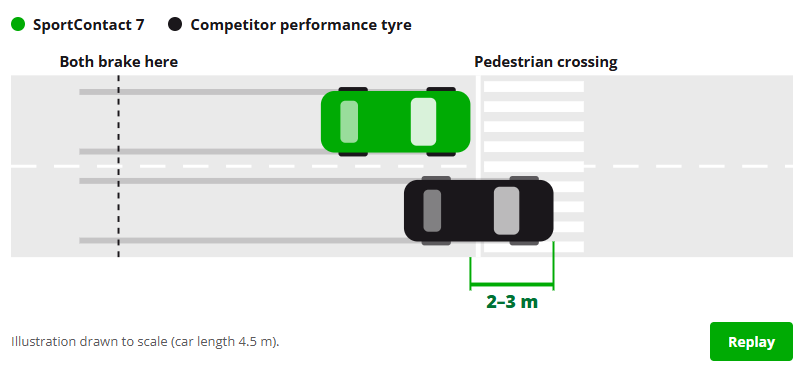
During the demonstration, we observed a difference of roughly two to three metres between the stopping points or averages shown.
That might not sound like much. But when you’re standing on the test area looking at where one car has stopped compared with the other, a few metres suddenly feels like a significant distance.
It was one of the clearest demonstrations of the day of how tyre choice can influence a car’s behaviour.
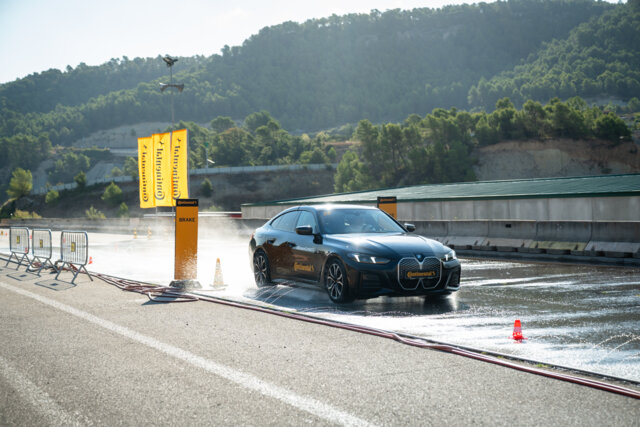
These were our observations during a Continental-organised demonstration, not results from an independent Blackcircles tyre test. We weren’t carrying out our own instrumented measurements, so the figures shouldn’t be treated as a scientifically verified comparison.
The Continental SportContact 7 is an ultra-high-performance tyre that we also experienced during the handling comparison and track activities at the event.
Its wet-braking performance has been measured in several independent tyre tests, providing a useful comparison alongside our first-hand experience.
In the 2026 Auto Bild Sportscars summer tyre test, eight performance tyres were tested on a BMW Z4, using 255/35 R19 tyres at the front and 275/35 R19 tyres at the rear.
For wet braking from 100 km/h (approximately 62 mph), the results were:
| Tyre | Wet braking distance |
|---|---|
| Continental SportContact 7 | 42.4 m |
| Bridgestone Potenza Sport Evo | 43.9 m |
| Hankook Ventus S1 Evo Z K129 | 46.0 m |
| Vredestein Ultrac Pro | 46.2 m |
| Pirelli P Zero PZ5 | 46.7 m |
| Kumho Ecsta Sport S PS72 | 47.0 m |
| Michelin Pilot Sport 4 S | 47.3 m |
| Goodyear Eagle F1 SuperSport | 51.5 m |
The SportContact 7 recorded the shortest wet stopping distance of the eight tyres tested.
It stopped 1.5 metres sooner than the Bridgestone and 4.9 metres sooner than the Michelin Pilot Sport 4 S. Compared with the longest-stopping tyre, the difference was 9.1 metres – approximately two car lengths.
Continental also took the overall win in this test, receiving an ‘Exemplary’ verdict for its performance.
In the 2025 AutoView sports tyre test, five performance tyres were tested on a BMW M3 xDrive, using a 275/35 R19 tyre size.
For wet braking from 80 km/h (approximately 50 mph), the results were:
| Tyre | Wet braking distance |
|---|---|
| Continental SportContact 7 | 21.91 m |
| Kumho Ecsta Sport S PS72 | 22.64 m |
| Hankook Ventus Evo | 22.93 m |
| Michelin Pilot Sport 4 S | 24.64 m |
| Pirelli P Zero PZ4 | 26.28 m |
The SportContact 7 recorded the shortest wet stopping distance of the five tyres tested.
The difference between the Continental and the longest-stopping tyre was 4.37 metres – roughly the length of a car.
Although the SportContact 7 finished second overall behind the Michelin, it led this particular wet-braking comparison.
These results aren’t directly comparable. Our demonstration in Spain involved braking from 70 km/h, while AutoView tested from 80 km/h and Auto Bild Sportscars from 100 km/h. Different vehicles, tyre sizes, surfaces and testing conditions also affect stopping distances.
However, both tests highlight the same important point: tyre choice can make a measurable difference to wet stopping distances.

When you press the brake pedal, your car’s braking system slows the wheels down. But it’s the tyres that must transfer that braking force to the road.
On a wet surface, maintaining grip becomes more challenging because water can interfere with the contact between the tyre and the road.
A tyre’s tread design, rubber compound and construction all contribute to its wet performance.
This helps explain why two tyres fitted to otherwise similar cars can produce different stopping distances under the same test conditions.
It’s also why manufacturers such as Continental invest so much time in developing and testing wet-grip performance.
Imagine two cars travelling at the same speed towards an unexpected hazard on a wet road.
Both drivers react at the same time and apply the brakes.
If one tyre setup allows the car to stop sooner, those extra metres could make a difference to the outcome.
The illustration below puts that distance into perspective, showing how a difference of just two to three metres could affect where a vehicle comes to a stop.
Real-world stopping distances depend on several factors, including speed, reaction time, road conditions, tyre condition and vehicle setup.
The results show why wet grip matters when choosing tyres.
With the UK’s frequently wet weather, consider wet-grip performance when buying replacement tyres.
The tyre label’s wet-grip rating is a useful starting point, while independent tests provide further insight into braking, handling and aquaplaning resistance.
Also choose tyres with the correct specifications for your vehicle, and maintain proper pressures and adequate tread depth.
Even a highly rated tyre needs to be properly maintained to perform at its best.
We experienced plenty of memorable moments during Continental’s Born to Outperform event.
There was the speed of the professional racing driver’s lap, the grip of the SportContact 7 on track and the surprising capability of the CrossContact H/T off-road.
But the wet-braking exercise was the one that felt most relevant to everyday driving.
It was simply a demonstration of two cars braking on a wet surface – something every driver can relate to.
Although our observations weren’t an independent test result, seeing the difference between the stopping points gave us a greater appreciation of how much tyre choice can matter.
And with independent testing showing measurable differences in wet stopping distances, it’s a reminder that the right tyres matter as much on the roads we drive every day as they do on a racetrack.

We love to hear from our customers. Connect with us today and let’s start a conversation.
